15 Non-Coding Jobs in Tech and How to Get Them
· updated
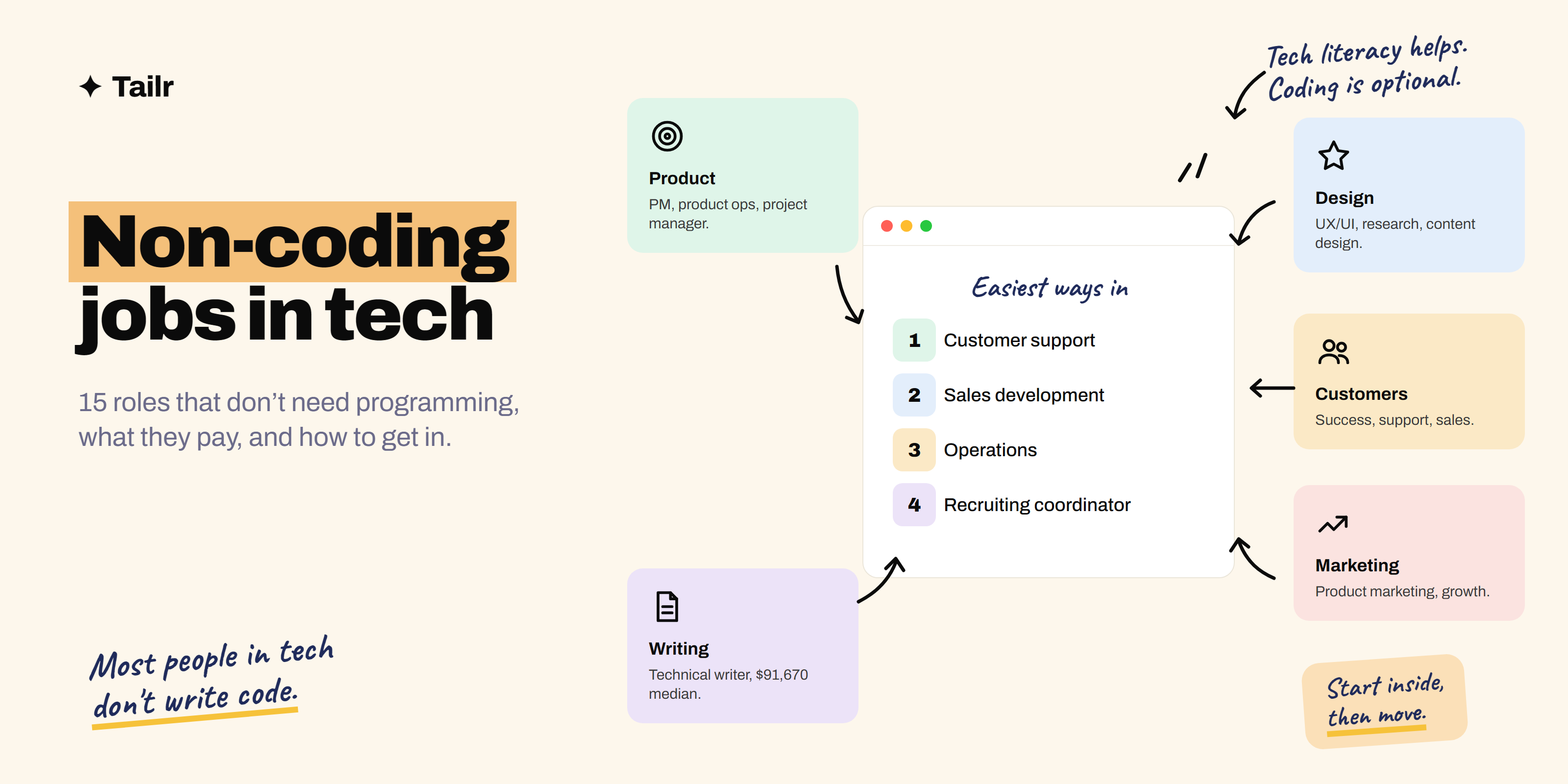
“Working in tech” doesn’t have to mean writing code. At most software companies, engineers are a minority; the rest of the company designs the product, decides what to build, explains it, sells it, supports customers, hires people and keeps everything running. Many of these roles pay well, grow fast, and are open to people from non-technical backgrounds. This guide covers 15 of them: what each does, who it suits, pay where reliable data exists, and how to get in.
The short answer: The main non-coding jobs in tech, grouped by the strength they use:
- Product and delivery: product manager, product operations manager, project manager, scrum master.
- Design and research: UX/UI designer, UX researcher, content designer.
- Writing: technical writer.
- Customers and revenue: customer success manager, customer support specialist, sales development rep and account executive, sales or solutions engineer.
- Marketing: product marketing manager, growth or digital marketer.
- People and operations: technical recruiter, business or operations analyst.
To get one: pick the role that matches your strengths and background, learn its core tools, build proof such as a portfolio, case study or writing samples, and apply with a resume tailored to each listing. Support, sales development and operations roles are the easiest first steps in.
Do you need any technical skills at all?
You don’t need to program, but “tech literacy” helps in every role below: understanding what an API is, how a product gets built and shipped, how data is stored, and being comfortable with tools like spreadsheets, SQL basics, analytics dashboards and AI assistants. Many non-coders now also build small prototypes and automations with AI tools; see how to get started with vibe coding.
Product and delivery roles
1. Product manager
What they do: decide what the product team builds next and why, working with engineers, designers and the business to ship it and measure whether it worked. Suits: people who like solving problems, talking to customers and making decisions with incomplete information. Pay: around $151,000 on average in the US in 2026. How to get in: move internally from support, sales, operations or analysis; build a PRD plus prototype for a real product. More in what does a product manager actually do.
2. Product operations manager
What they do: build the systems a product organisation runs on: metrics and dashboards, research repositories, planning and launch processes, tooling. Suits: organised, analytical people who like improving how teams work. Pay: around $133,000 to $159,000 on average in the US in 2026. How to get in: from operations, analytics or program management. See what does a product operations manager do.
3. Project manager
What they do: plan and run projects to deliver on time, on budget and in scope: timelines, dependencies, risks, status updates. Suits: people who love structure, coordination and getting things over the line. Pay: around $105,000 on average in the US in 2026. How to get in: from any role with coordination experience; certifications like PMP or CAPM help. See product manager vs project manager.
4. Scrum master or agile coach
What they do: help engineering teams run agile processes: planning, stand-ups, retrospectives, removing blockers. Suits: facilitators and coaches. How to get in: from project management or team leadership, often with a Scrum certification.
Design and research roles
5. UX/UI designer
What they do: design how a product works and looks: user flows, wireframes, interfaces, prototypes, usually in Figma. Suits: visual thinkers who care about how people use things. How to get in: a portfolio of two or three case studies showing process, not just screens. See how to build a portfolio to get hired in 2026.
6. UX researcher
What they do: find out what users need through interviews, usability tests and surveys, and turn findings into decisions. Suits: curious people with backgrounds in psychology, social science, market research or journalism. How to get in: run a small study on a real product and write it up as a case study.
7. Content designer (UX writer)
What they do: write the words inside a product: buttons, onboarding, error messages, help text, so the product is easy to use. Suits: writers who like clarity and user empathy. How to get in: rewrite a confusing flow from a real app and show before and after.
Writing roles
8. Technical writer
What they do: write documentation, guides, API references and help articles that explain how products work. Suits: clear writers who enjoy learning technical subjects; common from teaching, journalism and support. Pay: US median of $91,670 (Bureau of Labor Statistics, May 2024). How to get in: write sample docs for an open source project; contributing documentation is a strong first step (see what is open source contribution).
Customer and revenue roles
9. Customer success manager
What they do: own customer accounts after the sale: onboarding, adoption, health checks, renewals, expansion. Suits: relationship builders from account management, teaching, hospitality and consulting. How to get in: from support, sales or account management. See what does a customer success manager do.
10. Customer support specialist
What they do: help customers solve problems by chat, email or phone, and feed product issues back to the team. Suits: patient problem-solvers. How to get in: one of the most accessible entry points; a common springboard into success, QA, product and operations.
11. Sales development rep and account executive
What they do: SDRs find and qualify potential customers; account executives run the sales process and close deals. Suits: confident communicators motivated by targets. How to get in: SDR roles hire from many backgrounds; strong performers move into account executive roles within a year or two.
12. Sales engineer or solutions engineer
What they do: the technical half of a sales team: discovery, demos, proofs of concept, answering technical questions. Light scripting helps, but the core is explaining and configuring the product. Suits: technically curious people who enjoy people and presenting. Pay: US median for sales engineers of $121,520 (BLS); solutions engineers in software average around $170,000 in 2026. How to get in: from support engineering, implementation, or sales with technical interest. See what does a sales engineer do and what does a solutions engineer do.
Marketing roles
13. Product marketing manager
What they do: position the product, craft messaging, run launches, create sales material and understand competitors. Suits: strategic communicators who like both customers and product. How to get in: from marketing, sales enablement or product. Write a positioning doc and launch plan for a real product as proof.
14. Growth or digital marketer
What they do: grow users and revenue through channels like SEO, paid ads, email, content and experiments. Suits: data-minded, creative people who like testing. How to get in: run a real campaign (even a small one for a club or local business) and report results. See marketing interview questions.
People and operations roles
15. Technical recruiter and business or operations analyst
Technical recruiter: finds and hires engineers and other specialists; suits people who enjoy networking and persuasion; often an entry point via recruiting coordinator roles. Business or operations analyst: analyses processes and data to help teams make decisions; spreadsheets and SQL basics are the core tools; a strong fit for people from finance, operations and consulting.
Non-coding tech jobs at a glance
| Role | Main skill | Easiest route in | Code needed? |
|---|---|---|---|
| Product manager | Judgment, communication | Internal move, PRD + prototype | No (tech literacy yes) |
| Product ops | Process, data | Ops or analytics | No |
| Project manager | Coordination | Any coordination role, PMP | No |
| UX/UI designer | Design | Portfolio case studies | No |
| UX researcher | Research | Small study write-up | No |
| Content designer | Writing | Before/after rewrites | No |
| Technical writer | Writing | Sample docs, open source | No |
| Customer success | Relationships | Support or sales | No |
| Customer support | Problem-solving | Direct entry | No |
| SDR / account executive | Persuasion | Direct entry | No |
| Sales/solutions engineer | Tech + presenting | Support engineering, sales | Light scripting helps |
| Product marketing | Positioning | Marketing or product | No |
| Growth marketer | Experiments, data | Run a real campaign | No |
| Technical recruiter | Networking | Recruiting coordinator | No |
| Business/ops analyst | Analysis | Finance, ops | Spreadsheets, SQL basics |
How to get a non-coding job in tech
- Choose one role that matches your strengths and background. How to switch careers into tech maps backgrounds to roles.
- Learn its core tools and vocabulary from 20 real job listings.
- Build proof: a case study, portfolio, writing samples, a campaign, or a PRD, depending on the role. How to get experience when every job requires experience lists ways to create it.
- Get inside through an entry role (support, SDR, coordinator, operations) if a direct jump is hard; internal moves are much easier.
- Network: talk to people in the role; see how to cold message on LinkedIn for a job.
- Tailor every application so your most relevant experience shows first. Tailr does this from the job listing you’re viewing.
Tailor your resume for each non-coding role
The same background can fit several of these roles, which is exactly why a generic resume underperforms: a customer success listing wants your relationship results, a product ops listing wants your process improvements. Tailr is a Chrome extension that tailors your resume to the job listing you’re viewing, using only your real experience, writes a matching cover letter, and tracks every application.
Try TailrConclusion
Tech companies need far more than engineers. Product, design, research, writing, customer, sales, marketing, recruiting and operations roles are all ways into tech without coding, and several of them pay as well as engineering. Pick the one that fits your strengths, learn its core tools, build a small body of proof, and use an entry role or an internal move if the direct route is slow. Basic tech literacy helps everywhere; programming is optional.
Frequently asked questions
01Can you work in tech without coding?
Yes. Most people at tech companies don't write code. Product managers, designers, researchers, technical writers, customer success managers, sales and solutions engineers, marketers, recruiters, operations and project managers all work in tech without programming day to day. Understanding how software is built helps, but you don't need to write it.
02What is the highest-paying non-coding tech job?
Product management and technical sales roles tend to pay the most. In the US in 2026, product managers average around $151,000 and solutions engineers around $170,000, with senior roles higher. Technical program managers at large tech companies also earn very well, though the role expects a strong technical understanding.
03What is the easiest non-coding tech job to get?
Customer support, customer success, sales development and recruiting coordinator roles usually have the lowest barrier to entry and are common first jobs at tech companies. They teach you the product and the business, and internal moves into product, operations, marketing or sales engineering are common from there.
04Do non-coding tech jobs need a degree?
Many don't require a specific degree. Employers care more about relevant skills and proof, such as a design portfolio, writing samples, a PRD and prototype, campaign results, or experience with customers. Some companies still list a bachelor's degree, but skills, projects and referrals often matter more.
05How do I get a non-coding job in tech with no experience?
Pick one role, learn its core skills and tools, and create proof: a case study, portfolio, writing samples or a small project relevant to that role. Start with entry points like support, sales development or operations at a tech company, network with people in the role, and tailor your resume to each listing.
06Is it worth learning a little coding for non-coding tech jobs?
Often, yes. Basic SQL, spreadsheet skills, and a working understanding of how APIs, databases and deployments fit together help in product, operations, marketing and sales engineering roles. AI coding tools also make it easy for non-programmers to build small prototypes and automations, which is increasingly valued.