What Does a Solutions Engineer Do?
· updated
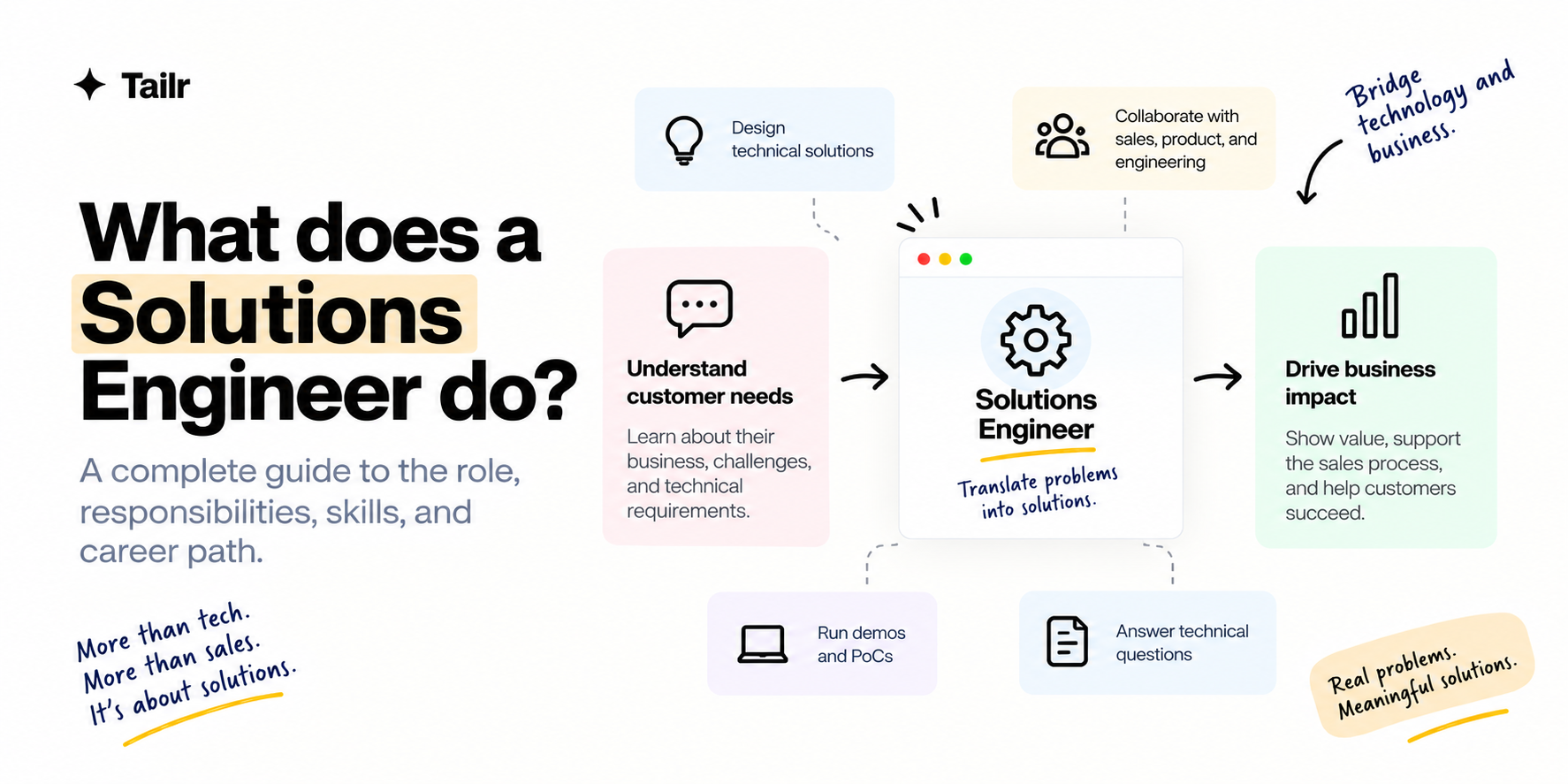
Solutions engineer is one of those titles that means little until you’ve seen the job up close. It sits in sales, but the people doing it are technical. It’s customer-facing, but nobody expects you to close a deal. If you’ve been wondering whether it’s a real engineering career or a sales job with a technical coat of paint, here’s what the role actually involves, what it pays, and who tends to be good at it.
The short answer: a solutions engineer (SE) is the technical half of a software sales team. While the account executive owns the commercial relationship, the SE owns the technical proof:
- Running discovery calls to understand what a prospect has and needs.
- Building custom demos.
- Scoping and running proofs of concept.
- Answering security questionnaires and RFPs.
- Handling technical objections.
- Documenting the agreed solution for the implementation team once the deal closes.
The role is pre-sale, has no personal quota at most companies but a variable pay component tied to team bookings, and pays around $170,000 on average in the US in 2026, with senior SEs at growing software companies well above $200,000.
Where the role sits
Picture a mid-size software company selling to other businesses. A prospect books a call. The account executive (AE) handles who’s buying, why now, what the budget is, and who signs. But within twenty minutes the prospect’s IT lead asks: “How does this integrate with our identity provider?” or “Can it handle our data volumes?” or “What happens to our data if we cancel?”
That’s where the solutions engineer comes in. The SE is paired with one or several AEs and joins deals whenever a technical question needs a credible answer. SEs usually report into a sales engineering or pre-sales leader rather than the engineering org, but they spend a lot of time talking to product and engineering because they’re the ones hearing what prospects can’t do with the product.
The ratio of SEs to AEs varies. Enterprise companies often run one SE per two or three AEs; transactional or product-led companies stretch it further.
The six things solutions engineers do
Job descriptions list a dozen responsibilities. In practice they collapse into six.
1. Technical discovery
Before you can demo anything useful, you need to know what the prospect actually has. SEs run discovery calls to map the prospect’s current systems, data, integrations, security requirements, and the workflow they’re trying to fix. Good discovery is mostly asking better questions than the prospect expects: not “what are your requirements?” but “walk me through what happens today when a new customer signs up.”
The output is usually a short internal write-up: what they have, what they need, what could go wrong, and whether the deal is technically winnable at all.
2. Custom demos
Generic product tours don’t close enterprise deals. SEs build demos using the prospect’s own language, data shapes, and scenarios. If the prospect is a logistics company, the demo environment has shipments, not “widgets”. A strong SE can build and rehearse a tailored demo in a day or two and then deliver it live, handling interruptions and going off-script when the prospect wants to see something specific.
3. Proofs of concept
For larger deals, the prospect wants to try the product on their own data before signing. The SE scopes the proof of concept (POC): what success looks like, how long it runs, what the prospect needs to provide, and what happens at the end. Then they set it up, unblock the prospect’s team during the trial, and present results against the agreed criteria. Unscoped POCs are how deals drift for months, so the scoping part matters more than it sounds.
4. Security questionnaires and RFPs
Any deal with a large company involves paperwork: security questionnaires with a few hundred questions, requests for proposal (RFPs) with technical sections, compliance checklists. The SE owns the technical answers, working from a library of past responses and pulling in the security team when something’s new. It’s not glamorous, but a late or sloppy questionnaire can stall a deal that was otherwise won.
5. Technical objection handling
Prospects raise concerns: it won’t scale, it won’t integrate, it’s not secure enough, the competitor does X. The SE’s job is to answer honestly. Sometimes that means showing the architecture, sometimes it means a reference call with an existing customer, and sometimes it means saying “we don’t do that today, here’s the workaround and here’s what’s on the roadmap.” SEs who over-promise create problems for the implementation team and for renewals, so the best ones are known for being straight.
6. Handoff to implementation
When the deal closes, the SE documents what was promised: the agreed architecture, integrations, success criteria, and any custom commitments. That handoff goes to the implementation, onboarding, or customer success team. At companies with forward deployed engineers, it’s often the FDE who picks up where the SE leaves off.
A typical week
A solutions engineer at a growing software company might be attached to eight to fifteen active deals at once. A representative week looks like:
- Monday: pipeline review with the AEs; two discovery calls; start a demo build for Thursday.
- Tuesday: POC check-in with a prospect’s engineers who are stuck on an API integration; afternoon on a 200-question security questionnaire.
- Wednesday: competitive deal prep, reading up on what the rival vendor showed; a call with product to ask whether a feature the prospect needs is on the roadmap.
- Thursday: the big demo, one hour with the prospect’s IT and operations leads; a debrief with the AE after.
- Friday: write up the POC results; record a demo video for a smaller deal that doesn’t justify a live session; update the internal demo environment.
Deal-heavy weeks near quarter end skew toward demos and objection handling; quieter weeks skew toward building demo assets and answering paperwork.
Solutions engineer vs the roles it gets confused with
| Role | When they work | Main output | Quota | Writes production code |
|---|---|---|---|---|
| Solutions engineer | Pre-sale | Demos, POCs, technical proof | Usually team-based variable pay | Rarely |
| Sales engineer | Pre-sale | Same as solutions engineer | Same, sometimes individual | Rarely |
| Solutions architect | Pre-sale and post-sale | Reference architectures, design documents | Sometimes | Rarely |
| Forward deployed engineer | Post-sale | Working software in the customer’s environment | No | Yes |
| Software engineer | Throughout | The core product | No | Yes |
Solutions engineer vs sales engineer: the same job under two names at most companies. We cover the sales engineer role in its own post, including the quota and on-target-earnings side. If the distinction exists at a particular company, “sales engineer” leans toward quota and “solutions engineer” toward advisory work.
Solutions engineer vs solutions architect: architects tend to be more senior, work on larger and more complex deals, and produce design documents rather than demos. At cloud providers, “solutions architect” is essentially the SE role with a bigger title.
Solutions engineer vs forward deployed engineer: the SE proves the product could work before the sale; the FDE makes it work after. The SE demos on sample data; the FDE ships code against the customer’s real systems.
Skills that actually matter
Technical:
- Deep product knowledge, including the ugly parts and known limitations.
- Enough understanding of APIs, authentication, data formats, and networking to talk to a prospect’s engineers as a peer.
- Security and compliance vocabulary: SSO, SOC 2, data residency, encryption at rest, and what those questions really mean.
- Basic scripting for demo setup, data loading, and quick integrations.
- Familiarity with the prospect’s likely stack (Salesforce, Snowflake, AWS, whatever your product plugs into).
Non-technical:
- Asking questions that uncover what the prospect didn’t say.
- Explaining something complicated in one clear sentence, then stopping.
- Running a room: managing a demo with six people interrupting.
- Juggling ten deals without dropping the one that matters.
- Writing clearly, because a lot of the job is written answers.
The people who struggle in SE roles are usually strong technically but uncomfortable being on stage, or great presenters who bluff when they don’t know. The people who thrive are curious about other people’s systems and honest when the product isn’t the right fit.
What solutions engineers earn
US figures for 2026, which vary by source and company type:
- Glassdoor puts average total pay around $170,000, made up of a $95,000 to $129,000 base plus $44,000 to $83,000 in variable pay and bonus.
- Junior SEs (0 to 2 years in the role) commonly start around $90,000 to $135,000 total.
- Senior and principal SEs at growing software companies reach $215,000 to $300,000 or more in total compensation, often with equity.
- San Francisco pays the most, with a median near $198,000; remote SE roles sit around $171,000.
The variable component is normally a 20% to 30% share of on-target earnings, tied to the team’s or region’s bookings rather than an individual quota. Ask how it’s structured, because “team quota” at one company can be a near-guaranteed bonus and at another can swing wildly with one enterprise deal.
How to get into the role
There’s no single path, but four backgrounds dominate:
- Customer support or technical support. You already know the product and its rough edges, and you’re used to explaining things to frustrated users. The gap is learning to run a deal rather than a ticket.
- Implementation or professional services. You’ve deployed the product for real customers and know what breaks. Moving to pre-sale means learning to scope rather than build.
- Technical consulting. You’re used to discovery, presenting to executives, and juggling clients. The gap is product depth.
- Software engineering. You’re technically credible from day one. The gap is presentation skill and comfort with a sales environment.
Most postings ask for two to five years of hands-on experience with a technical product. A computer science degree helps at developer-tool companies and matters much less elsewhere. The single most convincing thing in an SE interview is a good demo, so practise one: pick any product you know well, build a five-minute walkthrough for an imagined prospect, and deliver it to a friend who interrupts you.
If you’re looking at smaller companies, where SE roles often come with more equity and more variety, our guide to the best websites for startup jobs covers where they’re posted.
Tailoring your resume for a solutions engineer role
SE hiring managers screen for three things: technical credibility, customer-facing evidence, and commercial awareness. Most resumes from technical people show the first and bury the other two.
A support engineer’s bullet might read:
Resolved tier 2 technical tickets for enterprise customers, maintaining a 95% satisfaction score.
Rewritten for an SE posting:
Acted as the technical point of contact for 40 enterprise accounts, running integration troubleshooting calls with customer engineers and documenting fixes that the sales team reused in three renewals.
Same job. The second version shows customer engineers, calls, documentation, and a link to revenue, all of which an SE screener is looking for.
Each SE listing weighs these differently: one leads with a specific product ecosystem, another with security and compliance, a third with enterprise demo experience. That’s where Tailr helps. Open the listing, and it rewrites your resume to bring forward the experience that matches that posting, drafts a cover letter, and tracks the application. It only works from what’s on your resume, which is the right constraint for a job where you’ll be demoing your own claims in the interview. Our guides on tailoring your resume to a job description and tailoring without lying cover the method in detail.
Conclusion
A solutions engineer proves, before the sale, that a software product will solve a prospect’s technical problem. The work is discovery, demos, proofs of concept, questionnaires, objection handling, and a clean handoff to whoever implements the deal. It pays well, doesn’t usually carry a personal quota, and leads naturally to sales engineering leadership, product management, solutions architecture, or founding something.
If you’re technical, like people, and would rather explain a system than maintain one, it’s one of the better-kept secrets in software careers. When you find a listing worth applying to, make sure your resume tells the customer-facing story, not just the technical one.
Try Tailr to tailor your resume to the next solutions engineer listing you open.
Frequently asked questions
01What does a solutions engineer actually do?
A solutions engineer works alongside salespeople to prove that a software product will solve a prospect's technical problem. That means running discovery calls to understand the prospect's systems, building and delivering custom demos, scoping and running proofs of concept, answering security and RFP questionnaires, handling technical objections, and documenting the agreed solution for the team that implements it after the deal closes.
02Is a solutions engineer the same as a sales engineer?
Mostly, yes. The two titles describe the same pre-sales technical role and many companies use them interchangeably. Where a distinction exists, 'sales engineer' tends to be used by companies with a stronger quota culture or in hardware and industrial sales, and 'solutions engineer' by software companies that want to stress the advisory side. Read the job description rather than the title.
03Do solutions engineers need to code?
Some, but usually not much. Most solutions engineers can write scripts, call an API, read logs, and configure integrations, and at developer-tool or infrastructure companies the bar is higher. You don't typically ship production code. What matters more is understanding the product deeply enough to explain how it fits into a customer's architecture.
04How much does a solutions engineer make?
In the US in 2026, Glassdoor puts average total pay for a solutions engineer around $170,000, made up of roughly $95,000 to $129,000 in base plus $44,000 to $83,000 in variable pay and bonus. Junior roles start around $90,000 to $135,000 total; senior and principal solutions engineers at growing software companies can earn $215,000 to $300,000 or more. San Francisco pays the most.
05Do solutions engineers have a sales quota?
Usually not an individual one. Most solutions engineers have a variable component tied to the team's or region's bookings, commonly 20% to 30% of on-target earnings, so they benefit when deals close without carrying a personal number. A few companies do give solutions engineers individual quotas, so ask during interviews.
06How do you become a solutions engineer?
The most common routes are from customer support, implementation or professional services, technical consulting, and software engineering. Companies want two to five years of hands-on experience with technical products plus evidence you can explain things clearly to non-technical people. A computer science degree helps but isn't required; being able to demo confidently and ask good discovery questions matters more.