Product Manager vs. Project Manager: What's the Difference?
· updated
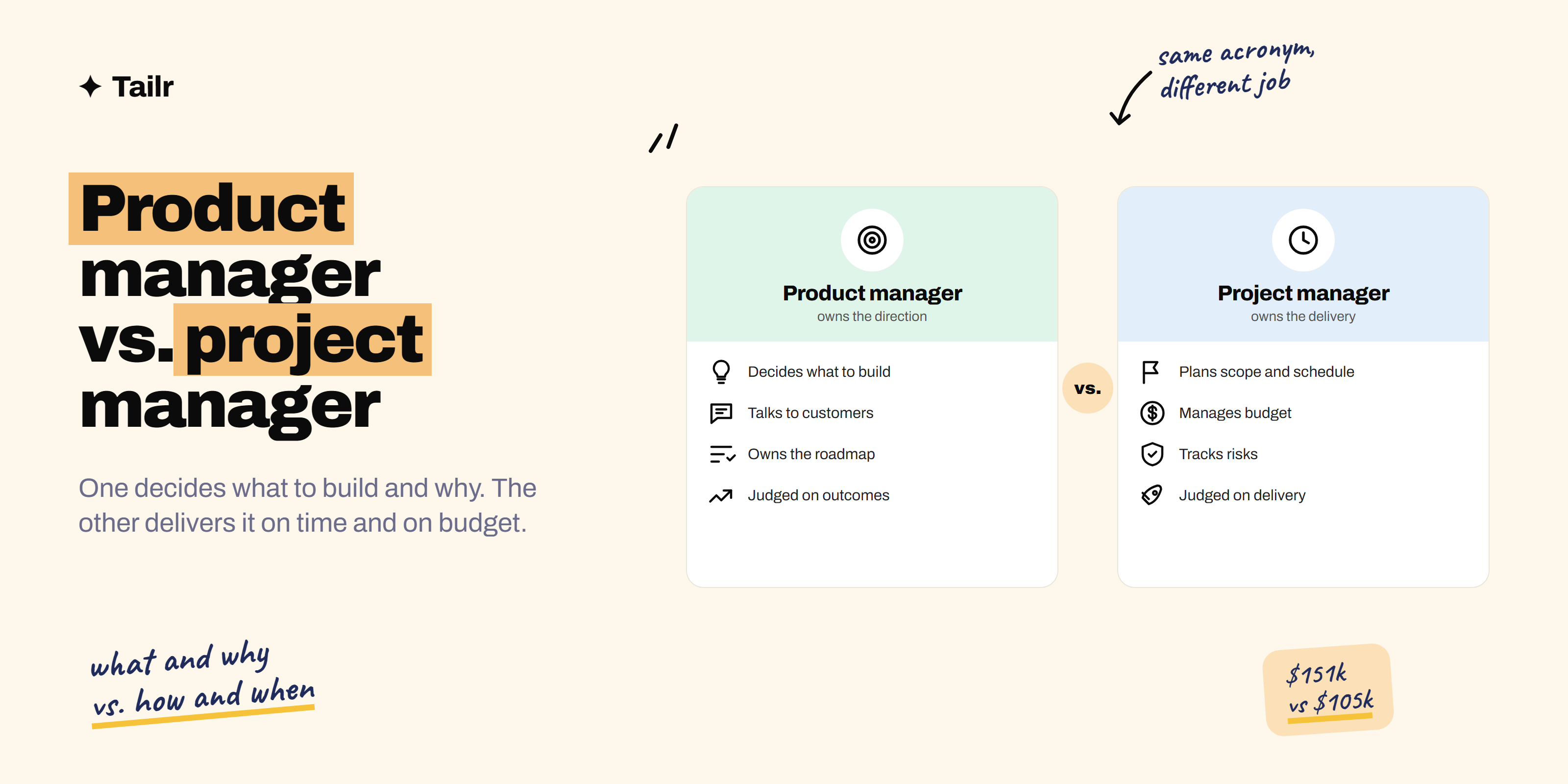
The titles are one word apart, the acronym is the same, and in plenty of job listings the duties overlap. But product management and project management are different jobs with different goals, different skills, and different pay. If you’re choosing between them, or trying to work out which one a listing actually wants, here’s how they compare.
The short answer: a product manager decides what to build and why, and is measured on whether the product succeeds with customers and the business. A project manager plans and runs the work to deliver a defined result on time, on budget, and within scope, and is measured on delivery. Product managers own the direction and work on a product for its whole life; project managers own execution and work on projects with a start and an end. In the US in 2026, product managers average about $151,000 and project managers about $105,000.
Product manager in one paragraph
A product manager is responsible for a product or a part of one. They talk to customers, study data, decide which problems are worth solving, write down what to build, and work with engineers and designers until it ships. Then they measure whether it worked and decide what’s next. There’s no finish line: the product keeps going, and so does the job. For the full picture, see what a product manager actually does.
Project manager in one paragraph
A project manager is responsible for delivering a specific project: launching a new office, migrating a system, running a marketing campaign, building a bridge. They define the scope, build the schedule, manage the budget and resources, track risks, and keep everyone informed until the project is done. Project management exists in every industry, not just tech, and has well-established methods and certifications such as the PMP from the Project Management Institute.
The key differences
| Product manager | Project manager | |
|---|---|---|
| Core question | What should we build, and why? | How do we deliver this on time and on budget? |
| Measured on | Product outcomes: usage, retention, revenue | Delivery: scope, schedule, budget |
| Time frame | Ongoing, for the product’s life | A project with a start and an end |
| Main inputs | Customer research, data, strategy | Requirements, plans, resources |
| Main outputs | Roadmap, specs, prioritised backlog | Project plan, schedule, status reports, risk log |
| Industries | Mostly tech and digital products | Every industry |
| Typical certification | None required | PMP, PRINCE2, Scrum certifications |
| US average pay (2026) | About $151,000 | About $105,000 |
How they work together
On a big launch, the two roles fit together cleanly. Say a bank is launching a new mobile app:
- The product manager decides which features the first version needs, based on customer research and the bank’s goals. They write the requirements, work with design on the experience, and later track how many customers adopt the app.
- The project manager turns that into a plan: the timeline, the dependencies between the app team, the security review, the legal sign-off and the marketing launch. They track progress, flag risks early, and keep the launch date realistic.
If the security review slips two weeks, the project manager spots it and re-plans. If early users ignore a key feature, the product manager decides what to change.
Where the lines blur
In practice the two roles overlap, and a few things cause confusion:
- Small teams. At startups, the product manager often does the project management too. There’s no one else.
- Agile teams. In Scrum, delivery is shared between the team and a scrum master, and the “product owner” handles the backlog. Many companies merge product owner and product manager.
- Program managers. In tech, the delivery role on large engineering efforts is often called technical program manager rather than project manager. See what is a technical program manager.
- Title inflation. Some listings titled “product manager” are really project coordination roles, and vice versa. Read the responsibilities, not the title.
A quick test for a job listing: if it talks about customers, discovery, roadmap, and metrics like retention, it’s product management. If it talks about timelines, budgets, stakeholders, status reports, and risk, it’s project management.
Skills each role needs
Product manager:
- Customer research and empathy
- Prioritisation and saying no
- Data analysis and experiment design
- Writing specs and making decisions under uncertainty
- Enough technical understanding to discuss trade-offs
Project manager:
- Planning and scheduling
- Budgeting and resource management
- Risk management
- Stakeholder communication and status reporting
- Methodologies such as waterfall, agile, and hybrid
Both need strong communication and the ability to lead people who don’t report to them.
Which one is right for you?
You’ll probably enjoy product management if you:
- like figuring out what people need and why;
- are comfortable making calls with incomplete information;
- want to be judged on outcomes, even though you don’t control everything that affects them.
You’ll probably enjoy project management if you:
- like turning a messy goal into a clear plan;
- get satisfaction from hitting dates and keeping things organised;
- want a career that transfers across almost any industry.
Neither is a step down from the other. Plenty of people move between them: project managers into product as they get closer to customers, and product managers into program leadership as they find they love the delivery side.
Moving from project manager to product manager
This is the most common switch. Your strengths, running cross-functional teams, managing stakeholders, and delivering, already cover half the PM job. To close the gap:
- Get closer to customers. Join user interviews and sales calls. Read support tickets.
- Learn product data. Get comfortable with the analytics tool your company uses.
- Own a decision. Volunteer to scope a small feature end to end, including deciding what’s out.
- Reframe your resume. Lead with outcomes and decisions, not only delivery.
That last step matters. A project manager’s bullet:
Managed delivery of a new customer portal across four teams, on time and under budget.
Reframed for a product manager listing:
Led the launch of a new customer portal across four teams; worked with support to cut the portal’s scope to the three most-requested tasks, and self-service logins rose 35% in the first quarter.
Same project, but the second version shows customer understanding and a product outcome. Tailr tailors your resume from the job listing you’re viewing, so the same experience gets framed for product or project roles as needed, and it drafts a cover letter and tracks the application too. For doing it by hand, see how to tailor your resume without lying.
Related guides
- 10 Terms You Should Know Before a Product Management Interview
- What Are KPIs? A Plain-English Guide With Examples
Conclusion
A product manager decides what to build and why, and is judged on whether the product succeeds. A project manager delivers a defined result on time and on budget, and is judged on the delivery. The roles overlap in daily work, often sit side by side on big launches, and are easy to confuse in job listings, but they call on different strengths. Pick the one whose questions you’d rather answer every day.
Try Tailr to tailor your resume to the product or project role you open next.
Frequently asked questions
01What is the main difference between a product manager and a project manager?
A product manager decides what to build and why, and is measured on whether the product succeeds with customers. A project manager plans and runs the work to deliver a defined outcome on time, on budget, and within scope. The product manager owns the direction; the project manager owns the delivery.
02Who earns more, a product manager or a project manager?
Product managers usually earn more. In the US in 2026, Glassdoor puts the average product manager salary at about $151,000 and the average project manager salary at about $105,000. Senior project and program managers at large tech companies can close much of that gap.
03Can a project manager become a product manager?
Yes, and it's a common move. Project managers already know how to run cross-functional teams and deliver. The gap to close is customer and product thinking: getting involved in user research, learning to read product data, and owning decisions about what to build rather than only how to deliver it.
04Is a product manager higher than a project manager?
Neither is officially above the other; they're different jobs with separate career ladders. In tech companies product management often has more influence over strategy and pays more, but a senior project or program manager can be more senior than a junior product manager.
05Do product managers need a PMP certification?
No. The PMP from the Project Management Institute is a project management credential and is valued for project manager roles, especially outside tech. Product manager hiring rarely asks for any certification; evidence of product decisions and their results matters far more.
06Does a team need both a product manager and a project manager?
Often, but not always. Small software teams usually have a product manager and let engineers run delivery with agile practices. Large programmes with many teams, vendors, or hard deadlines, such as a platform migration or a regulated launch, benefit from a dedicated project or program manager alongside the product manager.