How to Become a Forward Deployed Engineer (FDE) in 2026
· updated
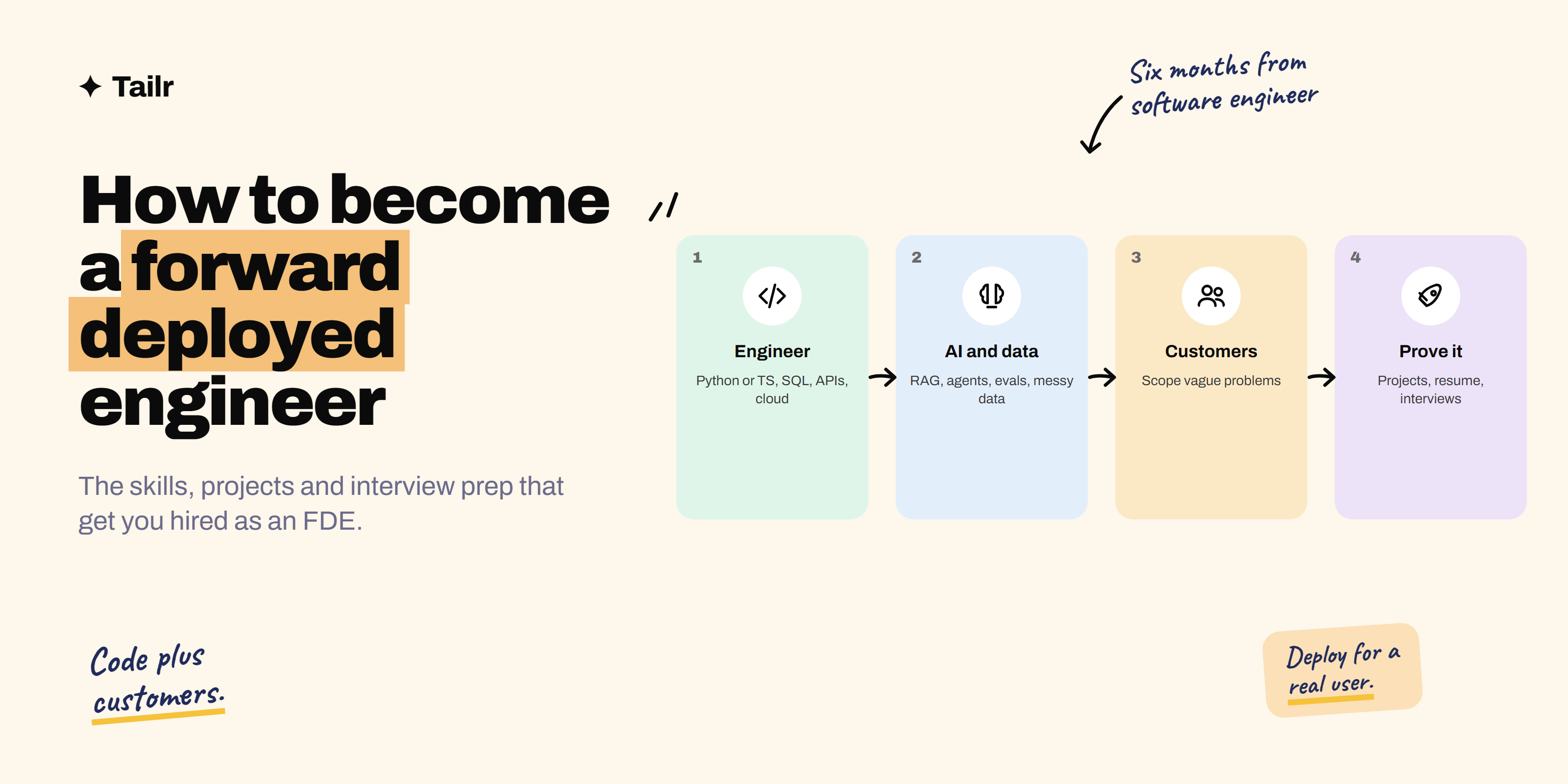
Forward deployed engineering has gone from a Palantir quirk to one of the most talked-about engineering jobs in AI. If you’ve read what a forward deployed engineer is and thought “that’s the job I want”, this guide is the next step: the skills to build, the projects that prove them, where to apply, and how the interview works.
The short answer: to become a forward deployed engineer:
- Get solid at software engineering: Python or TypeScript, SQL, APIs and cloud basics.
- Learn to work with messy data and integrations: connecting systems that weren’t built to talk to each other.
- Learn to build with AI: LLM APIs, retrieval, agents and evaluations.
- Get customer-facing experience: support, consulting, solutions or user research all count.
- Build two or three deployment-style projects for real users.
- Apply to the right companies with a resume that shows both code and customers.
- Prepare for the FDE interview: coding, problem decomposition and customer role play.
Most people take six to twelve months from a software engineering role, longer from a non-technical start.
What makes an FDE different
An FDE is a software engineer whose “spec” is a customer’s messy reality. Instead of building one feature for thousands of users, you build whatever it takes to make the product work for one customer: integrations, data pipelines, custom workflows, evaluation harnesses. So companies hire for two things at once:
- Engineering depth: can you ship production code quickly, in an unfamiliar environment?
- Customer judgement: can you work out what the customer actually needs, which is often not what they asked for?
Everything below builds one of those two. For how the role compares day to day, see forward deployed engineer vs software engineer.
Step 1: Get solid at software engineering
You need to code at the level of a mid-level software engineer, in at least one language that’s common in the role:
- Python for data work and AI.
- TypeScript for web apps, internal tools and many AI products.
- SQL, which you’ll use in almost every deployment.
- APIs: REST, authentication (OAuth, API keys), webhooks, rate limits.
- Cloud basics: deploying a service, environment variables, logs, a database, containers.
If you’re already a software engineer, you’re most of the way there. If not, this is the longest step. Our guide to how to ace your technical interview covers the coding level FDE interviews expect.
Step 2: Learn messy data and integrations
Most FDE work is connecting the product to systems that already exist: a CRM, a data warehouse, a document store, an old internal API with no documentation. Practise:
- Pulling data from several sources and joining it cleanly.
- Writing ETL scripts that cope with missing fields, bad dates and duplicates.
- Working within permissions: what each user is allowed to see.
- Debugging someone else’s system without being able to change it.
A good exercise: take two public datasets that don’t quite match (different IDs, formats and time zones) and build a pipeline that merges them into one reliable table.
Step 3: Learn to build with AI
Most new FDE roles are at AI companies, so learn to build real systems on top of models:
- Calling LLM APIs, structured outputs and tool use.
- Retrieval-augmented generation (RAG): grounding answers in a customer’s documents. See what is RAG.
- Agents and tools: letting a model take actions, safely. See what is an AI agent and what is MCP.
- Evaluations: measuring whether the system is actually good enough for the customer, which is the part most demos skip.
Step 4: Get customer-facing experience
This is what separates FDE candidates from other strong engineers. You don’t need the title; you need stories. Ways to get them:
- Volunteer for customer calls, escalations or on-call support at your current job.
- Build an internal tool for another team and run it like a customer project: interviews, scope, delivery, feedback.
- Take a solutions engineer or sales engineer role as a stepping stone.
- Freelance for a small business, where you’ll scope, build and support the whole thing.
What you’re collecting: times you turned a vague request into a working solution, handled a frustrated user, or said no to the wrong feature.
Step 5: Build deployment-style projects
Tutorial projects don’t help much. Build things for a real user with real data, and write up the deployment, not just the code. Ideas:
- A document Q&A system for a local organisation (a school, clinic or club) using their actual documents, with an evaluation set of 50 real questions and the accuracy you reached.
- An integration between two tools a small business uses, such as bookings into a spreadsheet and invoices, that saves them a measurable number of hours a week.
- An AI workflow for a messy process, such as triaging support emails, with a before-and-after on time spent.
For each one, write a short case study: the problem, constraints, what you built, what went wrong, and the result. That case study is your interview story. For more ideas, see weekend projects to build with Claude to get hired.
Step 6: Find the right companies
FDE roles are concentrated in a few kinds of companies:
- AI labs and AI-first companies deploying models into enterprises.
- Data and infrastructure platforms such as Palantir (which uses the title forward deployed software engineer), Databricks and Snowflake.
- Enterprise software startups that sell large contracts and need engineers on the customer side.
Search for “forward deployed engineer”, “forward deployed software engineer”, “applied AI engineer”, “deployment engineer” and “solutions engineer (technical)”. Titles vary; read the description. Hiring is heaviest in New York, San Francisco and London, with many roles requiring travel.
Step 7: Tailor your resume for FDE roles
An FDE resume has to prove both halves of the job. For each recent role, aim for bullets like:
- Engineering: “Built a Python ingestion service that unified data from 4 CRMs, processing 2M records a day.”
- Customer: “Led weekly working sessions with a 12-person operations team to scope and ship 3 internal tools in 8 weeks.”
- Outcome: “Cut manual reporting time from 15 hours to 2 a week.”
Use the listing’s words where they’re true: “customer-facing”, “deploy”, “integrations”, “production”, “LLM”. Tailr is a Chrome extension that tailors your resume to the job listing you’re viewing, using only your real experience, then writes a matching cover letter and tracks each application, which helps when you’re applying to companies that each use a different title for the same job. Our guide to tailoring your resume without lying explains the approach.
Step 8: Prepare for the FDE interview
FDE interview loops vary, but most include:
| Round | What it tests | How to prepare |
|---|---|---|
| Recruiter screen | Motivation, fit, travel | A clear “why FDE” story |
| Coding | Practical coding, often data-heavy | Easy to medium problems, plus parsing and transforming data |
| Decomposition or case | Breaking a vague customer problem into a plan | Practise “a hospital wants to reduce wait times; what do you build?” |
| Project deep dive or system design | Depth on something you built | Know one project inside out, including trade-offs |
| Customer or behavioural | Handling pressure, ambiguity and conflict | Six stories with clear results |
For the decomposition round, use a simple structure: clarify the goal and who the users are, list the data you’d need, propose the smallest useful first version, then how you’d measure success. The clarify, structure, solve approach in interview answer frameworks works well here, and system design interview prep covers the design round.
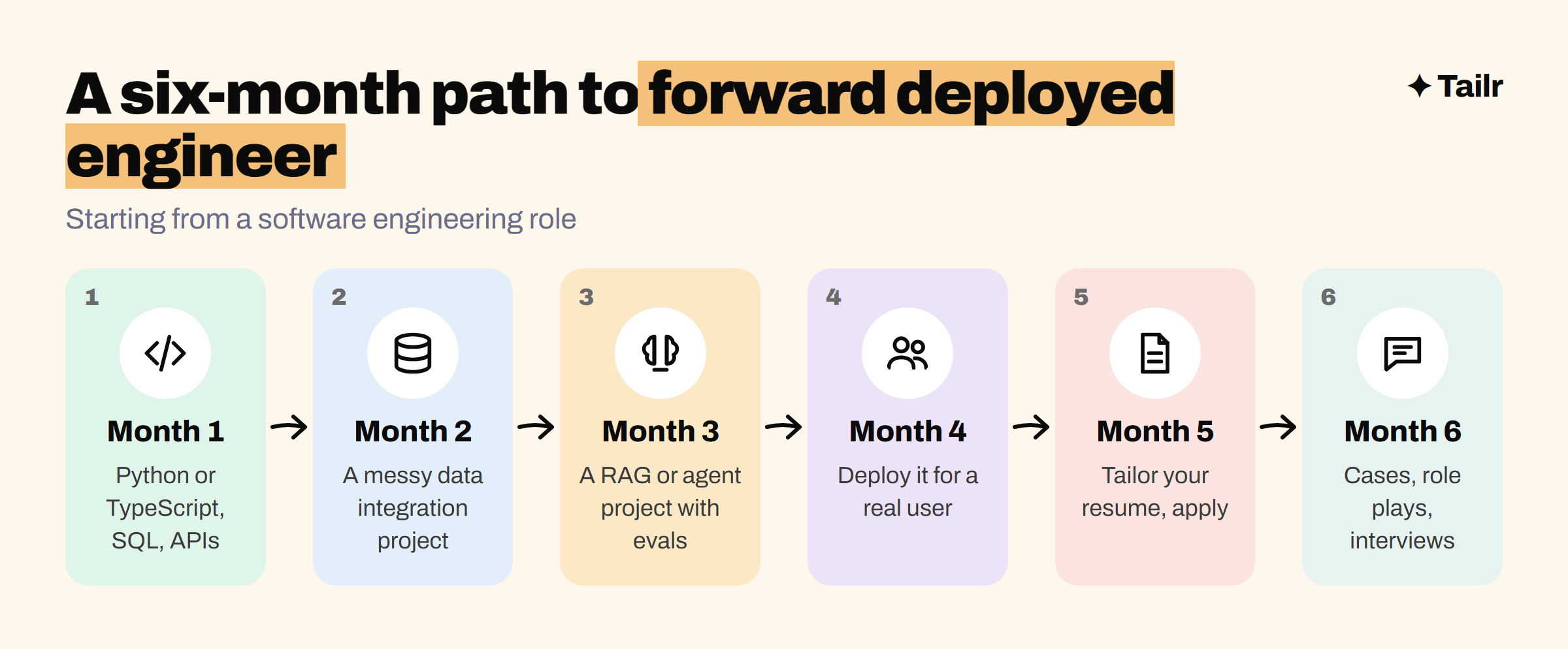
A six-month plan from software engineer to FDE
- Month 1: brush up Python or TypeScript and SQL; start a customer-facing habit at work.
- Month 2: build a data integration project with real, messy data.
- Month 3: build a RAG or agent project with an evaluation set.
- Month 4: deploy one project for a real user; write the case study.
- Month 5: tailor your resume, start applying, practise decomposition cases.
- Month 6: interviews, mock customer role plays, follow-ups.
Conclusion
Becoming a forward deployed engineer means building two kinds of credibility at once: you can ship production code in someone else’s mess, and you can work out what a customer really needs. Get strong at Python or TypeScript, SQL and integrations, learn to build and evaluate AI systems, collect customer-facing stories, and prove it all with projects deployed for real users. Then target the companies that hire FDEs, tailor your resume to each listing, and practise breaking vague problems into clear plans out loud.
Frequently asked questions
01How do I become a forward deployed engineer?
Build strong software engineering skills in Python or TypeScript plus SQL and APIs, learn to integrate messy data and AI models into real systems, get experience working directly with users or customers, build two or three deployment-style projects, then apply to AI companies and data platforms and prepare for coding, case and customer role-play interviews.
02Do you need a computer science degree to be an FDE?
No, but you need to code at the level of a solid software engineer. Many FDEs have CS or engineering degrees, while others come from physics, maths, consulting or self-taught backgrounds. What matters is shipping production code and showing you can work with customers.
03Can a new graduate become a forward deployed engineer?
Yes. Palantir has long hired forward deployed software engineers straight from university, and some AI companies hire new grads too, although many FDE roles ask for two or more years of experience. Internships, hackathons and projects built for real users are the strongest evidence for a new grad.
04What skills does a forward deployed engineer need?
Core skills are Python or TypeScript, SQL, APIs and integrations, cloud basics, and for AI roles, building with LLMs: retrieval, agents and evaluations. Just as important are communication, scoping a vague problem, handling customer pressure and explaining technical trade-offs to non-engineers.
05What is the FDE interview process like?
It usually includes a recruiter screen, a coding round, a problem decomposition or case round where you break down a vague customer problem, a technical project or system design discussion, and a behavioural or customer-facing round. Some companies add a take-home or a live role play with a mock customer.
06Is forward deployed engineering a good career?
For engineers who enjoy customers, travel and variety, it's an excellent one. Pay is high, learning is fast, and FDEs often move into product management, engineering leadership, solutions architecture or founding companies. The trade-offs are travel, context switching and more pressure than many product engineering roles.