Forward Deployed Engineer vs. Software Engineer
· updated
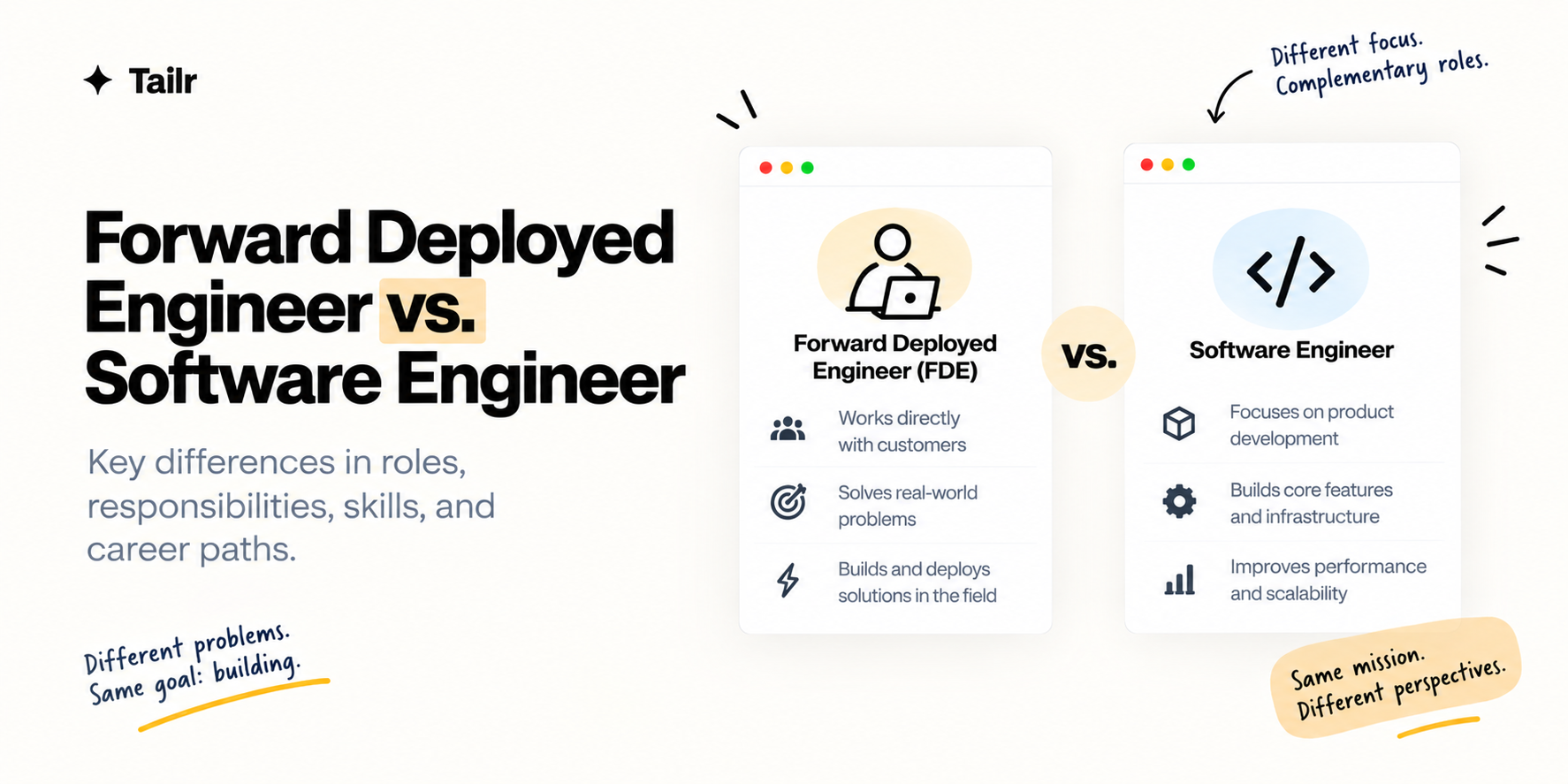
Forward deployed engineer roles have multiplied fast enough that a lot of software engineers are now weighing one against a conventional engineering job, sometimes at the same company. The titles sound like cousins. The day-to-day is more different than most people expect. This post lays out where the two roles diverge, what each one pays, and how to decide which suits you.
The short answer: a software engineer builds the core product for every customer, working mostly in the company’s own codebase and rewarded for depth in a specialism. A forward deployed engineer (FDE) takes that product to one customer at a time, writes whatever integrations and custom code it takes to make it work in that customer’s environment, and is rewarded for breadth, ownership, and the ability to work directly with people who aren’t engineers. Pay is similar at the median, with FDEs at AI companies earning more at senior levels and FDEs at consultancies earning somewhat less. Pick FDE if you want fast feedback, variety, and customer contact; pick software engineering if you want to go deep on hard technical problems without a customer in the room.
If you want the full background on the FDE role first, we have a dedicated guide to what a forward deployed engineer is. This post assumes you know the basics and want the comparison.
The two roles side by side
| Forward deployed engineer | Software engineer | |
|---|---|---|
| Who you build for | One customer at a time | Every customer |
| Where the code lives | The customer’s environment, plus your own repo | The company’s core codebase |
| Customer contact | Daily | Rare, usually via a product manager |
| What’s rewarded | Breadth, speed, ownership of outcomes | Depth, correctness, long-term maintainability |
| Typical spec | A goal, not a spec | A ticket, design doc, or PRD |
| Timeline pressure | Contract dates, often weeks | Roadmap dates, often quarters |
| Travel | Sometimes, depends on the company | Almost never |
| Sales quota | No | No |
Everything below is really an expansion of that table.
Who you build for
This is the difference that drives all the others.
A software engineer on a product team builds one capability that thousands or millions of users will touch. That forces a particular discipline: the code has to handle every edge case, scale, be observable, and stay maintainable by people who join the team years later. You’re writing for the general case.
An FDE builds many capabilities for one customer. The customer’s data lives in a specific set of systems with specific quirks. Their compliance team has specific rules. Their users have specific workflows. The FDE’s job is to make the product fit all of that, and the code they write often doesn’t need to generalise at all. It needs to work, here, by the date in the contract.
Palantir, which invented the title, framed it this way: product engineers build one thing for many customers; forward deployed engineers build many things for one customer. That framing still holds at the AI companies that copied the model.
What a week actually looks like
Ask a software engineer what they did this week and you’ll usually hear about two or three tickets, a design review, some code review, a planning meeting, and maybe an on-call shift. The people they talked to were other engineers, a product manager, and a designer.
Ask an FDE and the answer depends on where the deployment is:
- Early in a deployment: discovery workshops with the customer’s team, reading their documentation (or discovering there isn’t any), mapping their systems, writing a plan.
- Middle: mostly building. Connectors to their databases, data pipelines, evaluation harnesses, custom prompts or configuration, a small internal UI. Plus a standing weekly call with the customer to show progress.
- End: getting the thing through the customer’s security review, deploying into their cloud account or on-premise servers, training their users, writing up what the core product should change so the next customer doesn’t need as much custom work.
The FDE talks to the customer’s engineers, operations managers, security team, and sometimes their lawyers. Some of those meetings are about code. Many are about trust.
Breadth versus depth
A software engineer’s career usually rewards depth. You become the person who understands the payments system, or the search index, or the mobile build pipeline. That expertise compounds and is how most senior and staff promotions happen.
An FDE’s career rewards breadth. In a year you might work on a retrieval pipeline for a law firm, a fraud model for a bank, and a document workflow for a hospital. You’ll touch Python, SQL, three cloud providers, two identity systems, and whatever the customer’s ten-year-old internal API happens to speak. You won’t become the world expert in any of it. You will become very good at walking into a room full of unknowns and leaving with a working system.
Neither is better. But be honest with yourself about which one you find satisfying. Engineers who love going deep tend to find FDE work frustrating after the novelty wears off. Engineers who get bored on one subsystem tend to find product roles slow.
Ambiguity and ownership
Software engineers usually receive a fairly well-defined problem: a product manager has decided what to build, a designer has drawn it, and a tech lead has sketched the architecture. The engineer’s judgement goes into how to build it well.
FDEs receive a goal. “Get our support agents using this by November.” Working out what that actually requires (which systems, which data, which people need to sign off) is the job. Nobody hands you a spec, and if you wait for one, the deployment slips.
The flip side is ownership. When an FDE’s deployment goes live, the customer’s results are traceable to that engineer’s work. When a product feature ships, credit is shared across a team, a PM, and the roadmap. Some people find the FDE version motivating; others find it stressful. Both reactions are reasonable.
What each role pays
Both pay well. The spread is wider for FDEs because the title covers everything from a consultancy to an AI lab.
Software engineer. The US Bureau of Labor Statistics puts the median for software developers at about $133,000 (May 2024). At large tech companies, total compensation for mid-level engineers commonly sits in the $200,000 to $350,000 range once stock is included, and senior levels go higher.
Forward deployed engineer. Analyses of 2026 job postings put the advertised median base around $174,000, with entry-level offers of roughly $140,000 to $220,000 base plus equity. Palantir FDSE total compensation is commonly reported around $215,000 to $240,000. Mid-to-senior FDEs at OpenAI and Anthropic are reported at $350,000 to $550,000 total, and staff-level roles higher still.
One published comparison found FDEs earning around 9% less than product engineers on average, driven by lower-paying consultancy and defence roles, while AI-lab FDEs out-earn most product engineers at the same level. So the honest answer to “which pays more” is: it depends on the company far more than on the title.
Career paths from each role
From software engineering: senior engineer, staff engineer, tech lead, engineering manager. The ladder is well defined at most companies and promotions are mostly about technical scope and influence.
From forward deployed engineering: the ladder is less standardised, but the exits are unusually broad. FDEs move into product management (they’ve spent years learning what customers actually need), into leading customer engineering or solutions teams, into founding companies (Palantir’s FDE alumni have started a striking number of startups), and back into core engineering with more product context than most of their peers.
If you know you want to be a staff engineer, software engineering is the more direct route. If you’re not sure whether you want to stay an engineer at all, FDE keeps more doors open.
How the interviews differ
Both roles usually include a coding round, but the emphasis shifts.
A software engineering loop leans on data structures and algorithms, a system design round for anything above junior, and a deep dive on a past project. Interviewers want to see rigour: tests, edge cases, trade-offs made carefully.
An FDE loop keeps a coding round (often more practical: parse this data, call this API, build a small thing) and adds a customer-facing element. That might be a case study where the interviewer plays a customer with a vague problem, or a presentation where you explain a technical solution to a non-technical panel. Interviewers watch for whether you ask what “better” means before proposing a system, and whether you can say “I don’t know yet, here’s how I’d find out” without flinching.
If you’re moving from one to the other, the gap is usually the part you haven’t been practising: FDEs going back to product roles need to refresh algorithms; engineers going into FDE roles need to practise scoping out loud.
Which one should you choose?
Choose forward deployed engineer if:
- You get energy from seeing your work used by real people the week you ship it.
- You’d rather solve ten different problems shallowly than one problem deeply.
- You’re comfortable being the only engineer in a meeting.
- You can tolerate travel or on-site time (check the specific role; it varies enormously).
- You might want to move into product, founding, or leadership later.
Choose software engineer if:
- You want to become genuinely expert in a system or domain.
- You prefer well-scoped problems and time to solve them properly.
- Customer meetings drain you rather than energise you.
- You want a predictable promotion ladder.
- You’d rather your work be judged on craft than on a customer’s outcome.
A lot of people would enjoy both. If that’s you, consider that it’s easier to move from software engineering into FDE work than the reverse at most companies, simply because FDE hiring wants engineers who’ve already proven they can ship. Two or three years on a product team followed by an FDE role is a common and sensible sequence. For a sense of where the smaller companies posting these roles live, see our list of the best websites for startup jobs.
Tailoring your resume for each role
The same experience reads very differently depending on which role you’re applying for, and most engineers send the same resume to both.
Take one bullet from a product engineer’s resume:
Built and maintained the ingestion service for the analytics platform (Go, Kafka, Postgres), handling 2B events per day.
For a software engineering application, that’s already good. You might add the reliability story: “reduced p99 latency by 40%” or “led the migration to the new schema with zero downtime”.
For an FDE application, the screener is asking different questions: did you talk to customers, did you own something end to end, did you deal with ambiguity? The same work, reframed:
Owned the analytics ingestion service end to end (Go, Kafka, Postgres); worked directly with three enterprise customers to onboard their event streams, including on-site sessions to debug their firewall and auth setup.
Every word is true in both versions. The second one just brings forward what an FDE hiring manager needs to see. This is exactly what Tailr does when you open a listing: it reads the posting, reorders and rewrites your resume to lead with the matching experience, drafts a cover letter, and keeps track of the application. It works only from what’s really on your resume, which matters because both kinds of interview will dig into every claim. Our guides on tailoring your resume to a job description and tailoring without lying go through the method step by step.
Related guides
Conclusion
Forward deployed engineers and software engineers both write production code and both get paid well for it. The real difference is who they build for. Software engineers build the general product for everyone and are rewarded for depth. FDEs build a specific solution for one customer, in that customer’s environment, and are rewarded for breadth, speed, and the ability to work with people who don’t write code.
If you’re choosing between them, decide based on how you like to work rather than on pay, because pay depends more on the company than the title. And whichever you pick, make sure your resume tells that role’s story rather than the other one’s.
Try Tailr to tailor your resume to the next engineering listing you open.
Frequently asked questions
01What is the difference between a forward deployed engineer and a software engineer?
A software engineer builds the core product that every customer uses, usually from the company's own codebase. A forward deployed engineer takes that product to one customer at a time and writes the integrations, pipelines, and custom code needed to make it work inside that customer's systems. Both write production code; they differ in who they build for and how much customer contact the job involves.
02Do forward deployed engineers earn more than software engineers?
Roughly the same at the median, with a wider spread. Analyses of 2026 postings put advertised FDE base pay around $174,000, while the US Bureau of Labor Statistics puts the median for software developers near $133,000. At AI labs, senior FDE packages of $350,000 to $550,000 total are reported, which matches or beats senior product engineers. At consultancies and defence contractors, FDE pay is closer to a standard engineer's.
03Is a forward deployed engineer a real software engineer?
Yes. FDEs write, test, deploy, and maintain production code, often across the full stack and the customer's infrastructure. What they don't usually do is spend months on one deep subsystem. If you measure engineering by lines of code in the core repo, FDEs score lower; if you measure it by shipped systems that customers rely on, they score at least as high.
04Can a software engineer move into a forward deployed engineer role?
Yes, and it's the most common route in. Hiring managers look for engineers who have shipped end to end, worked directly with users or customers, and can explain trade-offs to non-engineers. Two to four years of experience is typical. Highlight any time you sat with a customer, owned a deployment, or scoped a vague request into a working system.
05Can a forward deployed engineer move back to a software engineering role?
Yes. FDEs bring unusual product context and end-to-end shipping experience, both of which product teams value. The main thing to prepare for is the interview: standard software engineering loops still test data structures, algorithms, and system design in depth, so you'll want to refresh those even if your day job hasn't needed them lately.
06Which is better for a new graduate, FDE or software engineer?
Most new graduates are better served by a software engineering role first. FDE work assumes you can already ship production code without much supervision and hold your own in front of a customer. That said, a few companies, including Salesforce and some startups, run associate or new-grad FDE programmes, and they suit graduates who have strong internship experience and like talking to people as much as writing code.