How to Answer "Why Should We Hire You?" (With Sample Answers)
· updated
“Why should we hire you?” sounds confrontational, but it’s really an invitation: the interviewer is asking you to make their decision easy. It usually comes near the end, and it’s your chance to pull the whole interview into one clear argument. Here’s a simple formula, sample answers for different situations, and the mistakes that make this answer fall flat.
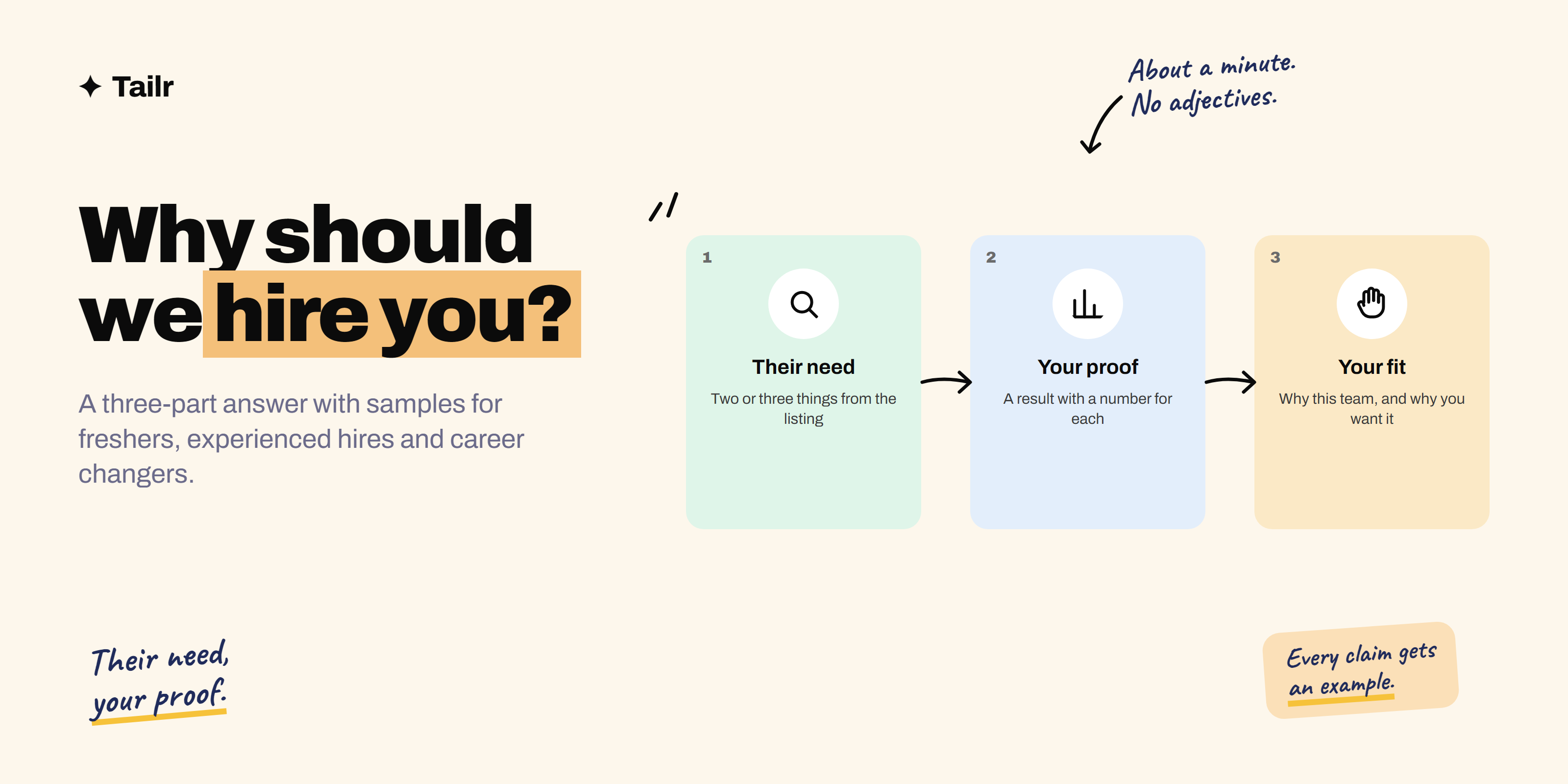
The short answer: answer “why should we hire you?” in three parts, in about a minute:
- Their need: name the two or three things this role needs most, taken from the job description.
- Your proof: for each one, give a specific example or result from your experience.
- Your fit: finish with what you’d bring to this particular team, and that you want the job.
Make it about their problem, not your wish list, and back every claim with evidence.
What the interviewer is really asking
Underneath the question are three smaller ones:
- Do you understand what this job needs? If you name the wrong priorities, it shows.
- Can you prove you can do it? Claims are cheap; examples aren’t.
- Will you fit and stay? Enthusiasm for this specific role matters.
A good answer handles all three. A weak one lists adjectives: “I’m hard-working, a fast learner and a team player.” Every candidate says that.
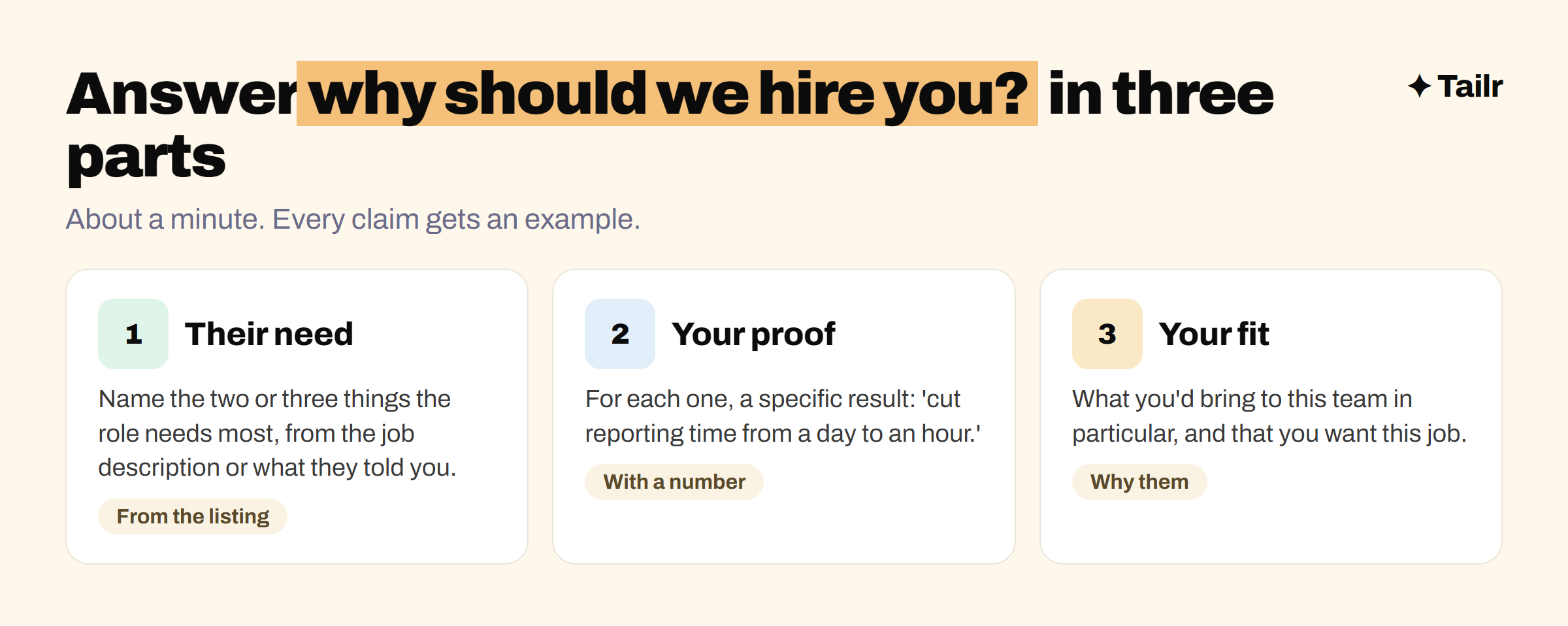
The need, proof, fit formula
1. Their need
Before the interview, re-read the job description and underline what appears more than once, or what’s listed first. That’s what the hiring manager cares about. Pick the top two or three. If the interview revealed a specific problem (“our onboarding flow is losing users”), use it. That beats anything from the listing.
2. Your proof
For each need, give one concrete example: a project, a result, a number.
- Weak: “I’m good with data.”
- Strong: “I built the weekly revenue dashboard my last team used for every pricing decision, and cut reporting time from a day to an hour.”
3. Your fit
Close by connecting it to them: “That’s exactly the kind of work you described for the first six months, and it’s the work I enjoy most.” It shows you listened and that you want this job, not just a job.
Sample answers
Experienced professional (marketing manager)
“From what you’ve described, you need someone to rebuild the email programme and get the content calendar running consistently. Those are the two things I’ve done most in the last three years. At my current company I rebuilt our lifecycle emails from scratch, and within six months email went from 8% to 21% of new revenue. I also introduced a simple content calendar that took us from posting irregularly to two articles a week for over a year. I’d bring that same approach here, and honestly, after hearing about your plans for the new product line, it’s the role I’m most excited about right now.”
Fresher or recent graduate (junior data analyst)
“The role needs strong SQL, clear dashboards and someone who can explain numbers to non-technical people. In my final-year project I wrote the SQL behind an analysis of 2 million bike-share trips and presented it to the city transport team, who used one of our findings to move three docking stations. During my internship, I built a Power BI dashboard the founders still use every Monday. I learn tools fast, and I really like that your analysts sit with the product teams, because that’s where I want to grow.”
For more on presenting projects as experience, see how to write a resume with no experience.
Career changer (teacher to customer success)
“Customer success is about helping people get value from something new, keeping them engaged and spotting problems early. I’ve done a version of that for eight years as a teacher: I onboarded 30 new students every term, tracked who was falling behind and stepped in before they failed. Last year, I also ran the rollout of a new learning platform for 40 teachers at my school, including training sessions and a help guide, and adoption hit 90% in a month. I’d bring that patience and structure to your customers, and I’ve already completed your product’s free certification to get a head start.”
Read how to switch careers into tech for more on framing transferable skills.
Technical role (backend engineer)
“You need someone who can scale the payments service and improve reliability. At my current company, I led the move from a monolith to three services, which cut deploy time from 40 minutes to under 10, and I set up the alerting that took our incident count from about six a month to one. I also enjoy mentoring, and I’d be glad to help with the junior engineers you mentioned are joining next quarter.”
Short version for a recruiter screen
“Three reasons: I’ve done this exact work for four years, I’ve got the numbers to show it, including a 40% lift in trial conversions last year, and I’m genuinely excited about your product.”
Fill-in-the-blank template
“From the role and our conversation, you need [need 1] and [need 2]. At [company or project], I [result with a number], and I also [second result]. I’d bring that to [their specific goal or team], and [one honest reason you want this job].”
Mistakes to avoid
- Generic adjectives. “Hard-working, passionate, team player.” No proof, no impact.
- Talking about what you want. “This would be great for my career” answers a different question.
- Comparing yourself to others. You don’t know the other candidates. Talk about yourself.
- Overclaiming. “I’m the perfect fit” invites the interviewer to find a gap.
- Repeating your whole resume. Pick the two or three things that matter most.
- Going too long. Over two minutes and the argument gets lost.
Your resume should make the same argument
The best answers to this question match the resume the interviewer is holding. If your top bullets show the same two or three strengths the job asks for, your answer confirms what they’ve already read. Tailr helps with that: it’s a Chrome extension that tailors your resume to the job listing you’re viewing, using only your real experience, and writes a matching cover letter. Then use the same proof points in your answer.
Try TailrRelated guides
- How to answer “tell me about yourself”
- How to answer “what is your greatest weakness?”
- Questions to ask at the end of an interview
Conclusion
“Why should we hire you?” is your closing argument. Name the two or three things the role needs most, prove each one with a specific result, and finish with why you’d bring that to this team in particular. Keep it to about a minute, keep it about their needs, and make sure your resume tells the same story. Do that, and you’ve given the interviewer a ready-made reason to say yes.
Frequently asked questions
01How do I answer 'why should we hire you?'
Use three parts: name the two or three things the role needs most, prove you have each with a specific example or number, and finish with what you'd bring to this team in particular. Keep it to about a minute and base it on the job description, not a generic list of strengths.
02How do I answer 'why should we hire you?' as a fresher?
Focus on the skills the role needs and prove them with projects, internships, coursework or part-time work. Add evidence that you learn quickly, such as picking up a new tool for a project, and show genuine interest in this company. Don't apologise for lacking experience.
03How long should my answer to 'why should we hire you?' be?
About 45 to 90 seconds, or roughly 120 to 200 words spoken. That's enough for two or three strengths with one proof each and a closing line. Longer answers start repeating what you've already said in the interview.
04What should I not say when asked why should we hire you?
Avoid generic claims like 'I'm hard-working and passionate' without proof, comparing yourself negatively to other candidates you've never met, talking about what the job gives you rather than what you give them, and arrogance like 'I'm the best person for this job' without evidence.
05Is 'why should we hire you' the same as 'what makes you unique'?
They're closely related. 'Why should we hire you' asks you to connect your skills to the job's needs, while 'what makes you unique' asks for the one thing that sets you apart. Use the same structure, but for the unique version lead with one distinctive combination of skills or experience.
06When is 'why should we hire you?' asked in an interview?
It's most often asked near the end of an interview, after the interviewer has heard about your experience, which makes it a natural place to summarise your case. Some interviewers ask it in the first round or a recruiter screen instead, so prepare a short version too.