How to Write a Thank-You Email After an Interview (With Templates)
· updated
You’ve left the interview and your brain is replaying every answer. Before you spiral, do one useful thing: send a thank-you email. It’s short, it’s expected, and it’s one of the few parts of the process you completely control. Done well, it reminds the interviewer of the best moment of your conversation and fixes something you wish you’d said. Here’s how to write one, with templates you can copy.
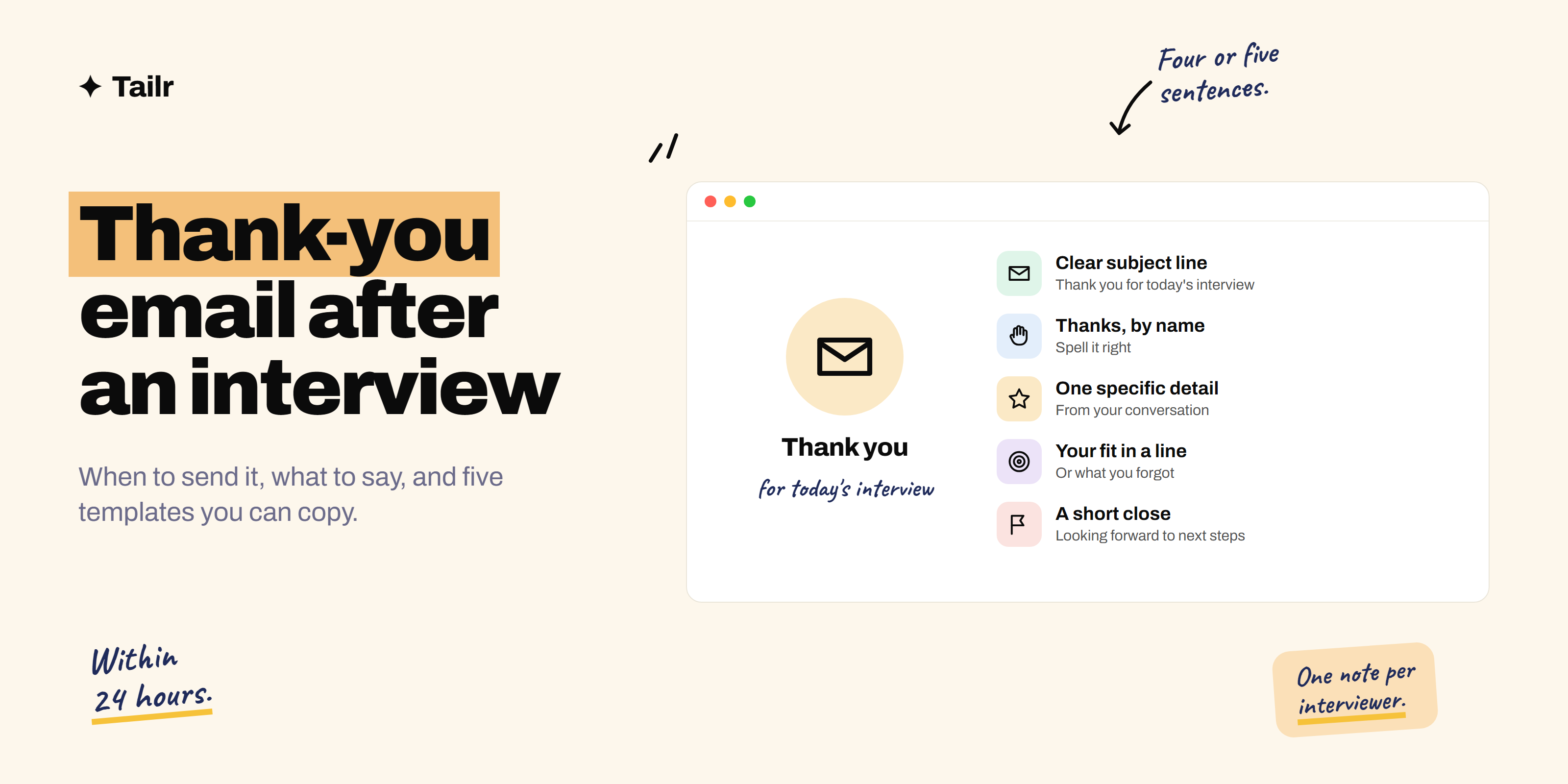
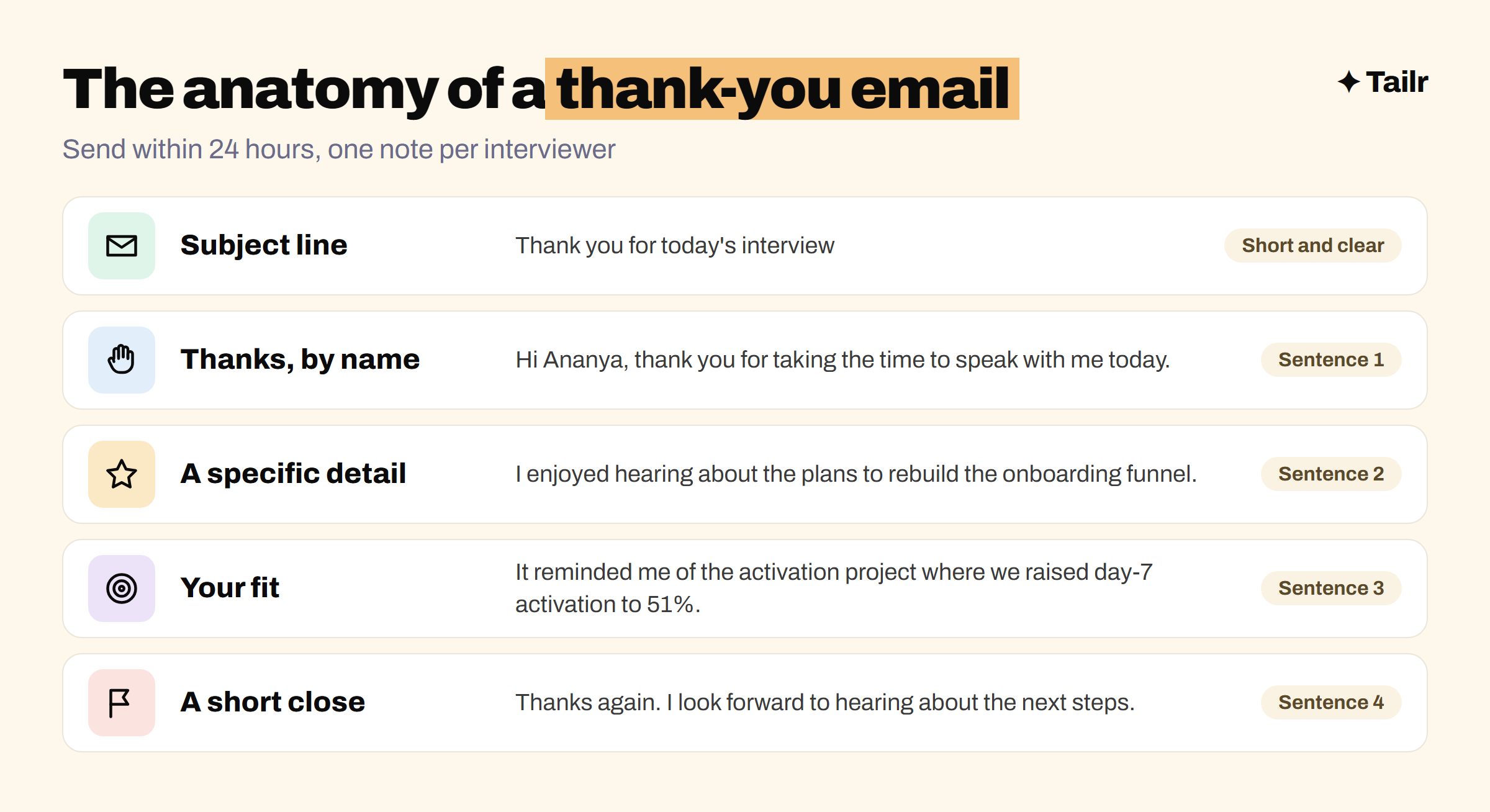
The short answer: send a thank-you email within 24 hours of the interview, to each person you spoke with, and keep it to four or five sentences:
- Thank them for their time, using their name.
- Mention one specific detail from your conversation.
- Restate your fit in one sentence, or add something you forgot to say.
- Close by saying you’re looking forward to next steps.
Use a clear subject line, proofread the names, and don’t attach anything unless asked.
Why it’s worth five minutes
- It’s expected. Many hiring managers notice when a thank-you doesn’t arrive, especially for client-facing roles.
- It keeps you memorable. After a day of interviews, a note that mentions your specific conversation helps them remember which candidate you were.
- It’s a second chance. Forgot to mention a relevant project? Gave a weak answer? A thank-you lets you add a line.
- It shows how you communicate. A clear, well-written note is a small sample of your work.
When to send it
- Within 24 hours. Same day is best.
- Morning interview: send it that afternoon.
- Late afternoon interview: the next morning is fine.
- Fast processes: if they said they’d decide today, send it within an hour or two.
Don’t send it from the lobby five minutes after you walk out. It looks automatic.
Subject lines that work
- Thank you for today’s interview
- Thank you, Product Analyst interview
- Great speaking with you today, Priya Sharma
- Following up on our conversation about the QA lead role
Or simply reply to the most recent email thread with that person, which keeps everything together.
Template 1: After a hiring manager interview
Subject: Thank you for today’s interview
Hi Ananya,
Thank you for taking the time to speak with me today about the Product Analyst role. I really enjoyed hearing about the plans to rebuild the onboarding funnel, and it made me even more excited about the role.
Our conversation reminded me of the activation project I led at my current company, where we raised day-7 activation from 34% to 51%, and I’d love to bring that experience to your team.
Thanks again, and I look forward to hearing about the next steps.
Best, Rahul Mehta
Template 2: After a phone screen with a recruiter
Subject: Thank you, Customer Success Manager role
Hi Sam,
Thanks for the call today and for walking me through the role and the interview process. It sounds like a great fit for my background in onboarding mid-market customers.
I’m available for the next round any time Tuesday to Thursday next week. Please let me know if you need anything else from me.
Best regards, Leah Thomas
Template 3: After a panel interview (send one to each person)
Subject: Thank you for today’s conversation
Hi Marcus,
Thank you for being part of my interview panel today. I especially enjoyed our discussion about how your team handles flaky tests in CI. Your quarantine approach is something I’d like to learn more about.
I’m very interested in the SDET role and in helping the team speed up its release pipeline. Thanks again for your time.
Best, Arjun Rao
Change the specific detail for each panellist. They often compare notes.
Template 4: Adding something you forgot
Subject: Thank you, and one thing I missed
Hi Elena,
Thank you for this afternoon’s interview for the Marketing Manager role. I enjoyed our conversation about expanding into the German market.
When you asked about international campaigns, I didn’t mention that I ran our launch in the Netherlands last year, which reached 18% of our first-year signup target in the first two months. I thought it was worth adding given your plans.
Thanks again, and I look forward to hearing from you.
Kind regards, Tom Fischer
Template 5: After a final round
Subject: Thank you for today
Hi David,
Thank you for meeting me today, and for the time your team has spent with me throughout this process. After meeting everyone, I’m even more sure this is the role I want. The team’s focus on reliability and the scale of the platform are exactly what I’m looking for.
Please let me know if there’s anything else I can share. I look forward to hearing from you.
Best, Mei Lin
Mistakes to avoid
- Copy-pasting the same note to everyone. Personalise one sentence per person.
- Spelling a name wrong. Check the calendar invite or email signature.
- Writing an essay. Five sentences is enough. Anything longer reads as nervous.
- Re-answering every question. Add one point, at most.
- Asking about the decision. “When will I hear back?” belongs in the interview, not the thank-you.
- Sending from an unprofessional email address. Use your name.
- Attaching your resume again. They have it, unless they asked for something.
Thank-you email vs follow-up email
A thank-you goes out within 24 hours of an interview. A follow-up goes out later, if you haven’t heard back by the date they gave you, usually a week or so after it passes. They’re different emails with different jobs. For follow-ups, see how to follow up after a job application.
Keep track of who you emailed
When you’re interviewing at several companies, it’s easy to lose track of who you’ve thanked, when you sent it and when to follow up. Tailr is a Chrome extension that tracks every application alongside the tailored resume and cover letter you sent, so you always know which version a company saw before the next round. Use the questions you asked at the end of the interview for your specific detail; our list of questions to ask at the end of an interview will give you good material.
Try TailrRelated guides
Conclusion
A thank-you email is five minutes of work that keeps you memorable and gives you one last chance to make your case. Send it within 24 hours, write a separate note to each interviewer, mention one specific detail from your conversation, and keep it to four or five sentences. Then let it go, prepare for the next round, and follow up only if the date they gave you passes.
Frequently asked questions
01Should you send a thank-you email after an interview?
Yes. It takes five minutes, it's expected by many hiring managers, and it gives you one more chance to show interest and remind them why you fit. A missing thank-you rarely loses an offer on its own, but a good one can help when the decision is close.
02How soon should you send a thank-you email after an interview?
Within 24 hours, ideally the same day. For a morning interview, send it that afternoon; for an afternoon or evening interview, the next morning is fine. If decisions are being made the same day, send it within a few hours.
03What should I say in a thank-you email after an interview?
Thank them for their time, mention one specific thing from the conversation, briefly restate why you're a good fit or add something you forgot to say, and close by saying you look forward to hearing about next steps. Keep it to four or five sentences.
04What is a good subject line for an interview thank-you email?
Keep it short and clear: 'Thank you for today's interview', 'Thank you, [Job title] interview' or 'Great speaking with you today, [Your name]'. If you're replying to an existing email thread with the recruiter or interviewer, replying in the same thread also works well.
05Should I send a thank-you email to each interviewer?
Yes. Send a separate, short email to each person you spoke with, and mention something specific from your conversation with them so the notes aren't identical. Interviewers often compare notes, and copy-pasted messages are easy to spot.
06What if I don't have the interviewer's email address?
Send your thank-you to the recruiter or coordinator and ask them to pass your thanks on, naming each interviewer. You can also find business emails in calendar invites or send a short LinkedIn message instead, though email is more professional.