How to Follow Up After a Job Application (With Email Templates)
· updated
You applied, and then nothing. It’s the most common experience in a job search, and it rarely means no: recruiters juggle dozens of roles, hiring managers get pulled into other work, and applications sit in queues. A short, well-timed follow-up can move yours to the top. A badly timed or pushy one won’t. This guide covers exactly when to follow up at each stage, who to contact, what to say, and email templates you can copy.
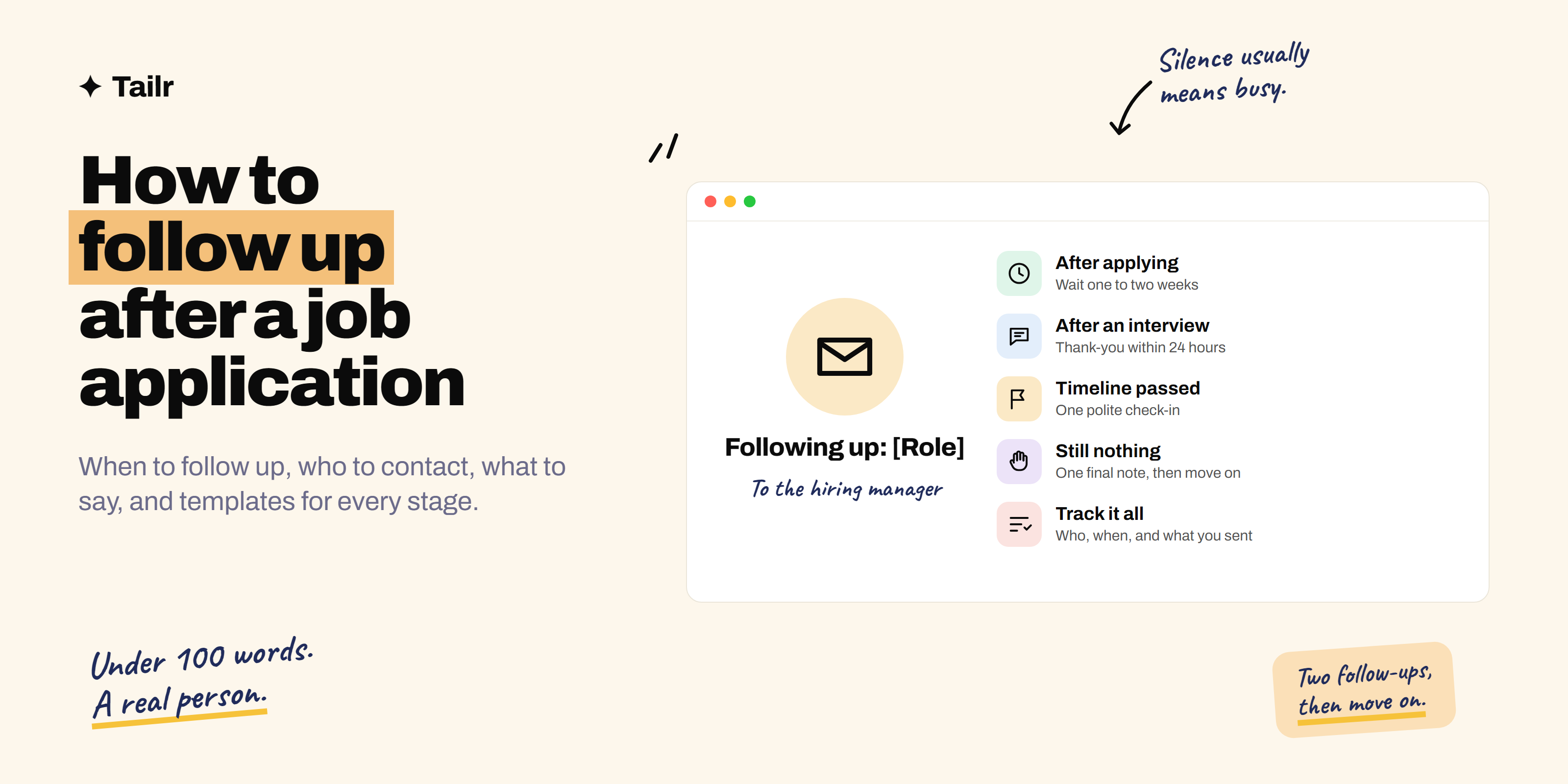
The short answer: How to follow up after a job application, stage by stage:
- After applying: wait one to two weeks (or until any timeline in the listing passes), then send one short email to the recruiter or hiring manager.
- After an interview: send a thank-you email to each interviewer within 24 hours.
- After the interview timeline passes: send one polite check-in asking about next steps.
- Still no reply: send one final follow-up about a week later, then move on.
Keep every follow-up under 100 words: the role, one specific reason you’re a fit, and a polite question. Never follow up more than twice without a response, and always track who you contacted and when.
Why following up works
- It resurfaces your application. Recruiters search their inbox before their applicant system; a follow-up puts you back in view.
- It shows interest. Between two similar candidates, the one who clearly wants the job has an edge.
- It gets you information. Even “we’ve paused hiring” is useful; it lets you move on.
- It builds a relationship. A courteous follow-up to a recruiter can lead to other roles even if this one doesn’t work out.
Stage 1: following up after you apply
When
About one to two weeks after applying. If the listing says “we’ll respond within three weeks”, wait until then. If it says “no phone calls or emails”, don’t.
Who
In order of preference:
- The hiring manager for the team (the person you’d report to).
- The recruiter for the role (often named on LinkedIn job posts).
- Someone you’ve already spoken to at the company.
Find names on the listing, the company’s LinkedIn “People” tab, or the team page. How to cold email for a job in 2026 covers how to find email addresses; how to cold message on LinkedIn covers reaching out there.
Template: follow-up after applying
Subject: Following up: [Role] application

Hi [Name],

I applied for the [Role] position on [date] and wanted to follow up.
I'm particularly excited about [specific thing about the team or product].

In my last role I [specific achievement relevant to the listing], and I
think that experience would transfer directly to [a responsibility from
the listing]. Here's a relevant project: [link]

Is there anything else I can share to help with my application?

Thanks,
[Your name]
[Phone] · [LinkedIn] · [Portfolio]
Template: second follow-up (about a week later, no reply)
Subject: Re: Following up: [Role] application

Hi [Name],

Just checking in on the [Role] role. I'm still very interested, and I
recently [new relevant thing: finished a project, earned a certification,
shipped an update]: [link].

If the role has been filled or is on hold, I'd be grateful to know,
and I'd love to be considered for similar openings.

Best,
[Your name]
Stage 2: the thank-you email after an interview
Send one to each interviewer within 24 hours. It’s short, specific and genuinely useful: it reminds them of you and lets you add anything you missed.
Template: thank-you after an interview
Subject: Thank you, [Role] interview

Hi [Name],

Thank you for taking the time to speak with me today about the [Role]
role. I especially enjoyed our conversation about [specific topic],
and it made me even more excited about [something about the team/work].

[Optional: One more thing I didn't mention: I recently [relevant example],
which relates to the [challenge] you described.]

I look forward to hearing about next steps.

Best regards,
[Your name]
Personalise each one if you met several people. Referencing something specific from each conversation makes it obvious you were listening.
Stage 3: when the interview timeline passes
If they said “you’ll hear by Friday” and it’s Tuesday, a check-in is expected and reasonable.
Template: follow-up after an interview, no response
Subject: Checking in: [Role] next steps

Hi [Name],

I hope you're well. I wanted to check in on the [Role] position, as you
mentioned the team hoped to make a decision by [date]. I'm still very
interested and happy to provide anything else that would help.

Thanks again,
[Your name]
If you have another offer
It’s fine, and useful for them, to say so honestly:
Subject: [Role]: timeline question

Hi [Name],

I've received an offer from another company and need to respond by
[date]. [Company] is my first choice, so I wanted to ask whether there's
any update on the [Role] process before then.

Thanks for understanding,
[Your name]
Only send this if it’s true. How to negotiate salary covers handling competing offers.
Stage 4: the final follow-up and moving on
After two follow-ups without a reply, stop. Send one last short note if you like, then put your energy into other applications.
Template: final follow-up
Subject: Re: [Role]

Hi [Name],

I haven't heard back, so I'll assume the team has moved forward with
other candidates. Thank you for your time, and I'd love to be considered
for future [type of] roles at [Company].

All the best,
[Your name]
This closes the loop graciously, and it’s surprisingly common to get a reply to it.
After a rejection
Reply within a day or two:
Hi [Name],

Thank you for letting me know. I enjoyed learning about the team and
would welcome the chance to be considered for future roles. If you have
any feedback on my application, I'd really appreciate it.

Best,
[Your name]
Many recruiters remember candidates who respond well to a no, and some come back when the next role opens.
Follow-up timing at a glance
| Stage | When | How many times |
|---|---|---|
| After applying | 1–2 weeks after, or after the stated timeline | Up to 2, a week apart |
| After an interview | Thank-you within 24 hours | Once per interviewer |
| After the interview timeline passes | 1–2 business days after the date they gave | Once, then once more a week later |
| After a rejection | Within 1–2 days | Once |
| With a competing offer | As soon as you know your deadline | Once |
Email or phone or LinkedIn?
- Email is the default: easy to read and reply to on their schedule.
- LinkedIn works if you can’t find an email, or the recruiter is active there. Keep it even shorter.
- Phone only if you’ve been speaking by phone already, or for small companies where it’s normal.
Follow-up mistakes to avoid
| Mistake | Fix |
|---|---|
| Following up after two days | Wait one to two weeks after applying |
| Sending to careers@ | Find the recruiter or hiring manager |
| Long emails restating your resume | Under 100 words, one specific point |
| Reattaching your resume unasked | Offer it or link your portfolio |
| Guilt-tripping (“I haven’t heard anything…”) | Friendly and forward-looking |
| Following up five times | Two follow-ups, then move on |
| Losing track of who you contacted | Log every application and follow-up date |
Keep track so nothing slips
The hardest part of following up isn’t writing the email; it’s remembering which of your 30 applications is due for one. Keep a simple log: company, role, date applied, contact, follow-up dates, status. Tailr tracks every application automatically as you tailor your resume from the job listing, so you can see what you sent, when, and to whom, and it writes a matching cover letter for each role too.
Try TailrRelated guides
Conclusion
Following up is expected, useful and easy to get right: wait one to two weeks after applying, send a short, specific note to a real person, thank interviewers within a day, check in once the stated timeline passes, and stop after two unanswered follow-ups. Keep each message under 100 words, add something new when you can, and track everything so no application falls through the cracks.
Frequently asked questions
01How long should you wait to follow up after applying for a job?
Wait about one to two weeks after applying, unless the listing gave a timeline, in which case wait until it has passed. Following up sooner rarely helps because many teams review applications in batches. If the listing says not to contact the company, respect that.
02Is it OK to follow up on a job application?
Yes, as long as it's short, polite and sent to the right person. A brief follow-up shows interest and can bring your application back to the top of a busy recruiter's list. What hurts is following up too often, too soon, or with a demanding tone.
03Who should I send a follow-up email to?
Send it to the recruiter or hiring manager if you know who they are, which you can often find on the listing, the company's LinkedIn page, or from anyone you've already spoken to. Avoid generic inboxes like careers@ or info@ if you can find a person.
04What should I say in a follow-up email after applying?
Keep it under 100 words: the role you applied for and when, one sentence on why you're a strong fit with a specific achievement or project, a link to your portfolio if relevant, and a polite question about next steps or the timeline. Don't reattach your resume unless asked.
05How many times should you follow up on a job application?
Usually twice at most: once about a week or two after applying and once more about a week later if there's no response. After that, move on and focus on other applications. For interviews, send a thank-you within a day and one follow-up after the timeline they gave you has passed.
06How do I follow up after an interview with no response?
If the date they gave you has passed, send a short, friendly email to your main contact asking whether there's an update on the timeline and restating your interest in one line. If there's still no reply after another week, send one final note, then move on while keeping the door open.