Best Tools for Product Managers in 2026
· updated
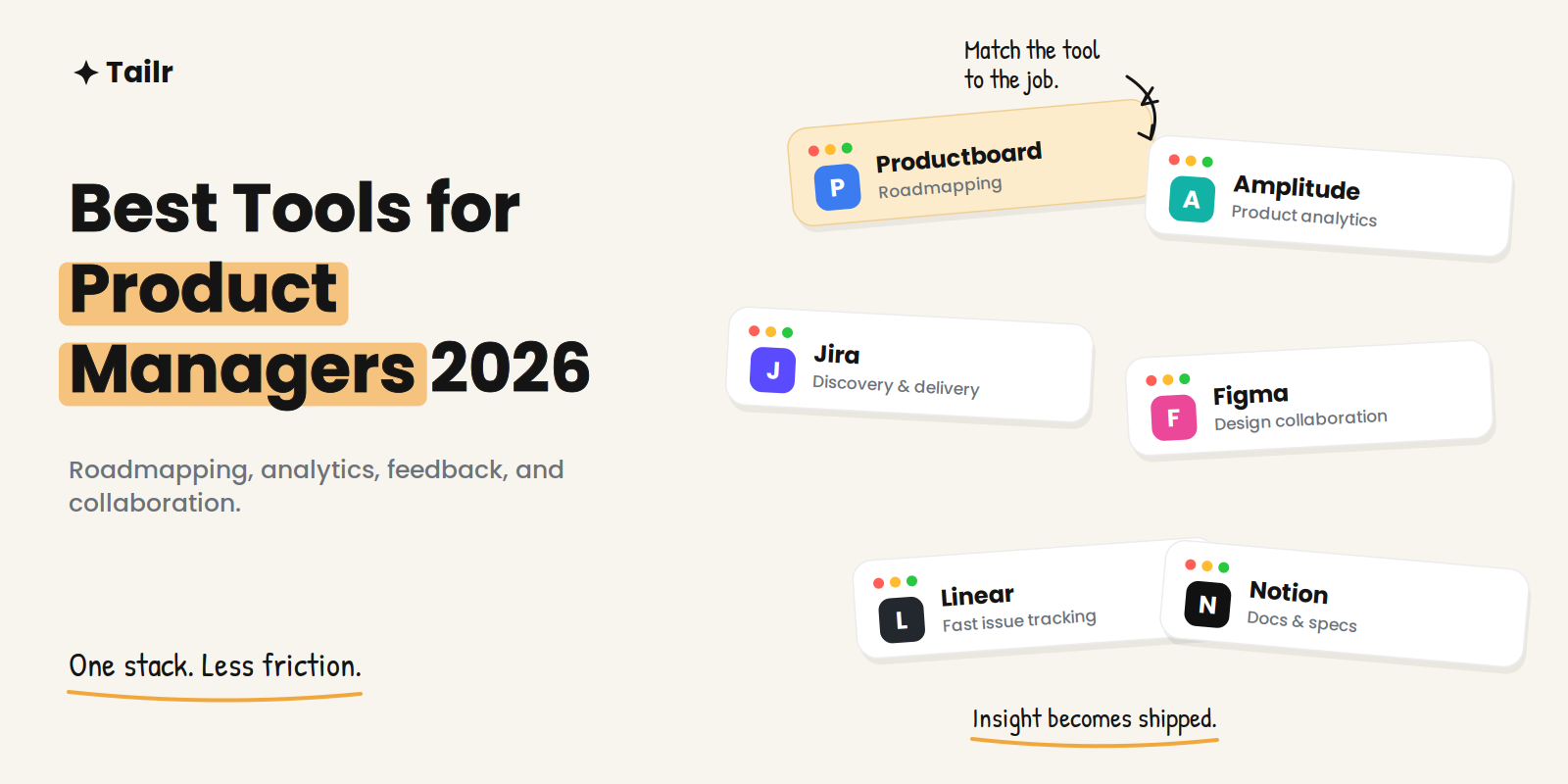
Product management spans strategy, research, analytics, roadmapping, and stakeholder communication — and no single tool covers all of it well. The PMs who ship consistently don’t chase an all-in-one platform; they assemble a small, coherent stack where each tool does one job and talks to the others. This guide breaks down the best tools for product managers in 2026 by function, so you can pick what fits your team’s size and stage.
The short answer: the best tools for product managers in 2026, by job:
- Roadmapping and discovery: Productboard, Jira Product Discovery.
- Product analytics: Amplitude, Mixpanel.
- User feedback and research: Dovetail, Canny.
- Docs and specs: Notion, Confluence.
- Whiteboarding: Miro.
- Design collaboration: Figma.
- Delivery: Linear or Jira.
Pair one tool per category and don’t add a fifth category until a real workflow demands it.
What makes a good PM tool in 2026
The best product management tools this year share three traits. They connect strategy to execution, so a prioritized idea can flow from feedback to roadmap to backlog without being re-entered three times. They integrate, because a roadmap tool that can’t pull in customer feedback is planning in the dark. And where they add AI, they build it into the actual workflow — triaging backlogs, summarizing feedback, surfacing patterns — rather than bolting on a chatbot. The value of any tool is what it lets a small team do that they couldn’t before.
One principle runs through everything below: match tools to jobs, not to hype. Over-tooling adds integration overhead, context-switching, and report-consolidation work — real costs that eat the time you were trying to save.
Roadmapping and discovery
Productboard (website: productboard.com) is the go-to dedicated roadmap tool. Its strength is workflow: it centralizes feature requests from support tickets, sales calls, and interviews, connects them to your roadmap, and helps you prioritize. It’s best for mid-size to enterprise teams with heavy feedback volume.
Jira Product Discovery (website: atlassian.com/software/jira/product-discovery) is built to bridge abstract ideas and concrete backlog items, with structured fields for scoring and prioritization. It shines when your engineering team already runs on Jira and you want a clean separation between discovery and delivery. A practical setup: pipe a Slack channel into it so stakeholders can drop ideas without breaking their flow.
Aha! (website: aha.io) suits larger organizations that need detailed strategy, goals, and portfolio-level roadmaps. It’s heavier than the other two, which is the point for enterprise product orgs juggling multiple product lines.
Product analytics
Amplitude (website: amplitude.com) is the default for data-driven product decisions — deep behavioral analytics with cohort analysis and funnels to understand how users actually move through your product. It’s the analytics tool most PM stacks are built around.
Mixpanel (website: mixpanel.com) covers similar ground with event-based tracking and a reputation for fast, real-time engagement and retention analysis without needing SQL. If you want quick answers to “did this feature move the metric,” it’s a strong pick.
PostHog (website: posthog.com) bundles analytics with session replays, feature flags, and experiments, and has a generous free tier. It’s popular with smaller, engineering-led teams who want several tools in one open platform.
User feedback and research
Dovetail (website: dovetail.com) is built for turning raw research — interview transcripts, survey responses, support notes — into organized, searchable insights. It’s the tool for teams that do real qualitative research and don’t want it to rot in a folder.
Canny (website: canny.io) captures and organizes feature requests in a public or private board, letting users vote so you can prioritize by demand. It’s a clean way to close the loop between “users asked for X” and “we shipped X.”
For synthesizing research fast, NotebookLM (website: notebooklm.google) is free and grounds its answers only in documents you upload — useful for querying a pile of customer interviews without inventing quotes.
Docs, specs, and collaboration
Notion (website: notion.so) is the flexible default for PRDs, specs, meeting notes, and lightweight roadmaps, with a genuinely usable free tier. Confluence (website: atlassian.com/software/confluence) is the heavier, more structured choice, especially if your company already runs on Atlassian. Miro (website: miro.com) is the whiteboard for story mapping, workshops, and anything that needs a shared canvas.
Design collaboration
Figma (website: figma.com) is where PMs, designers, and engineers meet. Even non-designers use it to review flows, comment on prototypes, and understand what’s being built before it’s built. It’s effectively required literacy for a modern PM.
Delivery
Linear (website: linear.app) has won a lot of product and engineering teams with fast, keyboard-driven issue tracking and AI features woven into the core — auto-triage, duplicate detection, priority suggestions. Jira (website: atlassian.com/software/jira) remains the enterprise standard for sprints and delivery at scale. Pick Linear for speed and modern feel, Jira for depth and org-wide standardization.
PM tools compared by category
| Category | Top picks | Best for |
|---|---|---|
| Roadmapping | Productboard, Jira Product Discovery, Aha! | Turning feedback into a plan |
| Analytics | Amplitude, Mixpanel, PostHog | Understanding user behavior |
| Feedback & research | Dovetail, Canny, NotebookLM | Capturing and synthesizing input |
| Docs & collaboration | Notion, Confluence, Miro | Specs, notes, and workshops |
| Design | Figma | Reviewing and building UI |
| Delivery | Linear, Jira | Shipping the work |
How to build a PM stack without over-tooling
Start from your stage. A solo or seed-stage PM realistically needs two tools: an analytics platform and one place to keep the roadmap and specs (Notion covers a surprising amount here). As the team grows, add a dedicated feedback tool when requests outgrow a spreadsheet, and a dedicated roadmap tool when prioritization becomes a real negotiation across stakeholders. The rule: add a tool when a workflow is painful, not because a listicle told you to.
Integration is the multiplier. A roadmap tool that pulls from your feedback tool, and a delivery tool that reflects what’s prioritized, turns four apps into one connected pipeline. Four disconnected apps just turn into four inboxes.
For PMs job hunting
Tools shape how you work, but landing the PM role you want is its own project — and it runs on the same skill as the job itself: matching what you offer to what’s being asked. When you’re applying for product roles, tailoring your resume to each specific job description is the highest-leverage move, because PM postings vary wildly in what they emphasize (growth vs. platform vs. zero-to-one). Tailr tailors your resume from the live job listing, generates a matching cover letter, and tracks the application, so you can apply to more of the right roles without rewriting from scratch each time. Try Tailr when you’re ready to move. For more, see the top AI tools for job search.
Related guides
- 10 Terms You Should Know Before a Product Management Interview
- RICE, MoSCoW and Kano: Prioritization Frameworks for PM Interviews
- OKRs vs KPIs: What’s the Difference?
Conclusion
The best tools for product managers in 2026 aren’t a single platform — they’re a small, well-integrated stack matched to your team’s stage. Pick one strong tool per function, wire them together, and resist adding more until a real workflow demands it. The goal isn’t the most tools; it’s the least friction between an insight and a shipped feature.
Frequently asked questions
01What tools do product managers use?
Most PMs run a small stack rather than one app: a roadmap or discovery tool, a product analytics platform, a feedback tool, and a collaboration or docs tool. A common 2026 combination is Productboard or Jira Product Discovery for roadmapping, Amplitude for analytics, Dovetail or Canny for feedback, and Notion plus Figma for docs and design.
02What is the best roadmap tool for product managers?
Productboard is the most popular dedicated choice because it links customer feedback directly to roadmap decisions. Jira Product Discovery is strong if your engineering team already lives in Jira and you want a clean separation between discovery and delivery. Aha! suits larger organizations that need detailed strategy and portfolio views.
03What is the best all-in-one product management tool?
There isn't a truly complete one, and chasing it usually leads to over-tooling. Platforms like ClickUp or Airtable can cover roadmapping and collaboration in one place, but you'll still want a dedicated analytics tool. Most effective PMs accept a small stack of specialized tools that integrate well over a single app that does everything adequately.
04What is the best free product management tool?
Notion has a genuinely useful free tier for docs, specs, and lightweight roadmaps, and NotebookLM is free for synthesizing research. Figma, Linear, and several analytics tools have free plans that work for solo PMs or small teams. You can assemble a real starter stack at no cost before deciding what to pay for.
05How many tools does a product manager need?
Fewer than most people think. A seed-stage PM often needs just a roadmap tool and an analytics platform; a PM at a larger company needs an integrated stack with shared data across teams. The common mistake is over-tooling before your processes justify it — add a tool only when a real workflow demands it.
06What is the difference between Jira and Productboard?
Jira is built for engineering execution — sprints, tickets, and delivery — while Productboard is built for discovery and prioritization, turning customer feedback into a roadmap. Many teams use both, with Productboard feeding prioritized ideas into Jira for the engineering team to build. They solve different halves of the product process.