Best AI Model to Use in Your Next Project (2026 Guide)
· updated
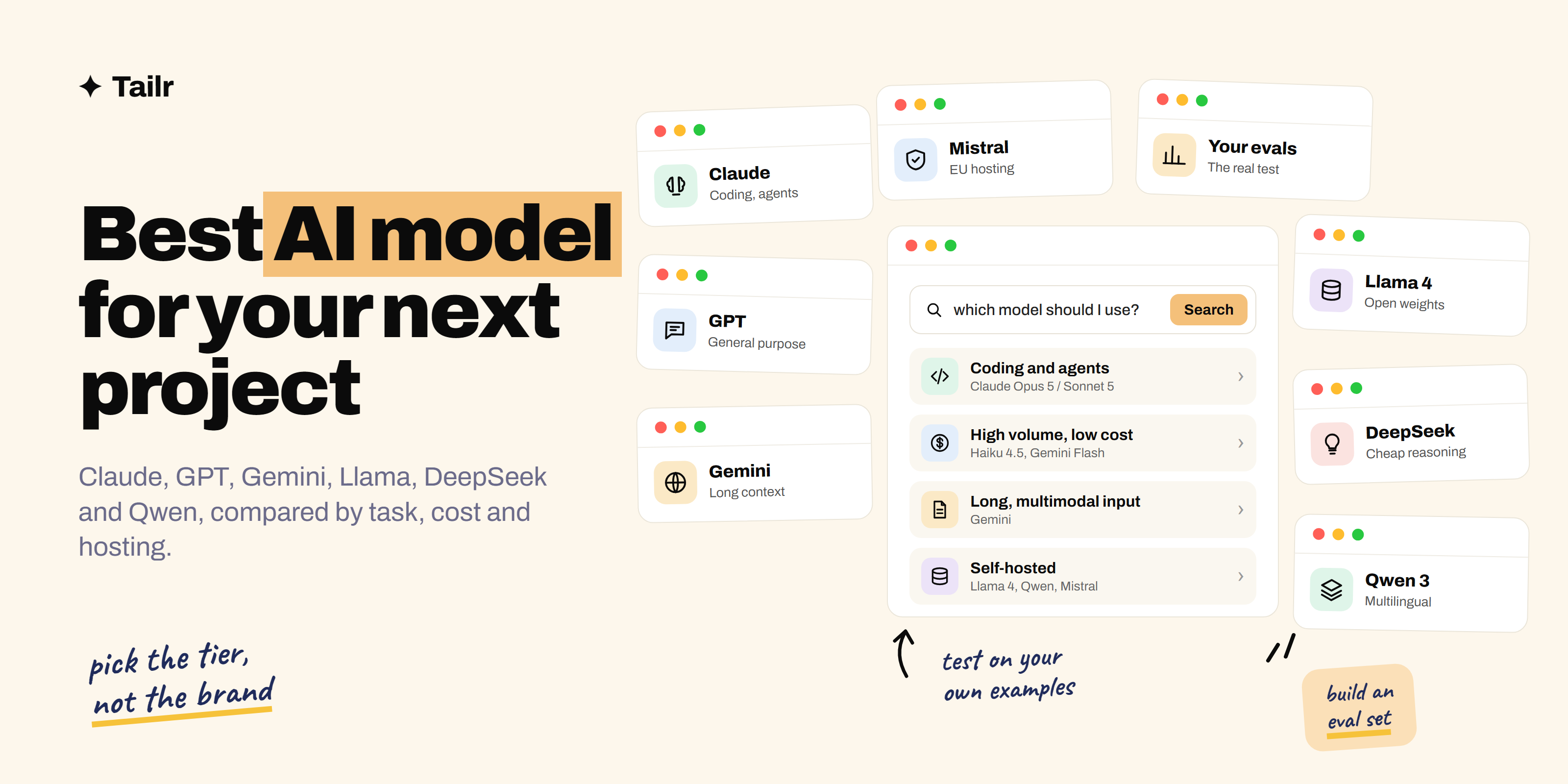
“Which model should I use?” is the first question on every AI project and the one that changes fastest. New releases land every few weeks, leaderboards reshuffle, and last quarter’s default is this quarter’s budget option. The good news is that the way you choose doesn’t change, even when the names do. This guide walks through the best AI model to use in your next project in 2026, by the job you need it to do.
The short answer: the best AI model for your next project in 2026 depends on the job:
- Coding and agents: Claude Opus 5 or Claude Sonnet 5.
- High-volume, low-cost work: Claude Haiku 4.5, Gemini Flash or an OpenAI mini model.
- Very long documents and multimodal input: Gemini.
- Broad general-purpose tasks and tool use: the GPT line.
- Open weights you can host yourself: Llama 4, DeepSeek, Qwen or Mistral.
Pick by task, cost and hosting constraints, then confirm with a small test on your own data.
Why the name matters less than you think
Every major provider now ships a family, not a model: a large tier for hard reasoning, a mid tier for everyday work, and a small tier for speed and volume. The tiers within a family differ far more than the families differ from each other. Choosing between Claude Sonnet 5 and Claude Opus 5 changes your costs by 2.5x; choosing between Sonnet 5 and its GPT or Gemini equivalent mostly changes the flavor of the output.
So the useful question isn’t “Claude or GPT?” It’s “what tier does this task need, what does it cost at my volume, and is there a constraint (data residency, fine-tuning, offline) that forces open weights?” Answer those three and the model picks itself.
Claude (Anthropic)
Website: anthropic.com
Anthropic’s current line is Claude Opus 5, Claude Sonnet 5 and Claude Haiku 4.5. Opus 5 is the model to reach for on long, multi-step coding and agent work, where it plans, uses tools and recovers from errors well. Sonnet 5 is the everyday default, close to Opus on most tasks at a fraction of the price. Haiku 4.5 is the fast, cheap tier for classification, extraction and high-volume chat.
List pricing in 2026 is $5 input and $25 output per million tokens for Opus 5, $2 and $10 for Sonnet 5, and $1 and $5 for Haiku 4.5. Opus and Sonnet take up to 1 million tokens of context, and thinking is adaptive by default, so the model decides how much to reason on each request. Claude is also available through AWS, Google Cloud and Microsoft Foundry if your stack lives there.
Best for: coding, agents, long documents, careful instruction following.
GPT (OpenAI)
Website: openai.com
OpenAI’s GPT-5 line is the broadest general-purpose family: strong writing, wide tool integrations, image and audio built in, and the largest third-party ecosystem, because so many products were built on it first. The mini and nano tiers are competitive on price with the other small models. If your project is a consumer-facing chat product with lots of integrations, or your team already knows the OpenAI tooling, it’s the low-friction choice.
Best for: general assistants, multimodal consumer products, teams with existing OpenAI experience.
Gemini (Google)
Website: ai.google.dev
Google’s Gemini 3 family stands out for very long context, native handling of video and audio, and the Flash tiers, which are among the cheapest hosted models that are still genuinely capable. If your inputs are hour-long recordings, hundreds of PDFs or a whole codebase, Gemini is where to start. It’s also the natural pick if you’re building on Google Cloud or inside Workspace.
Best for: long and multimodal inputs, cost-sensitive high volume, Google Cloud shops.
Llama (Meta)
Website: llama.com
Llama 4 is the most widely deployed open-weight family. You can download it, run it on your own hardware or a cloud GPU, fine-tune it on your data and never send a token to a third party. Quality trails the top closed models on the hardest tasks but is more than enough for most application work, and the ecosystem of tooling, quantized builds and hosting providers is the deepest of any open model.
Best for: self-hosting, fine-tuning, strict data residency.
DeepSeek and Qwen
Websites: deepseek.com, qwenlm.github.io
The Chinese open-weight labs changed the price of reasoning. DeepSeek’s V-series and R-series models deliver near-frontier reasoning at very low cost, both hosted and self-hosted, and Alibaba’s Qwen 3 models come in sizes from tiny to enormous with strong multilingual and coding results. Check your organization’s policy before using the hosted APIs, but the weights themselves are downloadable and run anywhere.
Best for: cheap reasoning, multilingual work, self-hosted coding assistants.
Mistral
Website: mistral.ai
Mistral is the European option, with a mix of open-weight and hosted models, EU data residency, and small models that punch above their size on edge and on-device deployments. If GDPR or EU hosting is a hard requirement, it’s usually the first place to look.
Best for: EU hosting, on-device and edge, compliance-driven teams.
AI models compared by use case
| Use case | First pick | Also consider |
|---|---|---|
| Coding and agents | Claude Opus 5 / Sonnet 5 | GPT-5 line, Gemini Pro |
| Everyday app backend | Claude Sonnet 5 | GPT mini, Gemini Flash |
| High-volume, low-cost | Claude Haiku 4.5 | Gemini Flash, GPT nano |
| Very long or multimodal input | Gemini | Claude (1M context) |
| Self-hosted, fine-tuned | Llama 4 | Qwen 3, Mistral |
| Cheapest reasoning | DeepSeek | Qwen 3 |
| EU data residency | Mistral | Claude via EU regions |
Choosing efficiently
Don’t start with a bake-off of six models. Start with the mid tier of whichever provider is easiest for you to access, build the feature, and write down 20 to 50 real examples of inputs and the outputs you’d want. That set is worth more than the model choice, because it lets you measure. Once it exists, swapping the model name and re-running takes minutes, and you’ll see quickly whether the big tier is worth 2 to 5x the cost or the small tier is good enough.
Two more habits save money. Cache the parts of your prompt that don’t change, since every major provider discounts repeated context heavily. And use a reasoning effort or thinking setting where the API offers one, turning it up for the hard requests and down for the routine ones, instead of paying for maximum reasoning on every call.
If you’re newer to this, our AI 101 explainer covers how these models work underneath, and the guide to context engineering vs. prompt engineering covers the part that matters more than model choice: what you put in the prompt.
For developers job hunting
Model choice has become an interview question. Postings for AI engineer and full-stack roles increasingly name specific families (“experience with Claude or GPT APIs”, “deployed open-weight models”, “built evals”), and a resume that says “worked with LLMs” won’t match any of them. Tailr reads the job listing you’re on and tailors your resume to it, so the models, evals and deployments that posting asks for are what a recruiter sees first, then writes a matching cover letter and tracks the application. Try Tailr if you’re applying to several AI roles, and read what an AI engineer does if you’re deciding whether that’s the path.
Conclusion
The best AI model for your next project in 2026 is the one that fits the task tier, the budget and the hosting rule, and you can only be sure once you’ve measured it on your own examples. Default to a mid-tier hosted model, build an eval set early, keep the model name in one place in your code, and upgrade or downgrade with evidence. The leaderboard will look different in three months. Your test set will still be right.
Frequently asked questions
01Which AI model is best for coding in 2026?
Anthropic's Claude models are the most common pick for coding and agentic work in 2026, with Claude Opus 5 for hard, multi-step tasks and Claude Sonnet 5 as the everyday workhorse. OpenAI's GPT line and Google's Gemini are close on many benchmarks, so the right answer is to run your own real tasks through two or three and compare, rather than trust a leaderboard.
02What is the cheapest AI model that's still good?
For hosted models, the small tiers are the value picks: Claude Haiku 4.5, Google's Gemini Flash models and OpenAI's mini models all cost a few dollars per million tokens or less. If you can self-host, open-weight models like Llama 4, DeepSeek and Qwen bring the per-token cost down further, at the price of running the infrastructure yourself.
03Should I use an open-source or closed AI model?
Use a hosted closed model unless you have a specific reason not to. Open-weight models like Llama, DeepSeek, Qwen and Mistral make sense when data can't leave your servers, when you need to fine-tune, or when volume is high enough that self-hosting beats API pricing. For most projects, the closed models are better, faster to start with and cheaper once you count engineering time.
04What does context window mean and how much do I need?
The context window is how much text the model can read in one request, measured in tokens. Current Claude models take up to 1 million tokens, roughly 750,000 words, and the leading GPT and Gemini models are in the same range. Most chat and extraction tasks use a few thousand tokens; you only need the big windows for whole codebases, long documents or long-running agents.
05How do I test which AI model is best for my use case?
Collect 20 to 50 real examples of the task with the answer you'd want, run each candidate model on them with the same prompt, and score the outputs. Track cost and latency alongside quality. This takes an afternoon and tells you more than any benchmark, because benchmarks measure someone else's task.
06Can I switch AI models later?
Yes, if you plan for it. Keep your prompts, tool definitions and evaluation set in your own code rather than tied to one provider's features, and route calls through a single module so the model name lives in one place. Teams that do this swap models in a day; teams that don't spend weeks untangling provider-specific quirks.