Best LLM Evaluation and Observability Tools in 2026
· updated
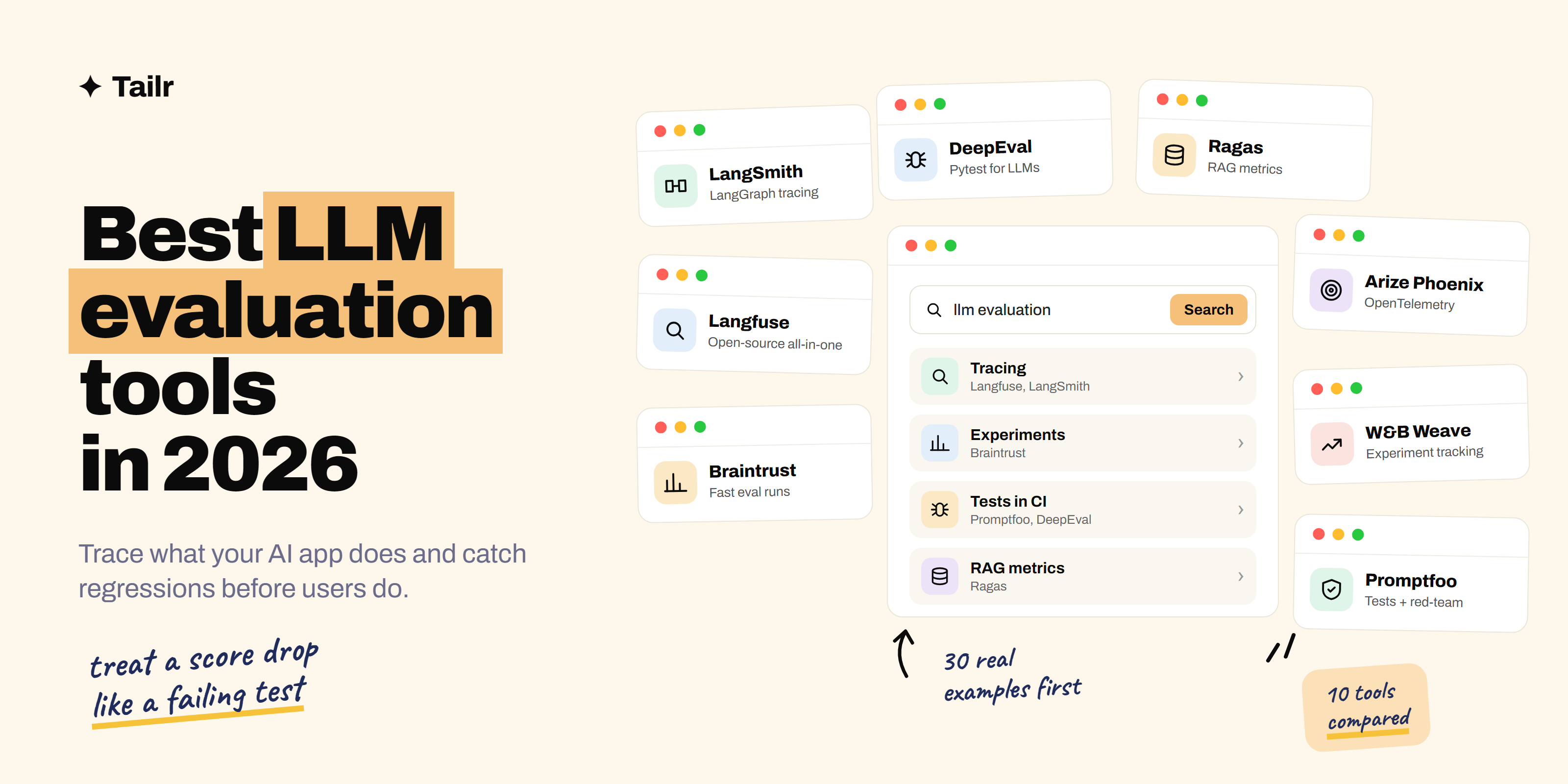
Building a demo with a language model takes an afternoon. Knowing whether it works, and whether it still works after you change the prompt, takes real tooling. That’s what LLM evaluation and observability tools are for: they record what your app does, test it against examples you care about and show you when a change makes things worse. In 2026 this is a standard part of the AI engineering stack, not an extra.
The short answer: the best LLM evaluation and observability tools in 2026 are:
- LangSmith: tracing and evals from the LangChain team, built for LangGraph apps.
- Langfuse: the leading open-source platform for tracing, prompts and evals.
- Braintrust: fast eval experiments and prompt comparison for product teams.
- Arize Phoenix: open-source tracing and evals built on OpenTelemetry.
- W&B Weave: tracing and evals from Weights & Biases.
- Promptfoo: a command-line tool for testing prompts and red-teaming apps.
- DeepEval: a Python testing framework for LLM apps, like pytest for AI.
- Ragas: metrics built specifically for evaluating RAG systems.
- Opik: Comet’s open-source tracing and evaluation platform.
- Helicone: a one-line proxy for logging costs and requests.
Most teams pick one platform for tracing and evals (Langfuse, LangSmith or Braintrust) and one code framework for tests in CI (Promptfoo or DeepEval).
Why evals matter
Language models don’t fail like normal code. A prompt tweak that fixes one answer can quietly break ten others. Without evals, you only find out when a user complains. With them, you get a score before you ship.
A good setup has three parts:
- Tracing: a record of every request, including prompts, responses, tool calls, cost and latency.
- Datasets: a set of real inputs, ideally pulled from production traces, with the answers or behavior you expect.
- Scorers: checks that grade each output. These can be exact rules (“contains a valid JSON object”), comparisons to a reference answer, or another model acting as a judge.
What to look for
- Open source or hosted. Self-hosting keeps sensitive data in your own systems; hosted saves setup.
- Framework support. Check that it works with your stack, whether that’s LangGraph, the OpenAI or Claude SDKs, LlamaIndex or plain API calls. OpenTelemetry support makes switching easier.
- Eval workflow. Can non-engineers review outputs and add examples? Can you run evals in CI?
- Cost tracking. Token costs add up quickly. Seeing them per feature and per user is useful.
1. LangSmith
Website: smith.langchain.com
LangSmith, from the team behind LangChain and LangGraph, traces every step of your app, lets you build datasets from real traces and runs evaluations with custom or model-based scorers. It works with any framework, but if you build with LangGraph, it’s the most seamless option. Annotation queues let teammates review and label outputs.
Why use it:
- Deepest integration with LangChain and LangGraph
- Turn production traces into eval datasets in a few clicks
- Human review queues for labeling outputs
Best for: teams building with LangChain or LangGraph.
2. Langfuse
Website: langfuse.com
Langfuse is the most popular open-source LLM engineering platform, covering tracing, prompt management, evaluations and cost tracking. You can self-host it or use the cloud version. It joined ClickHouse in early 2026 and has said it will stay open source and self-hostable. It works with most frameworks and supports OpenTelemetry.
Why use it:
- Open source and self-hostable
- Tracing, prompts and evals in one place
- Works with almost every framework
Best for: teams who want an open-source, all-in-one platform.
3. Braintrust
Website: braintrust.dev
Braintrust is built around running evals fast. You compare prompts and models side by side, see exactly which examples got better or worse, and track scores over time. It also handles logging and tracing in production, and its playground makes it easy for product managers to test prompts without code.
Why use it:
- Quick side-by-side comparisons of prompts and models
- Clear view of which examples improved or regressed
- Friendly for non-engineers on the team
Best for: product teams iterating on prompts quickly.
4. Arize Phoenix
Website: phoenix.arize.com
Phoenix is Arize’s open-source tool for tracing and evaluating LLM apps, built on OpenTelemetry. It runs locally or self-hosted, includes ready-made evaluators for things like relevance and hallucination, and is especially handy for debugging retrieval in RAG apps. Arize’s commercial platform adds enterprise features.
Why use it:
- Open source and built on open standards
- Good tools for debugging retrieval
- Runs in a notebook or on your own servers
Best for: teams who want open standards and RAG debugging.
5. W&B Weave
Website: wandb.ai
Weave is Weights & Biases’ toolkit for tracing and evaluating LLM apps. If your team already uses W&B for machine learning experiments, Weave brings the same habits, logging, comparing and versioning, to prompts and agents.
Why use it:
- Familiar to teams already on Weights & Biases
- Tracing, evals and version tracking
- Easy to add to Python code
Best for: ML teams moving into LLM apps.
6. Promptfoo
Website: promptfoo.dev
Promptfoo is an open-source command-line tool for testing prompts, models and apps. You write test cases in a simple config file, run them against several models at once and see results in a table. It’s also widely used for red-teaming, scanning apps for security problems like prompt injection. OpenAI announced it was acquiring Promptfoo in March 2026 and said it would keep the open-source tool going.
Why use it:
- Simple config-file test cases
- Compare several models in one run
- Built-in security and red-team testing
Best for: testing prompts in CI and checking apps for security issues.
7. DeepEval
Website: deepeval.com
DeepEval is an open-source Python framework that works like pytest for LLM apps. You write test cases in Python and use built-in metrics for things like answer relevance, faithfulness and hallucination, then run them in your CI pipeline. Confident AI, from the same team, adds a hosted dashboard.
Why use it:
- Tests feel like normal Python unit tests
- Many ready-made metrics
- Easy to add to CI
Best for: Python developers who want evals in their test suite.
8. Ragas
Website: ragas.io
Ragas is an open-source library focused on evaluating retrieval-augmented generation. Its metrics separate the two halves of a RAG system: did retrieval find the right context, and did the model use it faithfully? It can also generate test questions from your documents.
Why use it:
- Metrics designed specifically for RAG
- Separates retrieval problems from answer problems
- Generates test data from your documents
Best for: anyone building or tuning a RAG system.
9. Opik
Website: comet.com/site/products/opik
Opik is Comet’s open-source platform for tracing, evaluating and monitoring LLM apps. It covers the same ground as Langfuse and Phoenix, with built-in evaluation metrics and integrations with the major frameworks, and you can self-host it or use Comet’s cloud.
Why use it:
- Open source with a hosted option
- Tracing and evals together
- Good framework integrations
Best for: teams comparing open-source platforms.
10. Helicone
Website: helicone.ai
Helicone works as a proxy: change one line (your API base URL) and every request gets logged with cost, latency and usage. It’s the fastest way to see what your app is spending. Mintlify acquired Helicone in March 2026, and the team has said the product will keep receiving security fixes and new model support, so check its status before building heavily on it.
Why use it:
- One-line setup
- Clear view of costs and usage
- Caching and routing across providers
Best for: quick cost and usage logging.
LLM evaluation tools compared
| Tool | Open source? | Strongest at | Best for |
|---|---|---|---|
| LangSmith | No | LangChain integration | LangGraph apps |
| Langfuse | Yes | All-in-one, self-hostable | Most teams |
| Braintrust | No | Fast eval experiments | Product teams |
| Arize Phoenix | Yes | Open standards, RAG debugging | OpenTelemetry users |
| W&B Weave | No | ML-style experiment tracking | W&B teams |
| Promptfoo | Yes | Prompt tests and red-teaming | CI and security |
| DeepEval | Yes | Pytest-style tests | Python developers |
| Ragas | Yes | RAG metrics | RAG systems |
| Opik | Yes | Tracing and evals | Open-source alternative |
| Helicone | Yes | One-line cost logging | Quick visibility |
How to start evaluating your LLM app
- Add tracing first. You can’t evaluate what you can’t see. Pick a platform and log every request.
- Collect 30 real examples. Pull them from traces, including the ones that went wrong. That’s your first dataset.
- Write simple checks before fancy ones. “Is it valid JSON?” and “Does it mention the right product?” catch a lot.
- Use a model judge for fuzzy qualities. For tone or helpfulness, write clear grading instructions and spot-check the judge against your own ratings.
- Run evals on every change. Treat a drop in score like a failing test.
Building agents? See the best AI agent frameworks, and for the full stack, the best tools for building AI apps.
Evals are a hiring signal
“Built an eval suite that caught a 15% drop in answer accuracy before release” tells a hiring manager you can ship AI that works, not just demos. It’s one of the strongest lines an AI engineer can have on a resume. Different roles name different tools, so Tailr tailors your resume to the job listing you’re viewing, putting the evaluation and tracing experience that role asks for up front.
Apply to AI engineering roles faster
Try Tailr to tailor your resume, write a cover letter and track every application. To understand the role itself, read what an AI engineer does.
Conclusion
The best LLM evaluation and observability tools in 2026 cover two jobs: watching what your app does in production and testing it before every change. Langfuse is the best open-source all-rounder, LangSmith fits LangChain teams, and Braintrust is great for fast experiments. Add Promptfoo or DeepEval for tests in CI and Ragas if you’re building RAG. Start with tracing and a small set of real examples, and you’ll catch problems before your users do.
Frequently asked questions
01What is the best LLM evaluation tool in 2026?
Langfuse is the best open-source pick for tracing and evaluation together, and LangSmith is the natural choice if you build with LangChain or LangGraph. Braintrust is strong for teams that run lots of evals and prompt experiments. For tests in code, Promptfoo and DeepEval are the most popular open-source frameworks.
02What is LLM evaluation?
LLM evaluation is measuring how well a language model or AI app does its job, using a set of test inputs and checks on the outputs. Checks can be simple rules, comparisons to a correct answer, or another model grading the response. It tells you whether a change made your app better or worse.
03What is LLM observability?
LLM observability means recording what your AI app does in production: every prompt, response, tool call, cost and delay. It lets you debug bad answers, spot slow or expensive steps and find real examples to add to your evaluation sets.
04What is the difference between LLM evaluation and observability?
Evaluation tests your app against known examples before and after changes, like unit tests. Observability watches what happens with real users in production. Most teams need both, which is why many tools in this list do tracing and evals together.
05Are there free LLM evaluation tools?
Yes. Langfuse, Arize Phoenix, Promptfoo, DeepEval, Ragas and Opik are open source and free to run yourself. LangSmith, Braintrust and W&B Weave have free plans for individuals and small projects.
06What is LLM-as-a-judge?
LLM-as-a-judge means using a language model to grade another model's output against criteria like accuracy, relevance or tone. It's useful when there's no single correct answer. It works best with clear grading instructions and a check against human ratings on a sample.