Best AI Agent Frameworks in 2026
· updated
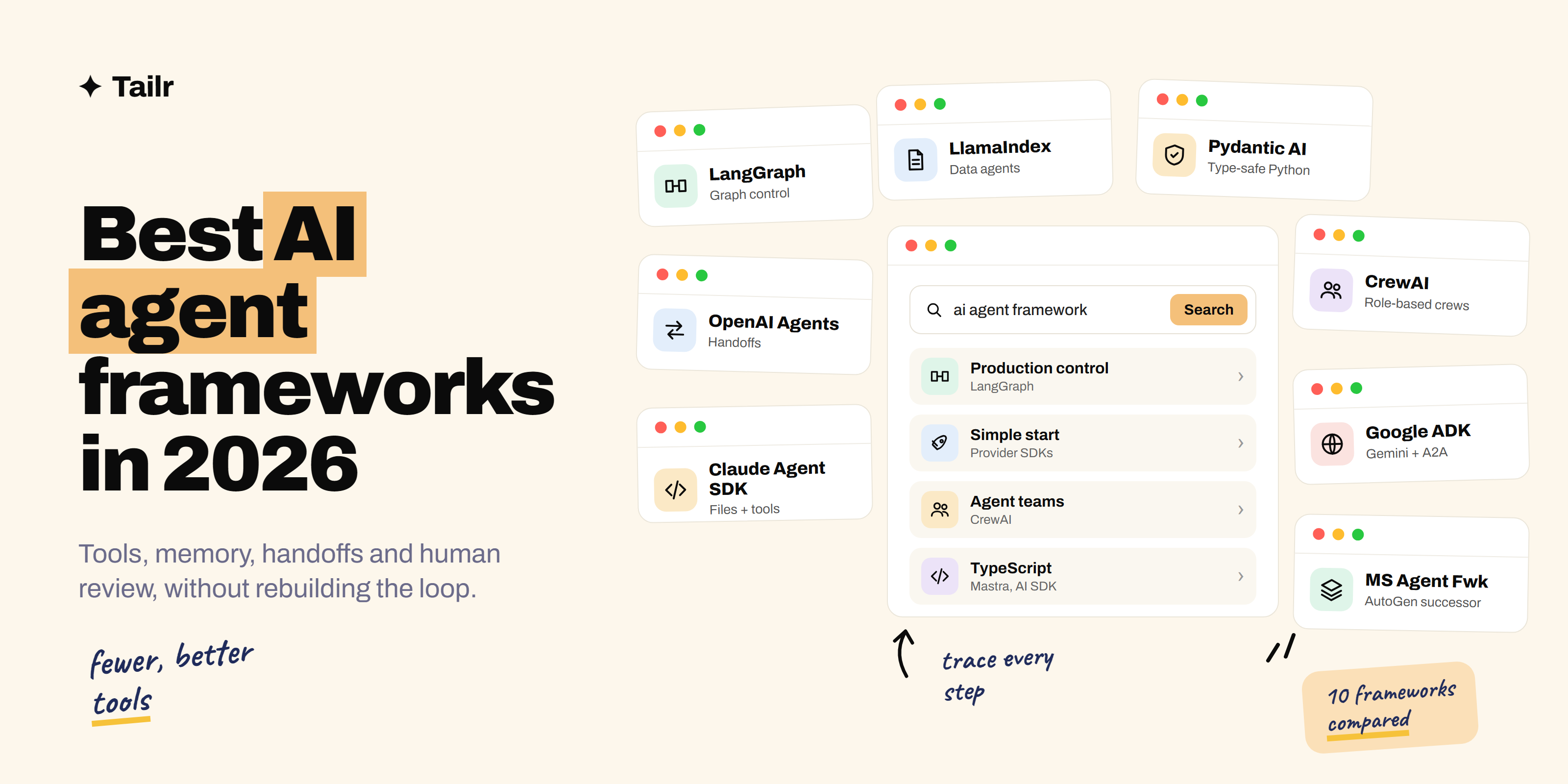
An AI agent is a model that can take actions: call tools, look things up, write files, hand work to another agent and keep going until the job is done. You can build one from scratch with a loop and some API calls, but once you need memory, error recovery, human approval or several agents working together, a framework saves a lot of time. The tricky part in 2026 is that there are a lot of them, and they’re built on very different ideas.
The short answer: the best AI agent frameworks in 2026 are:
- LangGraph: graph-based control for production agents with state and human review.
- OpenAI Agents SDK: a lightweight way to build agents with handoffs and guardrails.
- Claude Agent SDK: the agent loop behind Claude Code, ready to build on.
- CrewAI: role-based teams of agents you can set up quickly.
- Google ADK: Google’s Agent Development Kit, built for Gemini and Google Cloud.
- Microsoft Agent Framework: the successor to AutoGen and Semantic Kernel.
- LlamaIndex: agents built around your documents and data.
- Pydantic AI: type-safe agents for Python developers.
- Mastra: a TypeScript framework for agents and workflows.
- Vercel AI SDK: agents and tool calling for web apps in TypeScript.
Start with your model provider’s SDK for a simple agent, and move to LangGraph when you need more control. Use CrewAI for fast multi-agent prototypes and Mastra or the Vercel AI SDK if you work in TypeScript.
If agents are new to you, start with what an AI agent is and what MCP is, since MCP is how most of these frameworks connect agents to tools.
What a framework actually gives you
Every agent framework handles some mix of these:
- The agent loop: call the model, run the tools it asks for, feed the results back, repeat.
- Tools: a clean way to define functions the model can call, and often MCP support for ready-made tools.
- State and memory: what the agent remembers within a task and across sessions.
- Multi-agent coordination: handing a task from one agent to another, or running several in parallel.
- Human in the loop: pausing for approval before the agent does something risky.
- Tracing: a record of every step so you can see why the agent did what it did.
How to choose
- Your language. Most frameworks are Python-first. If your team writes TypeScript, look at Mastra or the Vercel AI SDK.
- Your model provider. Provider SDKs are the simplest path if you’re committed to one model family. Model-agnostic frameworks give you room to switch.
- How much control you need. Simple agents need little structure. Agents that touch money, customers or production systems need explicit steps, checkpoints and approvals.
- Your cloud. Google ADK fits Google Cloud; Microsoft Agent Framework fits Azure and .NET.
1. LangGraph
Website: langchain.com/langgraph
LangGraph, from the LangChain team, models an agent as a graph of steps. You define exactly how work flows, where the agent can loop, where it should stop for human approval, and what state it carries along. It saves progress so long-running agents can resume after a failure. It takes more code than simpler frameworks, but that control is why it’s so common in production. It pairs with LangSmith for tracing and evaluation.
Why use it:
- Precise control over each step and branch
- Built-in persistence, memory and human approval
- Works with any model provider
Best for: production agents that need to be reliable and auditable.
2. OpenAI Agents SDK
Website: openai.github.io/openai-agents-python
OpenAI’s Agents SDK is a small, focused library with a few core ideas: agents, tools, handoffs between agents, and guardrails that check inputs and outputs. Tracing is built in. It’s available in Python and TypeScript and, while designed around OpenAI models, can work with others.
Why use it:
- Very little code to get a working agent
- Handoffs and guardrails built in
- Built-in tracing
Best for: teams building on OpenAI models who want a simple start.
3. Claude Agent SDK
Website: docs.claude.com
The Claude Agent SDK gives you the same agent loop that powers Claude Code: reading and writing files, running commands, searching, managing context over long tasks and connecting to tools through MCP. It’s available in Python and TypeScript. It’s a strong starting point for agents that do real work on a computer, such as coding, research or operations tasks.
Why use it:
- A proven agent loop, the one behind Claude Code
- Strong file, command and tool support out of the box
- First-class MCP support
Best for: agents that work with files, code and long, multi-step tasks.
4. CrewAI
Website: crewai.com
CrewAI lets you describe a “crew” of agents, each with a role, a goal and tools, such as a researcher, a writer and an editor, and assign them tasks. That mental model makes it fast to get a multi-agent prototype working. It also has “flows” for more structured, step-by-step pipelines.
Why use it:
- Intuitive role-based setup
- Quick multi-agent prototypes
- Flows for more controlled pipelines
Best for: prototyping multi-agent ideas quickly.
5. Google ADK
Website: google.github.io/adk-docs
Google’s Agent Development Kit is an open-source framework for building agents, optimized for Gemini but usable with other models. It supports multi-agent setups, has a local dev UI for testing, supports the Agent2Agent (A2A) protocol for agents talking to each other, and deploys to Google Cloud’s Vertex AI.
Why use it:
- Tight fit with Gemini and Google Cloud
- Multi-agent and A2A support
- Local dev UI for testing agents
Best for: teams on Google Cloud.
6. Microsoft Agent Framework
Website: learn.microsoft.com/agent-framework
Microsoft combined AutoGen (its research framework for multi-agent conversations) and Semantic Kernel (its enterprise SDK) into the Microsoft Agent Framework. It supports Python and .NET, multi-agent workflows, and Azure integration, and it’s Microsoft’s recommended path going forward.
Why use it:
- Python and .NET support
- Brings AutoGen’s multi-agent ideas into an enterprise SDK
- Fits Azure and Microsoft 365
Best for: Microsoft and .NET shops.
7. LlamaIndex
Website: llamaindex.ai
LlamaIndex started as the go-to library for connecting language models to your data, and it’s grown into a full agent framework. Its strength is still data: loading documents, indexing them and building agents that search and reason over them. Its workflows let you build event-driven, multi-step agents.
Why use it:
- Best-in-class tools for working with documents
- Agents that search and reason over your data
- Large library of data connectors
Best for: agents built around documents and knowledge bases.
8. Pydantic AI
Website: ai.pydantic.dev
Pydantic AI, from the team behind the Pydantic validation library, brings type safety to agents. You define tools and outputs with Python types, and the framework validates everything, which catches a lot of errors before they reach production. It’s model-agnostic and feels natural to Python developers who use FastAPI.
Why use it:
- Type-checked tools and structured outputs
- Works with many model providers
- Familiar to FastAPI and Pydantic users
Best for: Python developers who want clean, reliable code.
9. Mastra
Website: mastra.ai
Mastra is an open-source TypeScript framework for agents, workflows, memory and evaluations. It gives JavaScript developers the kind of complete toolkit Python developers have had, with a local playground to test agents and easy deployment.
Why use it:
- TypeScript-native agents and workflows
- Memory, evals and tracing included
- Local playground for testing
Best for: TypeScript teams building agents into their products.
10. Vercel AI SDK
Website: ai-sdk.dev
The Vercel AI SDK is a TypeScript library for building AI features into web apps, including streaming chat, tool calling and agent loops. It works with most model providers through one interface and plugs straight into frameworks like Next.js. It’s less of a full agent platform than Mastra, but it’s often the quickest way to put an agent in front of users.
Why use it:
- One API across many model providers
- Streaming UI and tool calling for web apps
- Easy to add to Next.js and React projects
Best for: web developers adding agents to an app.
AI agent frameworks compared
| Framework | Language | Model support | Best for |
|---|---|---|---|
| LangGraph | Python, TS | Any | Production control |
| OpenAI Agents SDK | Python, TS | OpenAI first | Simple OpenAI agents |
| Claude Agent SDK | Python, TS | Claude | File and code agents |
| CrewAI | Python | Any | Role-based prototypes |
| Google ADK | Python, Java and more | Gemini first | Google Cloud |
| Microsoft Agent Framework | Python, .NET | Any | Azure and .NET |
| LlamaIndex | Python, TS | Any | Data-heavy agents |
| Pydantic AI | Python | Any | Type-safe Python |
| Mastra | TS | Any | TypeScript teams |
| Vercel AI SDK | TS | Any | Agents in web apps |
Tips for building agents that work
- Start without a framework. Build one simple loop by hand once. You’ll understand what every framework is doing for you.
- Give agents fewer, better tools. Five clear tools beat twenty vague ones. Write tool descriptions like you’re explaining them to a new hire.
- Trace everything. When an agent goes wrong, you need to see each step. Pair your framework with a tracing tool from our list of the best LLM evaluation and observability tools.
- Add human approval for risky actions. Sending emails, spending money or deleting data should pause for a person.
- Evaluate with real tasks. Collect 20 to 50 real examples and check how often the agent gets them right before and after every change.
For the wider stack, including vector databases and model APIs, see the best tools for building AI apps.
Put your agent projects on your resume
AI engineering roles often ask for one specific framework: “experience with LangGraph,” “built agents with the OpenAI Agents SDK.” If you’ve built with one, say so, with a result: “Built a LangGraph support agent that resolved 40% of tickets without escalation.” Tailr tailors your resume to the job listing you’re viewing, so the framework and projects each role asks for come first.
Apply to AI roles faster
Try Tailr to tailor your resume, write a cover letter and track every application. Prepping for interviews? See our AI engineer interview questions.
Conclusion
The best AI agent framework in 2026 depends on your language, your model provider and how much control you need. LangGraph leads for production agents, the OpenAI Agents SDK and Claude Agent SDK are the simplest ways to build on those models, and CrewAI is the fastest way to prototype a team of agents. Google ADK and Microsoft Agent Framework fit their clouds, and Mastra and the Vercel AI SDK serve TypeScript developers. Pick one, build something real, and trace every step.
Frequently asked questions
01What is the best AI agent framework in 2026?
LangGraph is the most popular choice for production agents that need control over each step, memory and human approval. The OpenAI Agents SDK and Claude Agent SDK are the simplest ways to build agents on those companies' models, and CrewAI is the quickest way to prototype a team of agents with different roles.
02What is an AI agent framework?
An AI agent framework is a library that handles the plumbing of building agents: calling a model in a loop, giving it tools, keeping memory, handing work between agents and recovering from errors. It lets you focus on what the agent should do instead of rebuilding that loop yourself.
03Do I need a framework to build an AI agent?
No. A simple agent is just a loop that calls a model, runs any tools it asks for and feeds the results back. Many teams start without a framework and add one when they need features like persistence, multi-agent handoffs, tracing or human review.
04LangGraph vs CrewAI: which is better?
LangGraph is better when you need precise control over each step, reliable state and production features. CrewAI is better when you want to set up several role-based agents quickly with less code. Many teams prototype in CrewAI and build production systems in LangGraph.
05What happened to AutoGen?
Microsoft combined AutoGen and Semantic Kernel into the Microsoft Agent Framework, which is now its recommended way to build agents in Python and .NET. AutoGen still exists as a project, but new Microsoft-focused work is moving to the Agent Framework.
06Which AI agent framework should I learn for a job?
LangGraph shows up in the most AI engineering job listings, so it's a safe first pick. After that, learn the agent SDK for the model provider your target companies use, and understand MCP, since most frameworks now use it to connect agents to tools.