Types of API Testing and Where Each One Is Used
· updated
An API is how one piece of software asks another for data or tells it to do something. Your banking app asks the bank’s servers for your balance. A checkout page asks a payment provider to charge your card. When those conversations break, everything on top of them breaks too, which is why API testing is one of the most in-demand skills in QA.
But “API testing” isn’t one thing. Checking that an endpoint returns the right data is a different job from checking that it survives 10,000 users at once, or that a stranger can’t read your account. Here are the types, what each one checks, and where you’ll see them used.
The short answer: the main types of API testing are:
- Functional testing: does each endpoint do what it should?
- Integration testing: do the API and the services behind it work together?
- Contract testing: do the API and its consumers agree on the data format?
- End-to-end testing: does a full user journey work across several API calls?
- Load and performance testing: is it fast enough, and does it hold up under heavy traffic?
- Security testing: can someone access or change data they shouldn’t?
- Negative and fuzz testing: what happens with bad, missing or random input?
- Schema validation: do responses match the documented structure?
- Regression testing: did a new change break something that used to work?
- Smoke testing: is the API up and basically working after a deploy?
- Monitoring: is the live API still working right now?
New to the topic? Start with our guide to what API testing is, then come back here.
1. Functional testing
Functional testing checks that a single endpoint does what its specification says. You send a request and check the status code, the response body and any side effects.
Example: GET /users/42 should return status 200 and the user with ID 42. POST /users with a valid email should create the user and return 201.
Where it’s used: everywhere. It’s the first type of API test any team writes, and it covers every endpoint in every product, from a startup’s login service to a bank’s account API.
Tools: Postman, Bruno, pytest with requests, REST Assured.
2. Integration testing
Integration testing checks that your API works with the things it depends on: databases, other internal services, third-party APIs and message queues.
Example: placing an order through POST /orders should reserve stock in the inventory service, charge the card through the payment service and write the order to the database. An integration test checks that all three actually happen.
Where it’s used: e-commerce checkouts, booking systems, logistics platforms and any product where one action triggers work across several systems.
Tools: the same tools as functional testing, plus test containers or staging environments with real dependencies.
3. Contract testing
Contract testing checks that an API and the apps that call it (its consumers) agree on the shape of requests and responses. Each consumer records what it expects, and the API is tested against those expectations.
Example: the mobile app expects user.firstName. A backend developer renames it to user.first_name. A contract test fails on the backend’s build, before the app breaks for real users.
Where it’s used: microservice architectures, where dozens of services owned by different teams call each other, and companies with mobile apps that can’t be updated instantly.
Tools: Pact, OpenAPI-based validators.
4. End-to-end testing
End-to-end API tests run a whole user journey as a sequence of calls, passing data from one step to the next.
Example: sign up, log in, add an item to the cart, check out, then check the order history. The token from login and the cart ID are passed through each step.
Where it’s used: critical journeys like sign-up and checkout in consumer apps, onboarding flows in SaaS products and loan applications in fintech.
Tools: Postman collections with the collection runner, pytest, Karate.
5. Load and performance testing
Performance testing measures how fast your API responds. Load testing checks how it behaves under expected traffic, and stress testing pushes past that to find the breaking point.
Example: simulate 5,000 users browsing products at once and check that 95% of responses come back in under 300 milliseconds and the error rate stays below 1%.
Where it’s used: before big launches, sales events like Black Friday, ticket sales for concerts and sports, exam result days and any API that gets sudden traffic spikes.
Tools: k6, JMeter, Gatling, Locust.
6. Security testing
Security testing looks for ways to access or change data you shouldn’t be able to. The most common API flaw is broken authorization: one user being able to see another user’s data by changing an ID in the request.
Example: log in as user A, then request GET /accounts/B-account-id. The API should return 403 Forbidden, not user B’s account.
Where it’s used: banking and payments, healthcare records, HR and payroll systems, and any API that handles personal data. Regulated industries often require it.
Tools: OWASP ZAP, Burp Suite, plus manual probing. The OWASP API Security Top 10 is the standard checklist.
7. Negative and fuzz testing
Negative testing sends invalid input on purpose (a missing field, a wrong data type, a string that’s far too long) and checks that the API rejects it cleanly. Fuzz testing automates this by sending large amounts of random or malformed data.
Example: send "email": null, "age": "twelve" and a 10,000-character name to POST /users. The API should return clear 400 errors, never a 500 crash.
Where it’s used: public APIs that anyone can call, form-heavy products like insurance quotes, and anywhere a crash could expose data or take a service down.
Tools: Schemathesis (generates tests from an OpenAPI spec), custom scripts.
8. Schema validation
Schema validation checks that every response matches the documented structure: the right fields, the right types, nothing missing.
Example: the OpenAPI spec says price is a number. A response returns "price": "19.99" as a string. Schema validation catches it.
Where it’s used: public APIs with published documentation, partner integrations, and teams that generate client code from their API spec.
Tools: OpenAPI validators, JSON Schema checks in Postman or pytest.
9. Regression testing
Regression testing re-runs your existing tests after every change to make sure nothing that used to work is now broken. It’s less a separate type than a way of running your functional, integration and contract tests continuously.
Example: a developer changes how discounts are calculated. The regression suite catches that shipping costs are now wrong too.
Where it’s used: every team with a CI/CD pipeline. The suite runs automatically on every pull request.
Tools: your existing test suite run in GitHub Actions, GitLab CI or Jenkins.
10. Smoke testing
Smoke tests are a small, fast set of checks that run right after a deploy to confirm the API is up and its most important endpoints respond.
Example: after deploying, check that /health returns 200, login works and the product list loads. If any fail, roll back.
Where it’s used: deployment pipelines in almost every company, especially those that release several times a day.
Tools: a short Postman collection, a handful of pytest checks, or your CI tool.
11. Monitoring
API monitoring runs checks against your live production API on a schedule, around the clock, and alerts you when something fails or slows down.
Example: every five minutes, call the payment endpoint with a test card. If it fails twice in a row, page the on-call engineer.
Where it’s used: payment providers, SaaS platforms with uptime commitments, and any business that loses money every minute its API is down.
Tools: Postman monitors, Checkly, Datadog synthetic tests.
Types of API testing compared
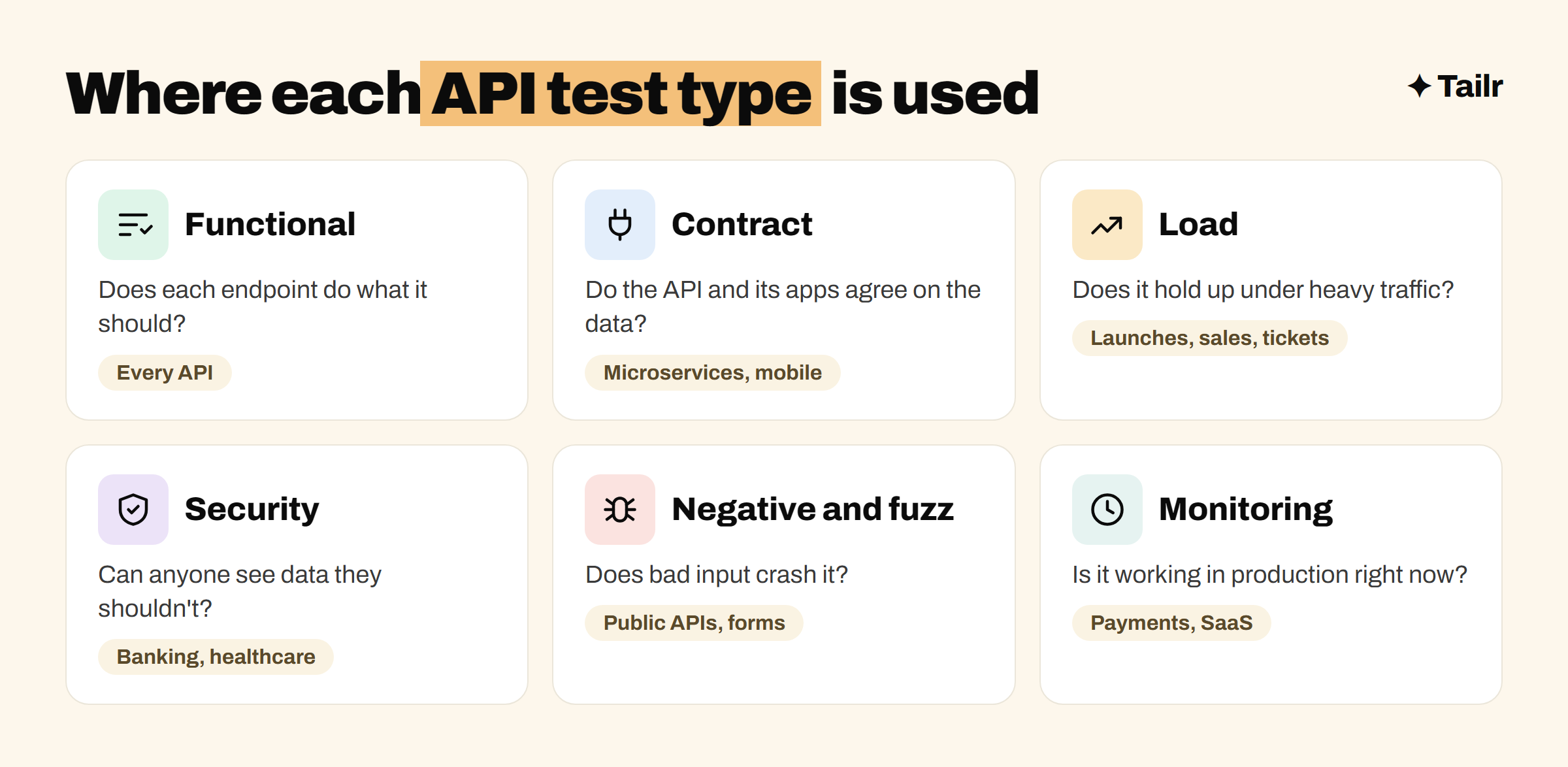
| Type | Question it answers | Typically used in |
|---|---|---|
| Functional | Does each endpoint work? | Every API |
| Integration | Do the connected services work together? | E-commerce, booking, logistics |
| Contract | Do the API and its consumers agree? | Microservices, mobile apps |
| End-to-end | Does a full journey work? | Sign-up and checkout flows |
| Load and performance | Is it fast and stable under traffic? | Launches, sales, ticketing |
| Security | Can anyone access what they shouldn’t? | Banking, healthcare, HR |
| Negative and fuzz | Does bad input break it? | Public APIs, forms |
| Schema validation | Do responses match the docs? | Public and partner APIs |
| Regression | Did a change break something? | Every CI/CD pipeline |
| Smoke | Is it up after a deploy? | Deployment pipelines |
| Monitoring | Is it working in production? | Payments, SaaS uptime |
Which types to start with
If you’re learning, follow the order most teams adopt them:
- Functional tests for every endpoint, including negative cases.
- Regression and smoke by running those tests in CI on every change and after every deploy.
- Contract tests once more than one team or app depends on the API.
- Load tests before any launch you’re planning to promote.
- Security tests as soon as the API handles personal or financial data.
For the difference between test cases, scenarios and plans in this work, see test case vs test scenario vs test plan. And when you’re ready for interviews, practise with our 50 API testing interview questions.
API testing on your resume
QA and SDET job listings rarely say just “API testing”. They name the types and tools: “contract testing with Pact”, “load testing in k6”, “REST Assured automation”. Matching that language on your resume matters, because recruiters and applicant tracking systems scan for those exact terms.
Tailr is a Chrome extension that tailors your resume from the job listing you’re viewing, so the testing types and tools that posting asks for show up first. It also writes a matching cover letter and tracks your applications. Try Tailr when you start applying.
Related guides
- What Is API Testing? Types, Tools and How to Start
- 50 API Testing Interview Questions and Answers
- QA Engineer vs. SDET: Differences, Salary and Which to Choose
- Best API Testing Tools in 2026
Conclusion
The types of API testing each answer a different question: does it work, does it work with everything else, does it hold up, and is it safe? Functional and regression testing are the foundation. Contract, load and security testing come next as more people depend on the API. Learn them in that order, practise on a free public API, and you’ll have one of the most useful skills in software testing.
Frequently asked questions
01What are the main types of API testing?
The main types are functional, integration, contract, end-to-end, load and performance, security, negative and fuzz, schema validation, regression, smoke and monitoring. Most teams start with functional and regression tests, then add contract, load and security testing as their APIs grow and more people depend on them.
02What is the difference between API functional testing and integration testing?
Functional testing checks that a single endpoint does what it should, such as returning the right user for a given ID. Integration testing checks that several parts work together, such as an order endpoint correctly calling the payment and inventory services and the database.
03What is contract testing in APIs?
Contract testing checks that an API and the apps that use it agree on the format of requests and responses. If the API team renames a field, a contract test fails before the mobile app breaks in production. It's most useful in microservices, where different teams own different services.
04Where is API testing used?
Almost everywhere software talks to other software: payment systems and banking apps, e-commerce checkouts, mobile app backends, healthcare record systems, SaaS products with integrations, and microservice architectures. Any company that exposes or depends on an API needs to test it.
05Which API testing tools should I learn first?
Start with Postman to explore and test endpoints by hand, then learn to automate tests in code with pytest and requests in Python or REST Assured in Java. After that, add k6 or JMeter for load testing and OWASP ZAP for basic security testing.
06Is API testing manual or automated?
Both. Testers often explore a new API manually in a tool like Postman to understand it, then write automated tests that run on every code change. Most API testing in mature teams is automated and runs in the CI/CD pipeline.