What Is Pattern Recognition? Meaning, Examples and How to Get Better at It
· updated
Pattern recognition is the skill behind most things we call intelligence: learning a language, diagnosing an illness, reading a chart, debugging code, and knowing that a job posting asking for “fast-paced environment” means understaffed. It’s also something employers test directly, and something machines now do at enormous scale. This guide explains what pattern recognition (sometimes called pattern identification) is, how it works in people and in software, where it shows up in hiring, and how to get better at it.
The short answer: pattern recognition is the ability to spot regularities in information and use them to predict, classify or decide. In people, it’s the mix of perception, memory and reasoning that lets you recognize a face, a melody or a familiar problem. In computing, it’s the field of building programs that classify data, from spam filters to medical imaging, which is the foundation of modern machine learning. Employers test it with abstract reasoning puzzles because it predicts how fast someone learns and solves new problems, and it improves with focused practice.
What pattern recognition means
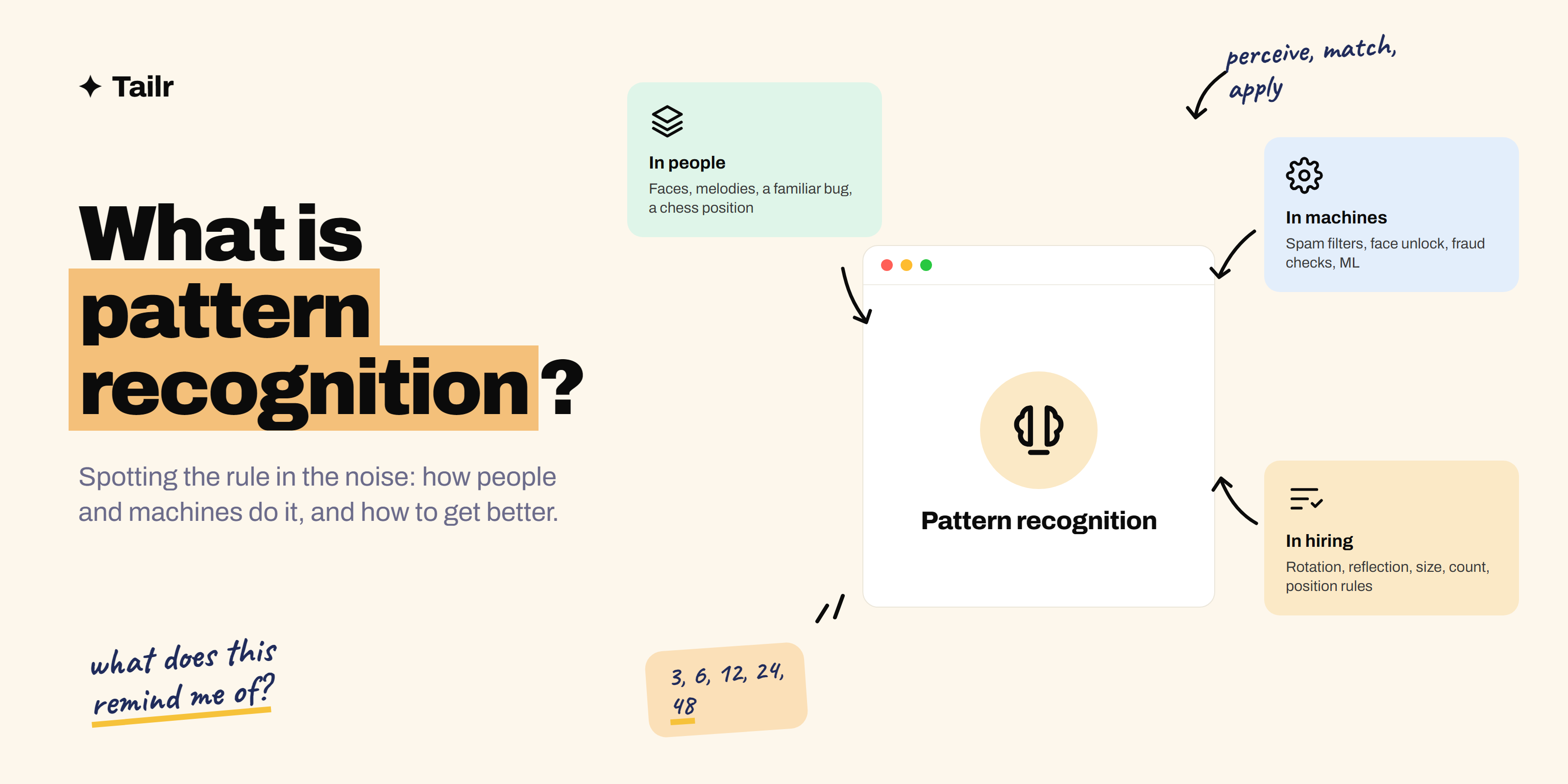
A pattern is anything that repeats or follows a rule: a sequence, a shape, a relationship between cause and effect. Pattern recognition is noticing the rule and doing something with it. Three steps happen almost instantly:
- Perceive the information: shapes, numbers, words, symptoms, behavior.
- Match it against things you’ve seen before, or work out the rule that connects the pieces.
- Apply the rule: predict what comes next, put the thing in a category, or decide what to do.
When you look at 3, 6, 12, 24 and say 48, you’ve done all three. When a mechanic hears an engine and says “timing belt”, same thing, with a much bigger library of past examples. The library is what separates experts from beginners: chess masters don’t calculate more than novices, they recognize more positions.
Types of pattern recognition
Psychologists describe a few different ways the brain does it, and they show up in different kinds of work.
Template matching compares what you see to a stored example. Recognizing a letter, a logo or a colleague’s handwriting.
Feature detection breaks something into parts and checks for the features that matter. A radiologist looking for specific shapes in a scan, or a recruiter scanning a resume for the three things the role needs.
Prototype matching compares against an average or typical case. You’ve never seen this particular dog, but it’s obviously a dog.
Sequence and rule detection finds the logic in a series. Number and shape sequences, trends in a chart, the rhythm of a customer’s buying cycle.
Analogy recognizes that a new situation has the same structure as an old one. The best problem solvers do this constantly: “this scaling issue is really the same as the caching problem we fixed last year.”
Pattern recognition in machines
In computer science, pattern recognition is the discipline of training programs to classify data, and it’s the root of what we now call machine learning. A spam filter learns the features of junk mail from millions of examples. Face unlock matches the geometry of your face to a stored template. Fraud detection flags a transaction because it doesn’t fit your usual pattern. Speech recognition, medical image analysis, recommendation engines and the models behind chat assistants all work by finding statistical patterns in huge amounts of data.
The difference from human pattern recognition is scale and blindness. A model can find patterns across a billion records that no person could see, and it will also happily learn a pattern that’s meaningless or biased if the data contains one. That’s why the human skill still matters: someone has to recognize when the machine’s pattern is wrong. If you want the plain-English version of how these systems work, read our AI 101 explainer.
Where employers test it
Pattern recognition tests, also called abstract, inductive or diagrammatic reasoning tests, are a standard part of graduate schemes, consulting and banking assessments, and many technical hiring processes. They present sequences of shapes or a 3x3 grid with a missing cell, and ask you to find the rule. No maths, no language, which is exactly why employers like them: the score is a proxy for how fast you learn and adapt, independent of background.
The rules that appear over and over:
| Rule type | What changes | Example |
|---|---|---|
| Rotation | Shape turns by a fixed angle | Arrow rotates 90° each step |
| Reflection | Shape flips | Mirror image alternates |
| Size | Elements grow or shrink | Circle gets larger each cell |
| Colour or shading | Fill changes by rule | Black, white, striped, repeat |
| Number | Count of elements changes | One more dot each step |
| Position | Elements move around the frame | Star moves clockwise |
| Add or remove | Elements appear or vanish | A line is added each step |
| Combination | Two or more rules at once | Rotates and adds a dot |
Formats include sequence completion, matrix reasoning, odd-one-out and figure analogies. Tests typically run 10 to 20 minutes with 15 to 30 questions, so about a minute each, and speed counts as much as accuracy.
Pattern recognition at work
Outside tests, the skill shows up in almost every job, just with different raw material.
- Engineers recognize a bug from its symptoms, a code smell from its shape, and a system design from a familiar bottleneck. Our guide to acing a technical interview is largely about recognizing which of a dozen problem types you’ve been handed.
- Analysts see the seasonality in a chart, the outlier in a table, the metric that moved for no good reason.
- Salespeople recognize which objection is really a budget problem and which is a timing problem.
- Managers notice that the same kind of project slips in the same way each time.
- Job seekers learn to read postings: which requirements are real, which are boilerplate, and what “wearing many hats” implies.
Experts in any field aren’t faster thinkers. They have a bigger, better-organized library of patterns to match against, built from years of examples and feedback.
How to get better at it
Because the skill is built on a library of examples, you improve it by deliberately adding to the library and testing yourself against it.
For aptitude tests: practice in short timed sessions of 10 to 15 minutes, a few times a week, for two to four weeks before the assessment. Learn the rule types in the table above and check them in a fixed order on every question: rotation first, then reflection, size, count, position, then combinations. Review every wrong answer until you can name the rule you missed. Under time pressure, if nothing clicks in 45 seconds, eliminate the obviously wrong options, pick, and move on.
For your field: collect examples. Keep notes of problems and how they were solved, read post-mortems and case studies, and after any new situation ask “what does this remind me of?” and “what would I look for next time?” Explaining a pattern to someone else, out loud or in writing, is one of the fastest ways to make it stick.
Guard against false patterns. The same brain that spots real rules also invents ones that aren’t there, which is how superstitions and bad business decisions happen. When you notice a pattern, ask how many examples it rests on and what would disprove it.
For job seekers
Pattern recognition is also what a good application depends on. Every job posting has a pattern: the requirements that repeat across the description, the ones near the top, the phrasing that reveals what the team actually struggles with. Reading it well tells you what to lead with. Tailr does this reading for you: it takes the job listing you’re viewing, identifies what the posting asks for and where your resume already shows it, then tailors your resume to match with nothing invented, generates a cover letter and tracks the application. Try Tailr to apply the same logic to every application, and see our guide to resume keywords for how to spot the patterns in a posting yourself.
Conclusion
Pattern recognition is spotting the rule in the noise and acting on it. It’s how people become experts, how machines learn, and why abstract reasoning puzzles turn up in hiring. It’s not fixed: a bigger library of examples, deliberate practice with the common rule types, and the habit of asking “what does this remind me of?” all make you measurably better at it, in a test and in the work itself.
Frequently asked questions
01What is pattern recognition in simple words?
Pattern recognition is noticing that something follows a rule and using that rule to predict or classify what comes next. It's what you do when you spot that every third bus is late, that a customer complaint sounds like last week's, or that a sequence of shapes is rotating. In computing it means the same thing done by a program, from spam filters to face unlock.
02What are examples of pattern recognition?
Recognizing a friend's face in a crowd, predicting the next number in 2, 4, 8, 16, hearing a song from its first two notes, a doctor spotting a familiar cluster of symptoms, a spam filter flagging an email, and a fraud system noticing an unusual transaction. In aptitude tests it's usually a sequence of shapes or a 3x3 grid with a missing piece.
03Why do employers test pattern recognition?
Because it predicts how quickly someone learns new systems, solves unfamiliar problems and adapts. The tests don't need maths or language, so they're used across roles, especially by consulting firms, banks, graduate schemes and technical employers who care about debugging and analysis. The score is a proxy for fluid reasoning, not for any specific knowledge.
04What types of patterns appear in aptitude tests?
The common rules are rotation, reflection, size change, colour or shading, number of elements, position or movement, elements being added or removed, and combinations of several rules at once. Formats include sequence completion, 3x3 matrices with a missing cell, odd-one-out and figure analogies. Most tests run 10 to 20 minutes with about a minute per question.
05How can I improve my pattern recognition skills?
Practice short, timed sessions of 10 to 15 minutes several times a week rather than cramming, learn the common rule types so you check them in order, review every mistake to see which rule you missed, and read widely in your field so you build a library of situations to match against. Most people see a clear improvement within two to four weeks.
06Is pattern recognition the same as pattern identification?
In everyday use, yes. Pattern identification usually means the first step, spotting that a pattern exists, and pattern recognition covers identifying it and applying it. In machine learning, pattern recognition is the established term for the field that trains models to classify data.