Resume Tailoring vs. Resume Rewriting: What's the Difference?
· updated
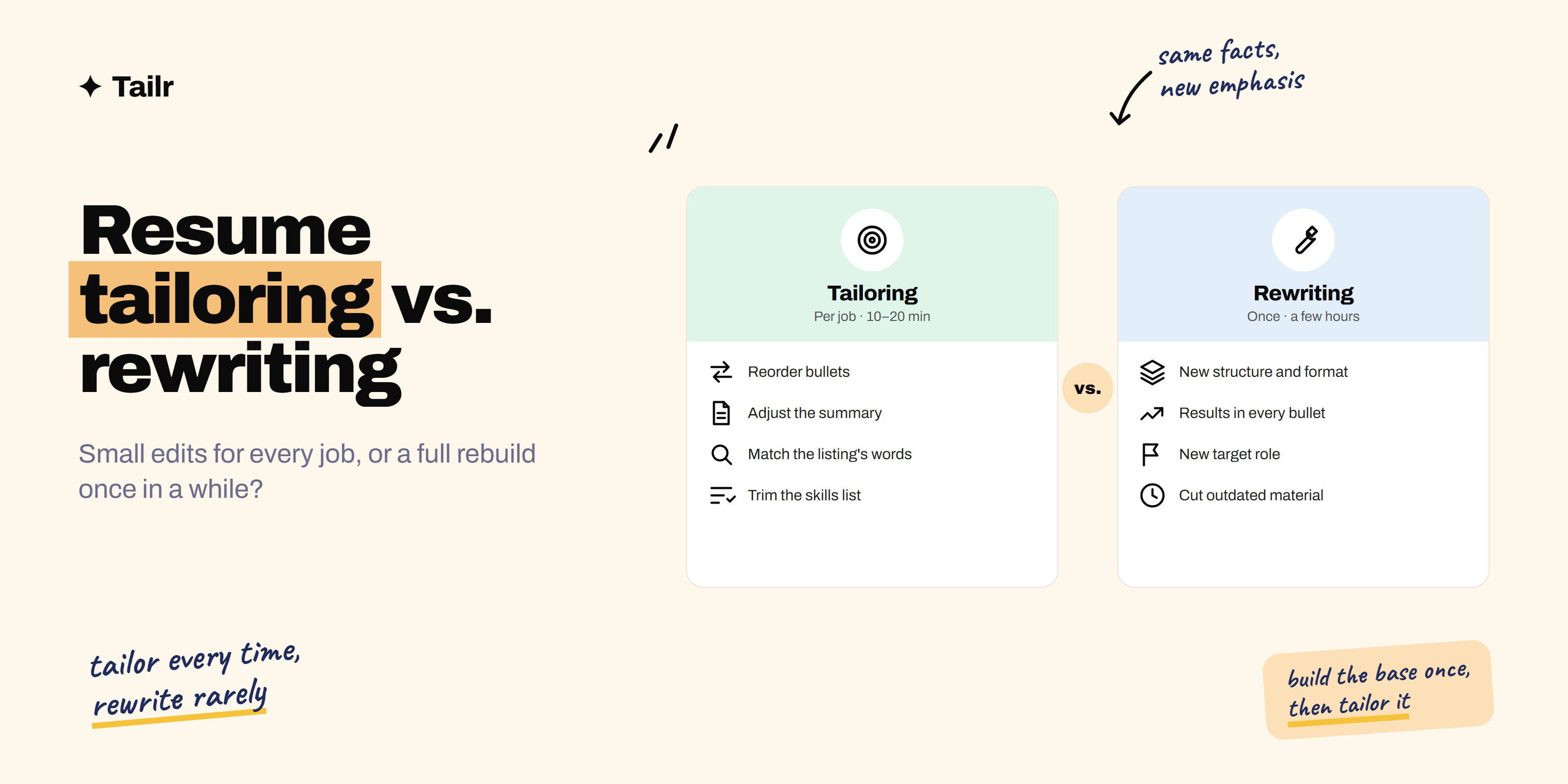
People use “tailoring” and “rewriting” as if they mean the same thing, and it leads to two common mistakes. Some people rebuild their whole resume for every application and burn out after five jobs. Others make tiny tweaks to a resume that needs a proper rebuild, and wonder why nothing changes. The two jobs are different, they solve different problems, and knowing which one you need saves a lot of time.
The short answer: Resume rewriting rebuilds your resume from scratch: structure, summary, bullets and often format. You do it rarely, when your career direction changes or the resume is outdated or simply not working. Resume tailoring adjusts an already-good resume for one specific job: you reorder bullets, adjust the summary, and match the listing’s language, without adding anything untrue. You do it for every application. Rewrite once to build a strong base, then tailor that base for each job.
What resume rewriting means
A rewrite treats your current resume as raw material, not a draft. You go back to what you’ve actually done, decide what story the resume should tell, and write it again.
A proper rewrite usually involves:
- A new target. Deciding which role and level the resume is for, because that changes everything else.
- New structure. Choosing section order, format (chronological, or a combination format for career changers), and length.
- A new summary that positions you for the new target.
- Every bullet rewritten in the pattern of action, what you did, and the result, with numbers wherever you have them.
- Cutting old material. Jobs from 12 years ago, skills nobody lists any more, and the “references available on request” line.
It’s a few hours of work, sometimes a weekend. You don’t want to do it often, and you shouldn’t need to.
What resume tailoring means
Tailoring starts from a resume that already works and bends it toward one job. Nothing is invented; you change what comes first and how it’s worded.
A typical tailor looks like this:
- The summary is adjusted to name the role and the two or three things the listing cares about most.
- Bullets are reordered so the most relevant one in each job comes first.
- Wording is matched to the listing where it’s accurate. If you wrote “customer onboarding” and they say “client implementation”, and it’s the same work, use their words.
- The skills section is trimmed and reordered to lead with what they ask for.
- Irrelevant detail is cut or shortened to make room.
It takes 10 to 20 minutes once you have a strong base, or a couple of minutes with Tailr, which does the first pass from the listing you’re viewing. How to tailor your resume to a job description walks through the full method.
A before and after that shows the difference
Here’s one bullet from a marketing coordinator’s resume.
Original:
Responsible for social media and email campaigns.
Rewritten (fixing the foundation, done once):
Planned and ran weekly email campaigns to a 40,000-subscriber list, lifting open rates from 21% to 29% over six months.
Tailored for a listing that asks for “lifecycle marketing” and “segmentation” (done per job, still true):
Ran lifecycle email campaigns to a 40,000-subscriber list, segmented by purchase history, lifting open rates from 21% to 29% over six months.
The rewrite added substance: a number, a scope and a result. The tailor added nothing new; it surfaced the segmentation work that was already true and used the listing’s term for it. You can’t tailor your way from the first version to the second. That’s what a rewrite is for.
Tailoring vs. rewriting at a glance
| Resume rewriting | Resume tailoring | |
|---|---|---|
| What changes | Structure, summary, every bullet, often format | Order, emphasis, summary line, matching wording |
| Starting point | Your career history | A strong existing resume |
| How often | Every year or two, or at a career change | Every application |
| Time | Several hours | 10–20 minutes |
| Goal | A strong, current base resume | The best match for one specific job |
| Main risk | Losing good material you forgot about | Drifting into claims you can’t back up |
When you need a rewrite
Tailoring can’t fix a weak foundation. Rewrite when:
- You’re changing careers or target roles. A teacher moving into instructional design, or an engineer moving into product management, needs a resume built around transferable work, not a list of old duties.
- It’s been two years or more. Your best recent work is probably missing, and older material is taking up space.
- You’ve moved up a level. A senior resume leads with scope, ownership and outcomes, not tasks.
- Your bullets describe duties, not results. If most lines start with “Responsible for”, no amount of reordering will help.
- You’re getting no callbacks. Thirty well-targeted applications with zero responses usually means the base resume is the problem.
- The format fights the software. Two columns, text in images, tables, or headers that applicant tracking systems can’t read.
When tailoring is enough
If your resume is current, results-focused and aimed at the kind of role you’re applying for, you don’t need another rewrite. You need to tailor it for each job. That’s true when:
- You’re applying for roles similar to your current or last job.
- Your bullets already have specific results in them.
- You get some callbacks, just not as many as you want.
- Each listing asks for a slightly different mix of the same skills.
For most active job seekers, this is where they spend most of their time: one solid base resume, tailored dozens of times.
How to tailor well without crossing a line
Tailoring has one hard rule: change emphasis and wording, never facts. A few habits keep you on the right side of it.
- Only use a keyword if you could talk about it for two minutes. If the listing says Kubernetes and you’ve only read about it, leave it out.
- Match terms, not claims. Swapping “clients” for “customers” is fine. Turning “supported a migration” into “led a migration” is not.
- Keep titles accurate. You can add a clarifier in brackets, like “Associate (Product Operations)”, when the work matches, but don’t change the title itself.
- Keep every version. You’ll want to know which resume you sent when a recruiter calls three weeks later.
How to tailor your resume without lying goes deeper on where the line sits, and resume keywords covers which listing terms are worth matching.
How to do this efficiently
The fastest workflow combines both:
- Rewrite once, properly. Build a base resume with every relevant bullet you have, even if it runs longer than two pages. Think of it as your master copy.
- Tailor from the master for each job. Pick the bullets that fit, put them in order, adjust the summary and skills, and trim to length.
- Save each tailored version with the company name in the filename.
- Refresh the master every few months with new projects and results, so you never need a full emergency rewrite again.
Where Tailr fits
Tailoring is the part you repeat for every application, so it’s the part worth speeding up. Tailr is a browser extension that reads the job listing you’re viewing and tailors your existing resume to it: it moves your most relevant experience up and matches the listing’s language where it’s true, without inventing anything. You review every change before you use it. It also writes a matching cover letter and keeps track of which version went to which company. It won’t do your big rewrite for you, but once your base resume is strong, it turns a 20-minute tailor into a few minutes of review. Try Tailr on the next job you apply for.
Conclusion
Rewriting and tailoring aren’t competing approaches. They’re two stages of the same process. Rewrite when the foundation is wrong: a new career direction, an outdated resume, or bullets that list duties instead of results. Tailor every time you apply, changing emphasis and wording but never facts. Get the base right once, and each tailor after that is quick.
Frequently asked questions
01What is the difference between tailoring and rewriting a resume?
Rewriting rebuilds your resume from the ground up: new structure, new summary, new bullets, often a new format. Tailoring starts from a resume that's already good and adjusts it for one specific job by reordering bullets, adjusting the summary and matching the listing's language. You rewrite once in a while; you tailor for every application.
02Do I need to tailor my resume for every job?
For any job you actually want, yes. A tailored resume puts the experience the listing asks for at the top, which is what a recruiter scanning for a few seconds and an applicant tracking system both look for. It doesn't have to take long: 10 to 20 minutes per application is usually enough once your base resume is solid.
03When should I completely rewrite my resume?
Rewrite when you're changing careers or target roles, when you haven't updated it in two or more years, when you've been promoted into a different level, or when you've sent out dozens of applications with no callbacks. In each case the problem is the foundation, and small edits for each job won't fix it.
04Is tailoring a resume the same as lying?
No. Honest tailoring only changes emphasis and wording: which true experience goes first, and which accurate words describe it. Adding skills you don't have, inflating titles or inventing results isn't tailoring, and it tends to fall apart in the interview when you're asked about them.
05How long should it take to tailor a resume?
With a strong base resume, 10 to 20 minutes per job: read the listing, pick its top five requirements, update the summary, reorder bullets and adjust the skills section. A tool like Tailr can do the first pass from the listing you're viewing so you spend your time reviewing rather than rewriting.
06Can I tailor a resume that isn't very good to begin with?
You can, but you'll get less out of it. Tailoring amplifies what's already there, so vague bullets without results stay vague however you order them. If your resume is weak, rewrite it once with specific, measurable bullets, then tailor that stronger version for each job.