What Is a Founder's Office Role? Responsibilities, Salary and How to Get In
· updated
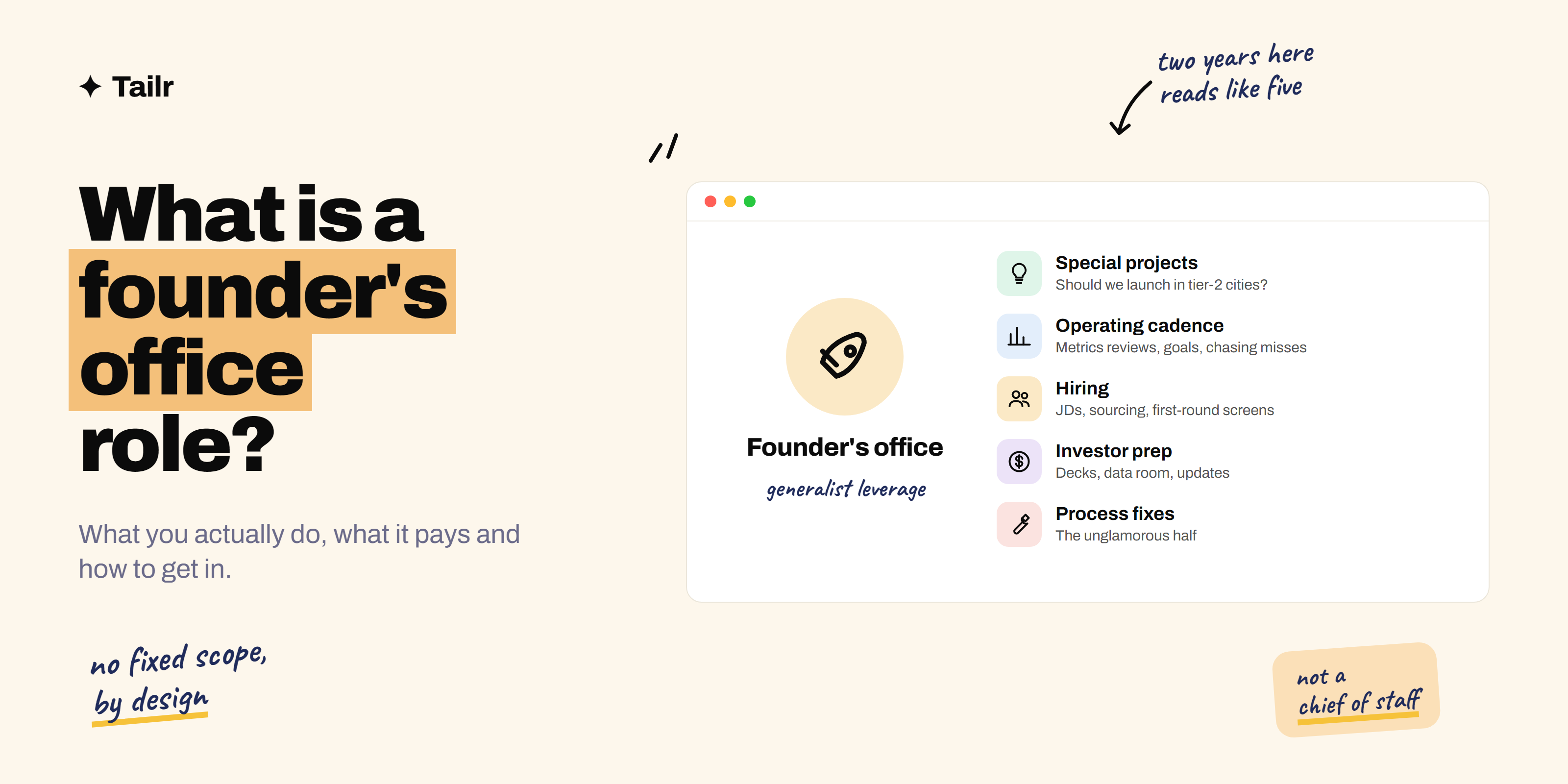
“Founder’s office” is one of those titles that means a lot inside startups and almost nothing outside them. It shows up on job boards with no clear job description, pays anywhere from intern money to a serious salary, and is either the best first job you’ll ever have or a glorified assistant role, depending on the company. This guide explains what a founder’s office role is, what you actually do, how it differs from chief of staff, what it pays, and how to get one that’s worth it.
The short answer: a founder’s office role is a generalist position working directly for a startup’s founders, taking on whatever high-priority work doesn’t have an owner yet:
- Special projects and research.
- Operating reviews and metrics.
- Hiring.
- Investor and board preparation.
- Building processes across teams.
It’s usually an early-career role, distinct from chief of staff (more senior, focused on managing the founder’s time), and it’s valued because a year or two in it teaches how a whole company runs.
What a founder’s office actually is
Early-stage companies have more important problems than people to own them. Someone needs to figure out whether the pricing is wrong, why the sales pipeline stalled, which city to expand to next, or how to prepare the board deck, and none of those belong cleanly to engineering, sales or marketing. The founder used to do all of it. A founder’s office is the small team that takes it on instead.
The team is usually one to four people, reports directly to a founder or CEO, and has no fixed remit. That’s the point. The scope changes every quarter with the company’s priorities, and the people in it are chosen for range and speed rather than a specialty.
What you do day to day
The work falls into five buckets, in roughly this mix:
Special projects. The classic founder’s office task is a question with no obvious owner. “Should we launch in tier-2 cities?” “What would it take to add a self-serve plan?” You scope it, research it, build the model, talk to customers or partners, and come back with a recommendation and a plan. Then, often, you run the first version.
Operating cadence. Weekly metrics reviews, quarterly goal setting, tracking whether teams are hitting their numbers, and chasing the ones that aren’t. You become the person who knows the state of the company better than anyone except the founder.
Hiring. Writing job descriptions, sourcing for critical roles, running first-round screens, setting up the interview process when none exists. Early startups hire constantly and rarely have a recruiter.
Investor and board work. Building the fundraising narrative, preparing the data room, drafting investor updates and board decks, running the numbers behind the story.
Process and fixes. The unglamorous half. Setting up the CRM properly, writing the onboarding doc, fixing the expense process, being the first line for whatever broke this week.
A concrete week might be: Monday, metrics review and chasing three teams on missed targets; Tuesday and Wednesday, building a pricing model and interviewing eight customers; Thursday, screening candidates for a head of sales; Friday, drafting the monthly investor update. Nobody trains you for this. You learn by doing it, badly at first, next to someone who’s done it before.
Founder’s office vs. chief of staff
The two titles get used interchangeably, and they shouldn’t be.
| Founder’s office | Chief of staff | |
|---|---|---|
| Seniority | Early career, 0–5 years | Mid to senior, often ex-consulting or ex-operator |
| Team size | Often several people | Usually one |
| Focus | Executing projects and analysis | Managing the founder’s priorities and leadership team |
| Reports to | A founder or the chief of staff | The CEO directly |
| Pay | Junior to mid | Significantly higher |
In many companies the chief of staff runs the founder’s office. If you see a posting for “founder’s office” that asks for eight years of experience and pays like a director role, it’s a chief of staff job with a different label. We’ve written about neighboring roles too: see what a technical program manager does and what a product operations manager does if you’re weighing these paths against each other.
Salary
Pay depends more on country, stage and how much money the company has raised than on the title.
In India, where the title is most common, internships at funded startups typically pay around 15,000 to 40,000 rupees a month, and full-time fresher roles at Series A to C companies land around 6 to 12 lakh rupees a year, with well-funded or later-stage companies going higher. In the US, listings under this exact title mostly sit in the 40,000 to 60,000 dollar range at very early companies; the same work at a funded startup is usually titled chief of staff or strategy and operations and pays much more. Equity is common and, at a company that works out, can matter more than salary.
Who it suits
The role suits people who like ambiguity, write clearly, are comfortable with a spreadsheet and a customer call in the same hour, and can take a vague question and turn it into a finished answer without being managed. It rewards agency. The best signal on a resume is something you started or fixed: a club, a small business, an event, a process at a previous job nobody asked you to improve.
It doesn’t suit people who need structure, a clear ladder or a defined scope. There’s no training program, feedback is usually blunt, and half the work is grunt work. Burnout is real when the founder treats the office as an extension of their own 80-hour week.
How to get a founder’s office role
Postings exist, but most of these roles are filled directly. What works:
- Target the right companies. Roughly 15 to 150 people, recently funded, growing fast enough that priorities outnumber owners. Too early and there’s no budget; too late and the work has been split into real departments.
- Write to the founder, not HR. A short, specific note: one thing you noticed about their business, one thing you’d do about it, and a link to something you’ve built or written. Founders read these when they’re good.
- Offer a trial. A week or a small project on a real problem beats any interview. It also tells you whether the founder is someone you’d learn from.
- Show evidence of range. A resume for this role should show you’ve done analysis, shipped something and worked with people, not that you’re a specialist in one of them.
- Check the role is real. Ask what projects the last person in the office ran and where they are now. If the answer is “scheduling and travel”, it’s an assistant job.
This is the kind of role where the posting and your resume rarely use the same words. One founder wants “strategy and ops”, another “special projects”, a third “chief of staff associate”. Tailr reads the posting you’re on and tailors your resume to it, surfacing the projects and evidence that specific founder is asking for, then generates a matching cover letter and keeps track of every application. Try Tailr if you’re reaching out to a lot of startups, and see our list of the best websites for startup jobs for where to find them.
Where it leads
The usual exits are product manager, business or operations lead, chief of staff at a bigger company, venture capital, or founding something yourself. The reason the role is worth its chaos is that after two years you’ve seen fundraising, hiring, pricing, expansion and a few crises up close, and you know which of those you want to spend the next decade on. Few other first jobs give you that view.
Conclusion
A founder’s office role is a generalist seat next to the people running a startup, with a scope that changes every quarter and a learning curve that’s steep by design. It’s not a chief of staff job, it doesn’t pay like one, and it isn’t for everyone. But at the right company, with a founder who invests in you, it compresses years of experience into a couple, and the people who come out of it tend to end up running things.
Frequently asked questions
01What does a founder's office do?
A founder's office is a small team of generalists who work directly for a startup's founders on whatever matters most that quarter: special projects, market research, hiring, investor preparation, operating reviews and fixing processes that don't exist yet. The job has no fixed scope by design. You take problems off the founder's plate and either solve them or set them up so someone else can.
02Is founder's office the same as chief of staff?
They overlap but aren't the same. A chief of staff is usually a single senior person who manages the founder's priorities, meetings and leadership cadence. A founder's office role is typically earlier in career, more hands-on and project-based, and there may be several people in the office. Think of chief of staff as the manager of the founder's time, and founder's office as the people executing the founder's projects.
03What is the salary for a founder's office role?
It varies widely by country and stage. In India, fresher roles at funded startups typically pay around 6 to 12 lakh rupees a year, with top companies paying more and internships from roughly 15,000 to 40,000 rupees a month. In the US, listings under this title mostly pay in the 40,000 to 60,000 dollar range at early-stage companies, with chief of staff titles paying considerably more. Equity is often part of the package.
04Is a founder's office role good for freshers?
It can be excellent if the company is real and the founder actually invests in you. You get exposure to strategy, finance, hiring and product in a year that would take several years in a specialist role, and alumni often move into product, operations, chief of staff or founding roles. The risks are burnout, no structure, and roles that are really executive assistant jobs with a better title.
05What skills do you need for a founder's office?
Clear writing, comfort with spreadsheets and basic financial models, the ability to research a question fast and summarize it in a page, project management across teams, and a lot of ownership with very little ego. Evidence of agency helps more than a specific degree: something you started, ran or fixed without being asked.
06What comes after a founder's office role?
Common next steps are product manager, business or operations lead, chief of staff, a move into venture capital, or starting your own company. Because the role touches every function, people usually discover which one they want to go deep on, and the founder's reference carries weight.