How to Answer "What Are Your Salary Expectations?" (With Scripts)
· updated
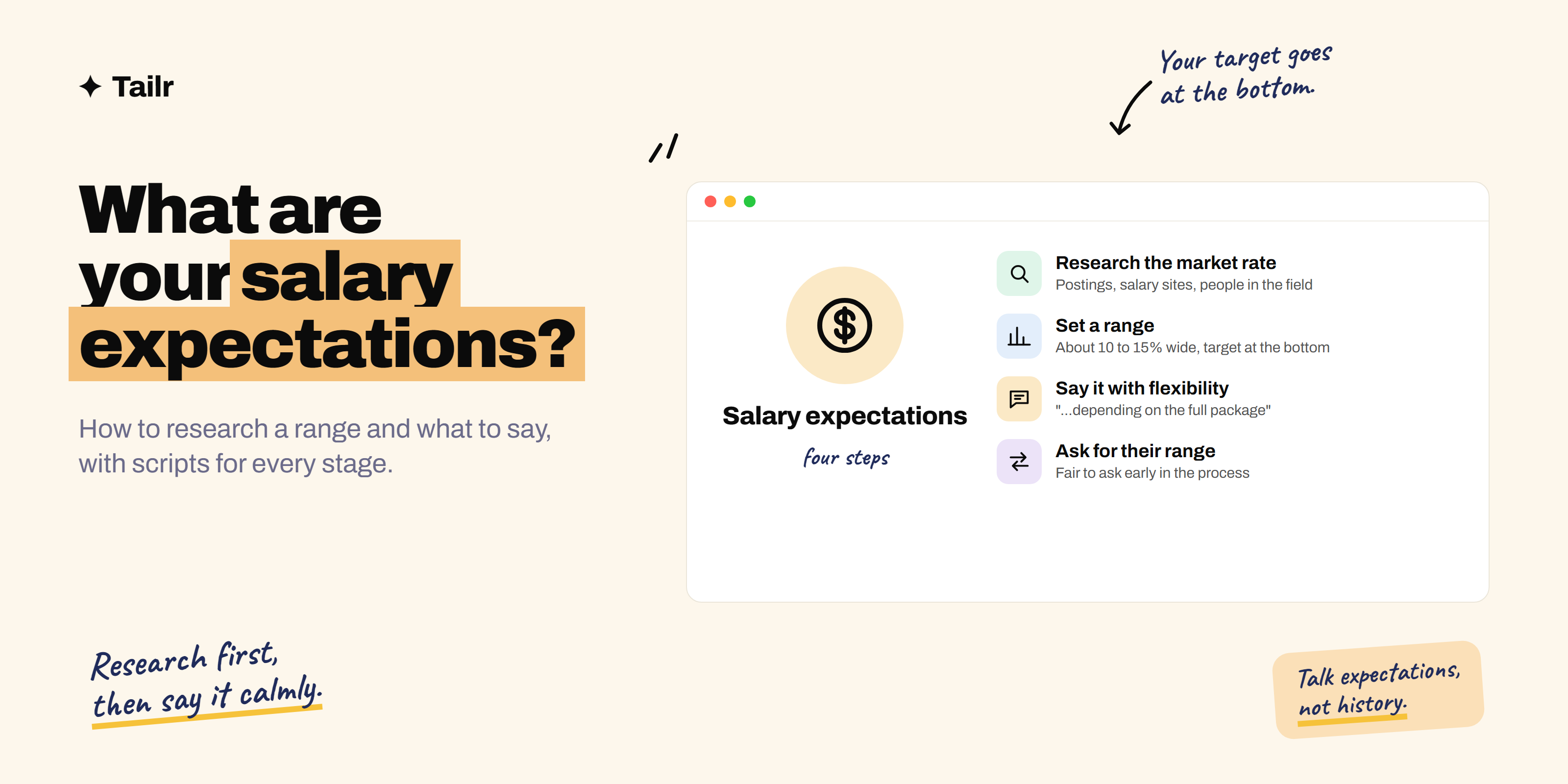
“What are your salary expectations?” is the interview question people dread most. Say too high and you worry you’ll be cut. Say too low and you leave money on the table for years. The fix is preparation: if you know the market rate before anyone asks, the answer becomes a simple statement of fact. Here’s how to answer “what are your salary expectations?” at every stage, from the application form to the final round.
The short answer: to answer “what are your salary expectations?”:
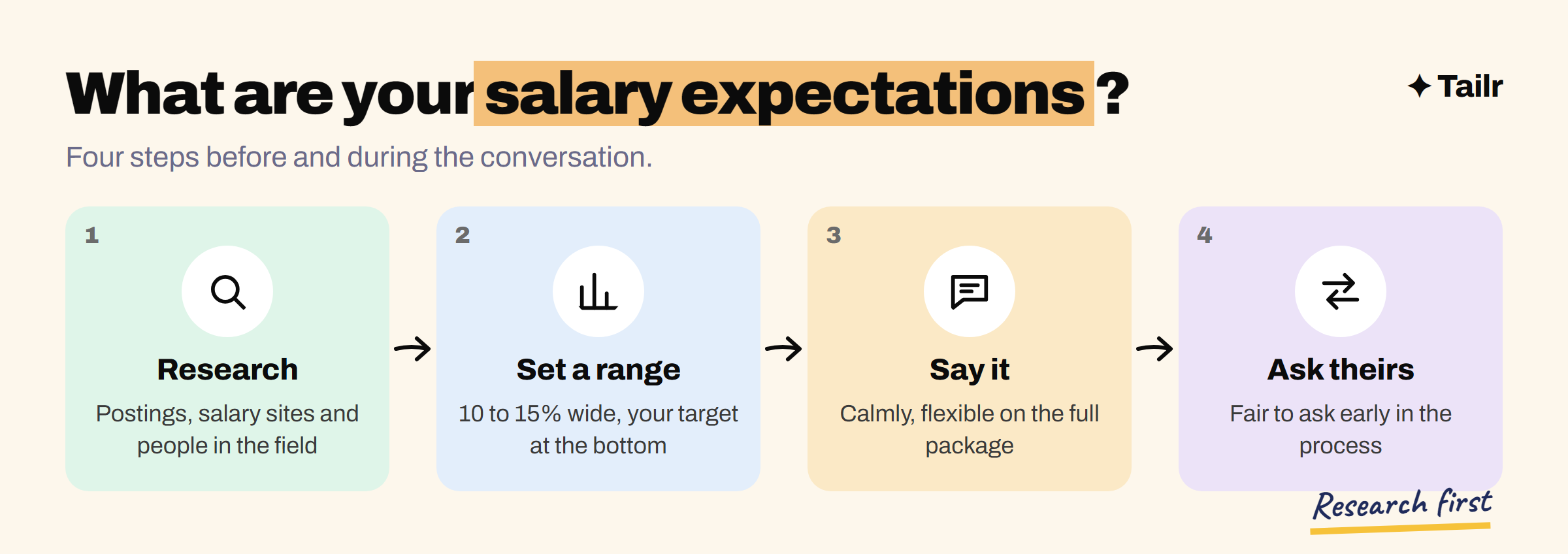
- Research the market rate for this role, level and location before the interview.
- Set a range about 10 to 15% wide, with the bottom end at a number you’d be happy to accept.
- Say it confidently and add that you’re flexible depending on the full package.
- Ask for their range if it’s early in the process, so you’re not guessing.
Give a range, not an apology, and talk about expectations, not your current salary.
Why they ask (and when)
Employers ask about salary expectations to check that you’re within their budget before spending more time on interviews. It usually comes up at one of three points:
- On the application form, as an “expected salary” field.
- In the recruiter screen, often in the first ten minutes.
- Late in the process, before or alongside an offer.
The earlier it comes up, the less you know about the role, so it’s reasonable to give a broader range or ask for theirs first. Later, you can be more precise. Negotiating the actual offer is a separate step, covered in how to negotiate salary.
Step 1: research the market rate
Spend 30 minutes building a realistic picture. Useful sources:
- The job posting itself. In places like California, Colorado, New York and Washington, employers must include a pay range in job ads, and many others do it voluntarily.
- Similar job postings. Look at five to ten comparable roles in the same city or remote market and note the ranges.
- Salary sites. Glassdoor (glassdoor.com), Payscale (payscale.com) and LinkedIn Salary give rough ranges by title and location. For tech roles, Levels.fyi (levels.fyi) tends to be more detailed, including bonus and equity.
- People. Ask friends, former colleagues or recruiters in the field what the role pays. Most people will share a range if you ask directly.
Adjust for the details: company size, your years of experience, specialist skills, and whether the role is more senior than your current one.
Step 2: set your range
Work out three numbers:
- Your walk-away number: the lowest you’d accept. Keep this to yourself.
- Your target: what you’d be genuinely happy with, based on your research.
- Your stretch: the top of the market for someone with your experience.
Your stated range goes from your target to your stretch. If your target is $90,000, you might say “$90,000 to $100,000”. (The examples here use US dollars, but the same approach works in any currency. In India, for example, you’d say “18 to 20 lakhs per annum”.) Employers often anchor on the lower number, so never put your walk-away number at the bottom.
Step 3: say it with confidence and flexibility
Say the range plainly, without apologising, then leave room to talk:
“Based on my research for similar roles in this area and my experience, I’m looking for something in the range of $90,000 to $100,000. I’m flexible depending on the full package and the scope of the role.”
Then stop talking. The pause feels long, but filling it with “but I could go lower” undoes your answer.
Step 4: ask about their range
Early in the process, it’s fair to turn the question around:
“I’d like to learn more about the role before I give an exact number. Could you share the range you’ve budgeted for it?”
If they share a range that fits, you can say “That’s in line with what I’m looking for” and move on. If they push back and ask again, give your range. Refusing twice can stall the conversation.
Scripts for every situation
On an application form
If the posting lists a range, enter a number within it that fits your experience. If it doesn’t and the field accepts text, enter your range. If it needs a single number, enter your target. Don’t enter “0” or “1” to skip it, because some application systems filter candidates on this field automatically.
In a recruiter screen
“I’m still learning about the scope of the role, but based on what I’ve seen for similar positions, I’m targeting $90,000 to $100,000. Does that fit with the range you have in mind?”
When they ask for your current salary
“I’d rather focus on what’s right for this role, since the responsibilities are different from my current job. Based on my research, I’m looking for something in the range of $90,000 to $100,000.”
In many US states and cities, employers aren’t allowed to ask about your salary history at all, but this redirect works anywhere.
As a fresher or for your first job
“From what I’ve seen for entry-level analyst roles in this city, the typical range is around $55,000 to $62,000. I’m comfortable within that range, and I’m most interested in the learning and growth this role offers.”
For freshers, it’s especially important to research, because it’s easy to undersell yourself without realising it.
When you’re changing careers
“I know I’m moving into a new field, so I’ve looked at what junior-to-mid roles pay here, which is roughly $70,000 to $80,000. Given that I’m bringing six years of project management experience, I’d be looking at the upper half of that.”
When their range is lower than you hoped
“Thanks for sharing that. It’s a bit below what I was expecting, given my experience with X and Y. Is there any flexibility in the base, or other parts of the package we could look at, like a signing bonus or an earlier review?”
Mistakes to avoid
- Not researching. Guessing on the spot is how people undersell themselves.
- Giving your walk-away number. Whatever you say first becomes the ceiling, not the floor.
- A range that’s too wide. “$60,000 to $120,000” tells them nothing and they’ll pick the bottom.
- Apologising. “Sorry, I know this might be high, but…” weakens a perfectly reasonable number.
- Talking about what you need. Rent and loans are real, but pay is based on the role’s market value, not your expenses.
- Forgetting the rest of the package. Bonus, equity, leave, remote work and learning budgets all count.
- Lying about your current salary. It’s easy to check and can cost you the offer.
Apply to roles where the numbers fit
The salary conversation is much easier when you’ve applied to roles that match your level in the first place. Read the posting’s range before applying, and tailor your resume to the role you’re actually targeting, so the experience you show supports the number you’ll ask for. Tailr is a Chrome extension that tailors your resume to the job listing you’re viewing, writes a matching cover letter, and tracks every application you send. For the manual version, see how to tailor your resume to a job description.
Try TailrRelated guides
- How to negotiate salary after a job offer
- How to answer “why are you leaving your current job?”
- Questions to ask at the end of an interview
Conclusion
“What are your salary expectations?” stops being scary once you’ve done the research. Find the market rate for the role, set a range with your target at the bottom, say it calmly with a note of flexibility, and ask for their range when it’s early. Talk about the job’s value, not your current pay, and keep the whole package in view. Preparation turns this from a guessing game into a two-sentence answer.
Frequently asked questions
01How do I answer 'what are your salary expectations?'
Research the market rate for the role, level and location, then give a range whose bottom end is a number you'd be happy with. Say it confidently, add that you're flexible depending on the full package and responsibilities, and, if you're early in the process, ask what range they've budgeted for the role.
02Should I give a number or a range?
A range is usually best, around 10 to 15% wide, with the bottom end at or slightly above the salary you actually want. The employer will often anchor on the lower number, so don't put anything at the bottom you wouldn't accept. A single number works if you have strong evidence for it.
03Is it OK to avoid giving a number?
Early on, yes. You can say you'd like to learn more about the role first, or ask what range they've budgeted. But if they ask twice, give a range. Refusing completely can stall the process or make you seem difficult, and some application forms won't let you continue without a number.
04What should I put in the 'expected salary' field on an application?
If the job posting lists a range, enter a number within it that fits your experience. If it doesn't, enter your researched target, or a range if the field allows text. Avoid entering zero or a silly number to skip it, because some systems filter applications automatically by this field.
05Do I have to tell them my current salary?
Not always. In many US states and cities, employers aren't allowed to ask about your salary history. Wherever you are, you can redirect: 'I'd rather focus on what's fair for this role. Based on my research, I'm looking for something in the range of X to Y.' Talk about expectations, not history.
06What if their range is lower than my expectations?
Ask whether there's flexibility, and explain why you're worth more using specific skills or results. If base pay is fixed, ask about other parts of the package, such as a signing bonus, equity, a faster review, extra leave or remote days. If the gap is too big, it's fine to say so politely and walk away.