How to Answer "Why Are You Leaving Your Current Job?"
· updated
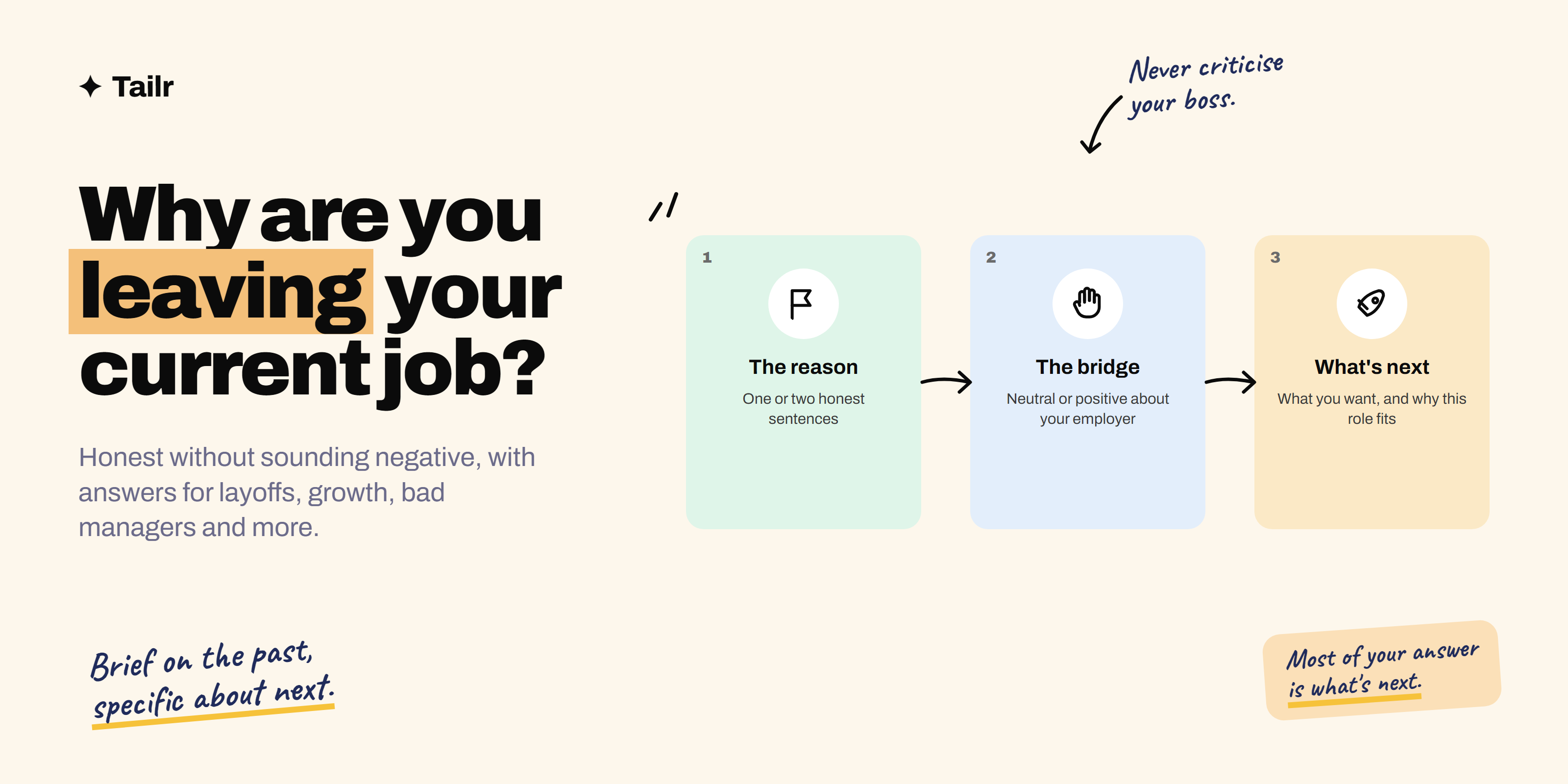
“Why are you leaving your current job?” is a question where honesty and tact both matter. Say too much and you sound bitter; say too little and you sound evasive. The good news is there’s a simple structure that works for almost every reason, from wanting a promotion to being laid off. Here’s how to answer “why are you leaving your current job?” plus sample answers for the situations people find hardest.
The short answer: answer “why are you leaving your current job?” in three parts:
- The reason: one or two honest sentences about why you’re leaving.
- The bridge: keep it neutral or positive about your current employer.
- What’s next: spend most of the answer on what you’re looking for and why this role fits.
Keep it under a minute, never criticise your current company or manager, and turn the focus forward.
What the interviewer is really asking
This question is about risk. The interviewer wants to know:
- Is there a problem with you? Were you pushed out, do you clash with people, do you get bored quickly?
- Will the same thing happen here? If you’re leaving because you want remote work and this job is in the office, you’ll leave again.
- How do you talk about people? Whatever you say about your current boss, they’ll assume you’ll say about them.
So the goal isn’t to hide the reason. It’s to show the reason is reasonable, that you’ve handled it maturely, and that this job solves it.
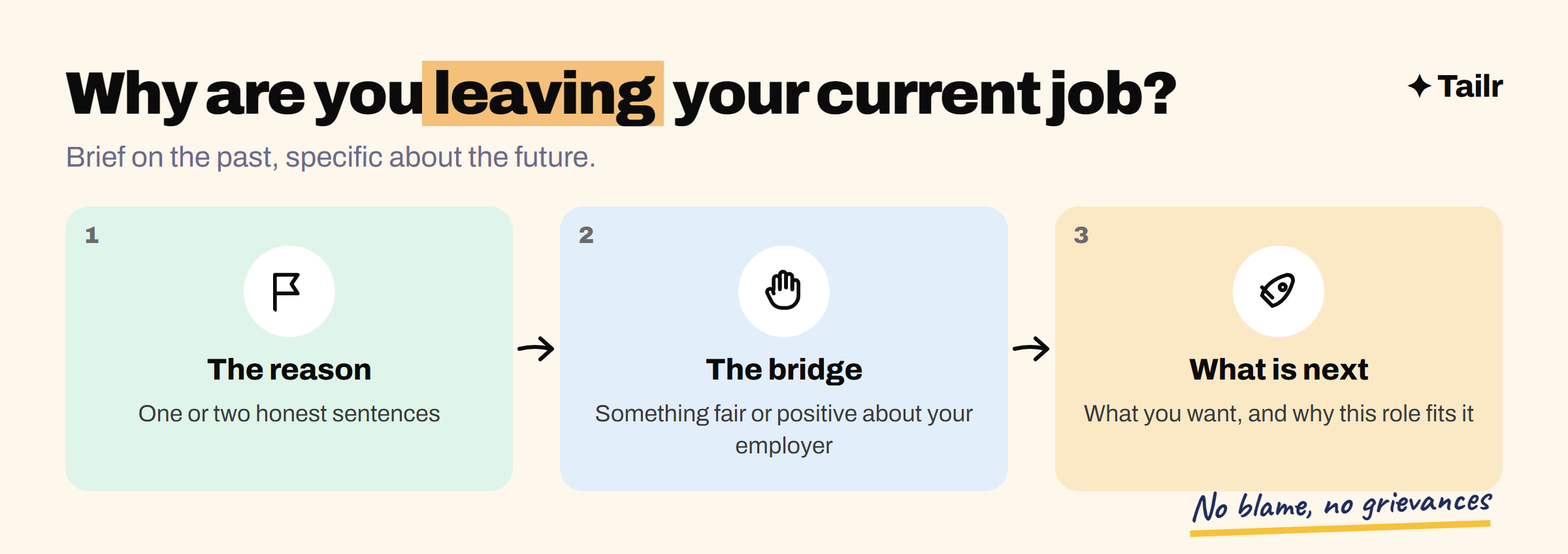
The reason, bridge, next formula
1. The reason: short and honest
One or two sentences. Don’t invent a reason, because the interviewer may call a reference. But you also don’t owe them every detail. “There’s no room to move into a product role at my current company” is enough.
2. The bridge: neutral about your employer
Say something fair or positive about where you are: “I’ve learned a lot there, especially about working with enterprise customers.” It shows you’re leaving towards something, not running away.
3. What’s next: the bulk of the answer
Describe what you’re looking for, then connect it to this role: “I’m looking for a role where I own the roadmap for one product area, which is what this position is about.” This is where the answer earns its points. Use details from the job description or the conversation so far.
Sample answers by situation
You want more growth or responsibility
“I’ve been at my company for three years and I’ve learned a lot, especially about running campaigns on a tight budget. But the team is small and the senior roles are filled, so there isn’t a clear next step for me there. I’m looking for a role where I can own a channel end to end and grow into leading people, and from what you’ve described, this role offers both.”
You were laid off
“My role was cut in a restructure in March, along with about 15% of the company. It wasn’t performance-related, and I’m proud of what I did there, including the onboarding redesign that lifted activation by 12%. Since then I’ve been looking carefully for the right next role rather than the first one, and this one stood out because of how much it focuses on onboarding.”
Layoffs are common and interviewers know it. Say it plainly, without apologising.
You want a different kind of work
“I’ve enjoyed working in agency marketing, but after four years of switching between clients every few months, I want to go deep on one product and see the long-term results of my work. That’s why I’m looking at in-house roles, and your team in particular, because you’re at the stage where a lot of the marketing foundations are still being built.”
You’re relocating
“My partner and I are moving to Bengaluru next month, so I’m looking for a role here. I’ve loved my current team and they’ve been very supportive. What I’m looking for next is a similar mix of hands-on analysis and working with product teams, which is exactly what this role describes.”
You’re unhappy with the culture or your manager
“The company has changed a lot in the last year, and the way the team works now is quite different from when I joined. I’m looking for a team with clearer priorities and more room to do focused, deep work. From what I’ve read and what you’ve told me about how your team plans each quarter, it sounds like a much better fit.”
Notice what’s missing: no blame, no details about the manager, no complaints. You’re describing what you want, not what you hate.
You were fired
“I was let go after eight months. Honestly, the role needed more experience with enterprise sales cycles than I had at the time, and I didn’t ask for help early enough. Since then I’ve taken a sales methodology course and spent four months in a contract role closing mid-market deals, which went well. I’d bring that, plus a much better sense of when to ask for support.”
Brief, honest, and focused on what changed. Don’t over-explain.
You’re leaving after a short time
“I joined expecting a product analytics role, but after a few months it became mostly reporting, which isn’t the work I want to do long-term. I gave it a fair go and raised it with my manager, but the team’s needs have changed. I’d rather move now than stay in a role that isn’t a good fit for either of us, and this role is much closer to what I was hired to do there.”
You’ve already left
“I left last year to look after a family member. That’s settled now and I’m ready to get back to work full time. During that time I also completed a certificate in data analytics to keep my skills current. I’m looking for a role where I can combine my operations background with more data work, which is why this one caught my eye.”
For more on explaining time away, see how to explain employment gaps.
Fill-in-the-blank template
“I’ve [learned/enjoyed something specific] at [current company], but [short, honest reason: no clear next step, restructure, want different work, moving]. I’m looking for [what you want next], and this role stood out because [specific detail from the listing or conversation].”
What not to say
- Criticising your boss or company. Even if it’s deserved, it makes you look like a risk.
- Long explanations. The more detail you give, the more it sounds like a grievance.
- Only money. It’s a valid reason, but alone it suggests you’ll leave for the next offer.
- “I’m bored.” Say what you want to be challenged by instead.
- Reasons this job doesn’t fix. If you hated commuting and this role is five days in the office, they’ll notice.
- Lies. Reasons for leaving are easy to check with a reference call.
Make the “next” part visible in your application
The forward-looking part of your answer works best when your resume already points the same way. If you’re leaving to do more product work, put your product-related projects first. Tailr tailors your resume to each job listing you’re viewing, using only your real experience, and writes a matching cover letter, so every application reflects where you’re heading, not just where you’ve been. It also tracks the roles you’ve applied to, which helps when you’re job hunting while still employed.
Try TailrRelated guides
- How to answer “why do you want to work here?”
- How to answer “what are your salary expectations?”
- 30 most asked HR interview questions and answers
Conclusion
“Why are you leaving your current job?” is easier than it looks. Give a short, honest reason, stay neutral about your current employer, and spend most of your answer on what you’re looking for and why this role fits. Whether you’re after growth, were laid off or had a rough time with a manager, the same structure works: brief on the past, specific about the future.
Frequently asked questions
01How do I answer 'why are you leaving your current job?'
Give a short, honest reason in one or two sentences, keep it neutral about your current employer, and spend most of the answer on what you're looking for next and why this role fits. Common good reasons are wanting more growth, a different kind of work, a layoff or restructure, relocation, or a better fit.
02What are good reasons for leaving a job?
Good reasons include wanting more responsibility or growth, wanting to work on a different product or industry, a layoff or restructure, relocation, wanting a more stable or flexible setup, a career change, and the company changing direction. Any honest reason works if you explain it briefly and focus on what's next.
03Can I say I'm leaving for more money?
You can, but don't lead with it. Money is a fine reason, but on its own it suggests you'll leave again for a better offer. Mention it alongside growth or scope: 'I've grown into a bigger role than my title and pay reflect, and I'm looking for a position that matches the work I'm doing.'
04How do I explain leaving a job because of a bad manager or toxic workplace?
Don't criticise anyone. Describe what you're looking for instead: 'I'm looking for a team with clearer communication and more support for development.' Interviewers know bad managers exist, but complaining makes them wonder what you'd say about them later.
05How do I explain being fired or let go?
Be brief and honest, take responsibility for your part, and show what you learned. For example: 'The role wasn't a good fit. It needed deep experience in X, which I didn't have yet. Since then I've done Y to build it.' For layoffs, simply say your role was cut in a restructure, which is common and not a mark against you.
06What if I've already left my last job?
Use the same approach in the past tense, and say what you've done since. 'I left to care for a family member, and now I'm ready to get back to work full time' or 'I left to finish a certification in data analysis.' If there's a gap, explain it in one line and move on to why you want this role.