How to Answer "Why Do You Want to Work Here?" (With Examples)
· updated
“Why do you want to work here?” comes up in almost every interview, often in the first ten minutes. It sounds like small talk, but it’s a filter: interviewers use it to separate people who chose this company from people who applied to 80 companies with the same resume. Here’s how to answer “why do you want to work here?” with something specific, plus sample answers and the mistakes that make it sound generic.
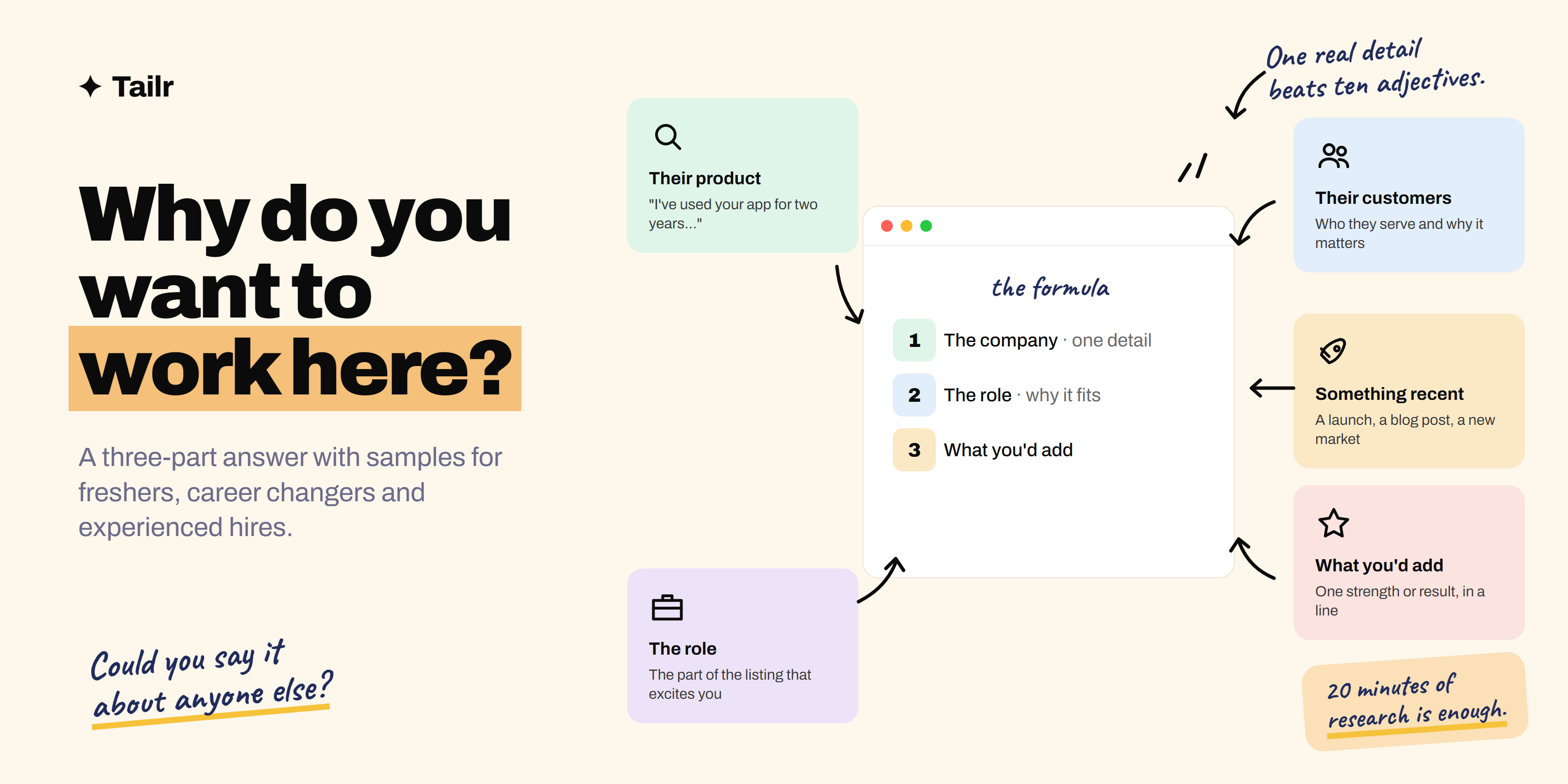
The short answer: answer “why do you want to work here?” in three parts, in about a minute:
- The company: name one specific thing about them that genuinely interests you, such as their product, customers, a recent launch or how they work.
- The role: explain why this job fits the work you do well or want to do more of.
- What you’d add: finish with what you’d bring to the team.
If your answer could be said about any other company, it’s not specific enough.
What the interviewer is really asking
Under the question sit three smaller ones:
- Did you do your homework? If you can’t say anything specific about them, you probably won’t stay long.
- Do you understand what this job is? People who want the actual work tend to do it well.
- Are you motivated by the right things? Pay and perks matter to everyone, but if they’re the only reason, the interviewer worries you’ll leave for a better offer.
A good answer shows all three without sounding like you’ve memorised their About page.
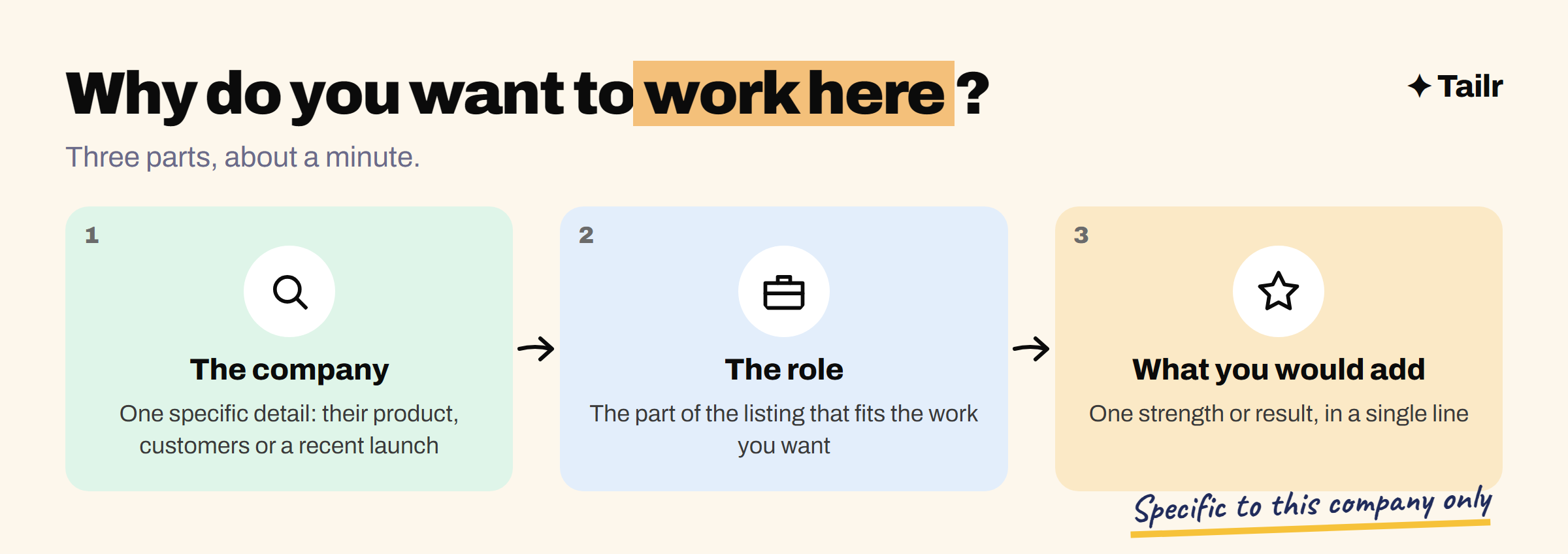
The company, role, add formula
1. The company: one specific detail
Pick one thing you actually find interesting and can talk about for a sentence or two. Good sources:
- The product. Use it if you can. “I’ve used your app for two years to split rent with flatmates” beats “I love your product.”
- Their customers or market. “You sell to small clinics that most software ignores” shows you understand the business.
- Something recent. A launch, an expansion, a blog post from the engineering or design team, a talk by someone on the team.
- How they work. Small teams, a strong writing culture, analysts embedded in product teams, whatever the job listing or their careers page says.
Specific beats impressive. One real detail is worth more than three adjectives about their “mission”.
2. The role: why this job fits you
Connect the job to what you’ve done or want to do. Re-read the job description and pick the part that genuinely excites you: “The listing says this role owns onboarding end to end, and onboarding is the part of my current job I’ve enjoyed most.” This shows you read it and that the work itself motivates you.
3. What you’d add
Close by turning it back to them, in one line: “I’ve rebuilt two onboarding flows already, and I’d love to bring that here.” It’s not a full sales pitch (that’s why should we hire you), just a reminder that wanting the job and being good at it go together.
How to research a company in 20 minutes
You don’t need hours. Spend 20 to 30 minutes on:
- The job description. What do they list first, and what comes up more than once?
- Their website and product. Sign up for a free trial or download the app if you can.
- Recent news or their blog. Look for a launch, funding, a new market or a team post.
- LinkedIn. Look at your interviewer and two or three people in the team. How long have they stayed? What did they do before?
- Reviews. Glassdoor (glassdoor.com) can tell you how people describe the culture, but take single reviews with a pinch of salt.
Write down two details you could mention honestly. You’ll use one and keep the other in reserve.
Sample answers
Experienced professional (product designer at a fintech company)
“I’ve been using your app to manage my freelance invoices for about a year, and what struck me is how much effort you put into the boring parts, like the payment reminders. That’s the kind of design I like doing: making dull, important flows feel easy. The listing says this role owns the business accounts experience, which is close to what I did at my last company when we redesigned our billing settings and cut support tickets by a third. I’d love to bring that here.”
Fresher or recent graduate (junior software engineer)
“I read your engineering blog post about moving your search to a new indexing system, and I liked how openly you wrote about what went wrong. I’d like to start my career somewhere that cares about doing things properly and explains why. In my final-year project I built a small search feature using Postgres full-text search, so this team’s work is exactly what I want to get better at, and I’d bring solid fundamentals and a lot of willingness to learn.”
Career changer (retail manager to customer success)
“Your customers are mostly independent shop owners, and I’ve spent seven years on the other side of that counter as a retail manager. I know how little time they have and how much they rely on tools that just work. This role is about helping them get value quickly, which is what I did when I trained new staff on our point-of-sale system. I’d bring that patience, plus a real understanding of what their day looks like.”
For more on framing a switch, read how to switch careers into tech.
Large, well-known company (marketing associate)
“Everyone knows the brand, but what interested me was the shift you’ve made over the last two years towards smaller, local campaigns, like the one you ran with neighbourhood bakeries last spring. That’s the kind of marketing I enjoy, where you can see the effect on a real community. This role sits on that local team, and in my internship I ran a small campus campaign that tripled sign-ups for a student app, so I’d bring some hands-on experience with exactly that kind of work.”
Fill-in-the-blank template
“What drew me to [company] is [one specific detail: product, customers, recent launch, how the team works]. I’m especially interested in this role because [the part of the job that excites you, from the listing], which is close to [what you’ve done or want to do more of]. I’d bring [one strength or result] to the team.”
Mistakes to avoid
- Only talking about what you get. “Great benefits and close to home” answers a different question.
- Generic praise. “You’re an industry leader with a great culture” fits every company on earth.
- Reciting the mission statement. They wrote it; they don’t need it read back.
- Overdoing the flattery. One genuine detail sounds sincere. Five sound like you’re auditioning.
- Admitting you didn’t look. “I don’t know much about you yet, but…” is the one answer that’s hard to recover from.
- Saying it’s a stepping stone. Wanting to grow is fine. Saying you plan to leave in a year isn’t.
Your application should tell the same story
Interviewers often ask this after reading your resume and cover letter. If those are generic, your answer has to work twice as hard. A resume that leads with the skills from this listing, and a cover letter that mentions something specific about the company, make your answer sound like a continuation rather than a performance. Tailr is a Chrome extension that tailors your resume to the job listing you’re viewing and writes a matching cover letter, so the whole application points at this company, not just your interview answer. See how to tailor your resume to a job description for the manual version.
Try TailrRelated guides
- How to answer “tell me about yourself”
- How to answer “where do you see yourself in 5 years?”
- Questions to ask at the end of an interview
Conclusion
“Why do you want to work here?” is really asking whether you chose them. Answer with one specific detail about the company, one honest reason this role fits you, and one line about what you’d add. Spend 20 minutes on research, keep it to about a minute, and test your answer by asking whether it could be said about any other company. If it couldn’t, you’ve got it.
Frequently asked questions
01How do I answer 'why do you want to work here?'
Use three parts: name one specific thing about the company that genuinely interests you, explain why this particular role fits the work you do or want to do, and finish with what you'd add to the team. Keep it to about a minute and make sure every part could only be said about this company.
02What should I not say when asked why I want to work here?
Avoid answers that only talk about what you get, like salary, location, perks or 'it's a big brand'. Also avoid generic praise that fits any company ('you're an industry leader'), reading their mission statement back to them, and saying you just need a job, even if it's true.
03How do I answer 'why do you want to work here?' as a fresher?
Focus on what you'd learn and what you can already contribute. Name something specific about the company, such as a product you've used or how their teams work, connect the role to a project or course you enjoyed, and say what you'd bring, like strong fundamentals in the tools they use.
04How do I research a company before an interview?
Spend 20 to 30 minutes on their website, recent news and blog posts, the product itself if you can try it, the job description, and the LinkedIn profiles of people on the team. You're looking for one or two specific details you can mention honestly, not a summary of everything they do.
05Is 'why do you want to work here' the same as 'why do you want this job'?
They overlap. 'Why do you want to work here' leans towards the company: its product, mission, customers or culture. 'Why do you want this job' leans towards the role and the work itself. A good answer covers both, so you can use the same three-part formula for either and adjust the emphasis.
06How long should my answer be?
About 45 seconds to a minute, roughly 100 to 150 words spoken. That's long enough for one specific detail about the company, one reason the role fits and one line about what you'd bring. Any longer and it starts to sound rehearsed.