How to Answer "Where Do You See Yourself in 5 Years?"
· updated
“Where do you see yourself in 5 years?” is one of the oldest interview questions, and one of the easiest to get wrong. Nobody expects you to predict the future. The interviewer wants to know whether this job fits where you’re heading, and whether you’ll still be around once they’ve trained you. Here’s how to answer “where do you see yourself in 5 years?” with a clear direction, plus sample answers and what to avoid.
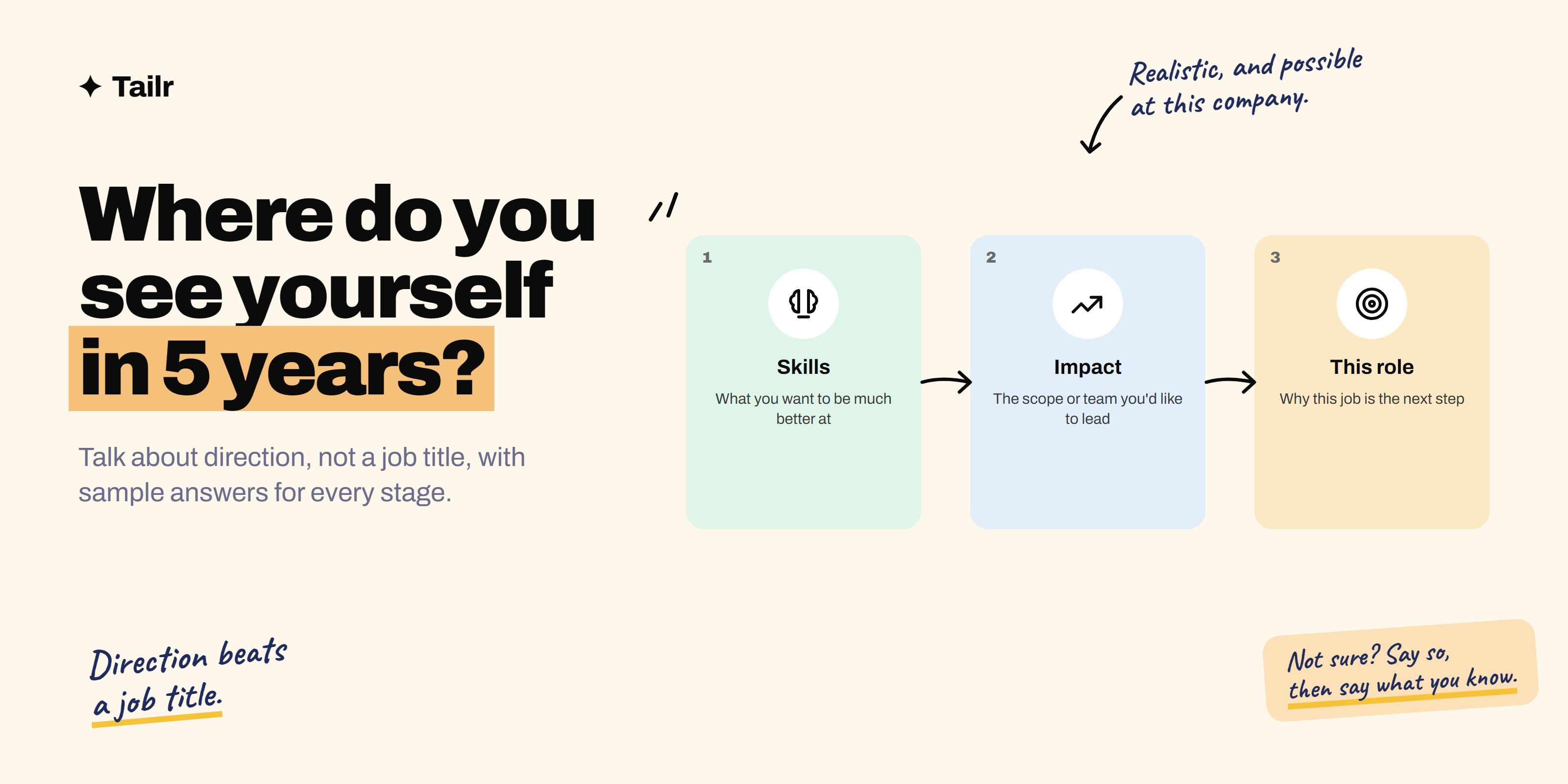
The short answer: answer “where do you see yourself in 5 years?” with direction, not a job title, in three parts:
- Skills: the skills you want to be much better at in five years.
- Impact: the kind of responsibility or impact you’d like to have, such as owning a product area or leading a small team.
- This role: how this job is a natural step towards that.
Keep it to about a minute, keep it realistic, and make sure the path you describe could happen at this company.
What the interviewer is really asking
The question is about the present more than the future. Interviewers are checking:
- Will you stay? Hiring and training someone is expensive. If your plan is clearly somewhere else, that’s a risk.
- Do your goals match the role? If you want to manage people and the role is a deep specialist job with no team, someone ends up unhappy.
- Have you thought about it at all? People who know what they want to get better at tend to grow faster.
You don’t need a ten-step career plan. You need a direction that makes this job make sense.
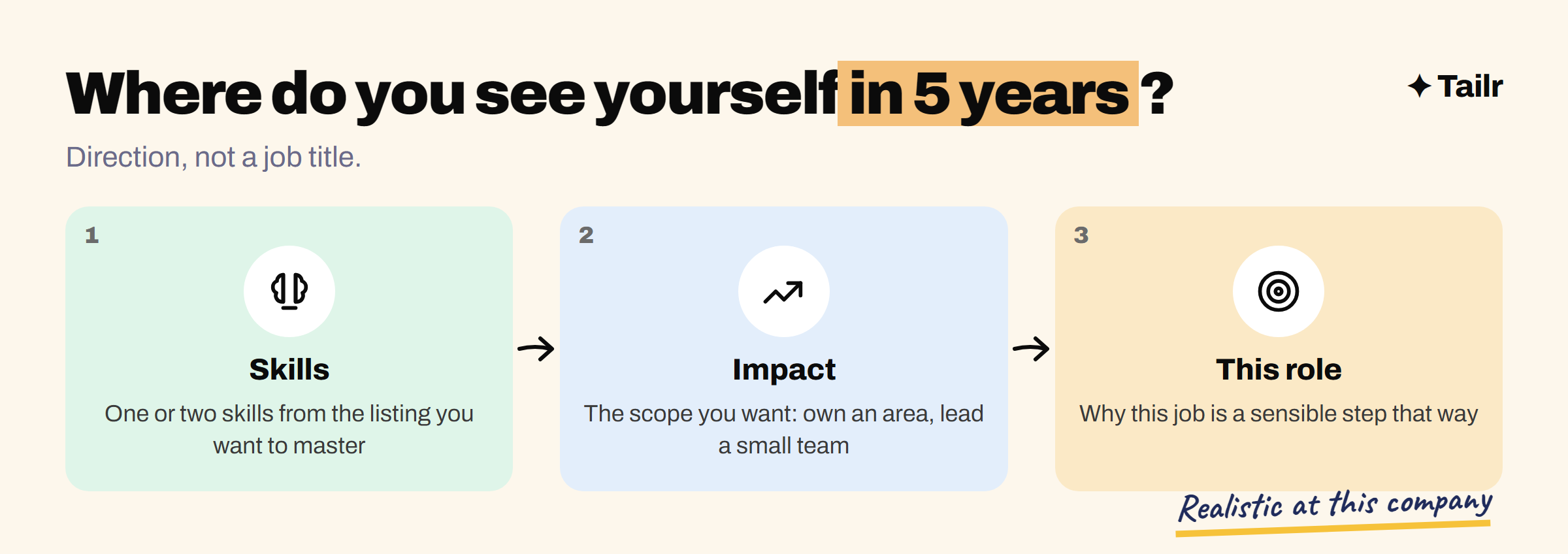
The skills, impact, this role formula
1. Skills you want to build
Start with what you want to be good at. Pick one or two skills that matter in this role, taken from the job description: “In five years I’d like to be someone people come to for anything to do with pricing analysis.” Skills are safe to aim for because they don’t depend on a particular org chart.
2. The impact you want to have
Then describe the scope you’d like: owning a product area, leading a small team, mentoring newer people, being trusted with bigger customers. Keep it about responsibility, not a title. “Leading a small team” sounds ambitious and realistic. “VP by 30” sounds like a demand.
3. How this role fits
Close by connecting it to this job: “That’s why this role appeals to me. It’s hands-on with pricing from day one, and you mentioned analysts here often move into owning a product line.” If the interviewer told you about career paths earlier in the conversation, use what they said.
How to find a realistic five-year answer
If you’re not sure what to say, do a little homework:
- Look at the job description. What does the senior version of this role do? That’s a reasonable five-year direction.
- Look at LinkedIn. Find two or three people who held this job at the company or a similar one. Where are they now?
- Ask yourself what you enjoy. Which parts of your current work would you happily do more of? Which would you drop?
- Listen during the interview. If they mention promotions, team growth or new projects, connect your answer to them.
Sample answers
Experienced professional (marketing manager)
“In five years I’d like to be leading a small growth team, with a couple of people I’ve helped develop, and owning a meaningful part of the company’s acquisition numbers. I’ve spent the last four years getting good at paid search and lifecycle email, and the next step for me is combining those into a full-funnel view and helping others do the same. This role covers both channels and you mentioned the team is growing next year, so it feels like a natural fit for that direction.”
Fresher or recent graduate (junior data analyst)
“For the first couple of years I want to get really strong at the fundamentals: SQL, building dashboards people actually use, and explaining numbers clearly to non-technical teams. By five years I’d like to be the analyst a product team relies on, someone who’s trusted to own an area and spot problems before anyone asks. This role is a great start for that because your analysts work directly with product managers from day one.”
Technical role (software engineer)
“I’d like to be a senior engineer who other people trust with the hard parts of the system, the kind of person who can take a vague problem and design something that lasts. I’m less sure yet whether that leads towards management or staying technical, and I’d like to figure that out by doing more mentoring. Your team’s work on the payments platform is exactly the kind of complex, high-stakes area where I’d learn that fastest.”
Career changer (teacher to instructional designer)
“In five years I’d like to be an experienced instructional designer who leads course projects end to end, from research with learners to measuring whether the course worked. I’ve got the teaching side from eight years in classrooms, and this role would give me the corporate learning and tool experience I need. I’d like to grow here, and I liked hearing that your designers take on their own projects within the first year.”
When you honestly don’t know
“I don’t have a fixed title in mind, and I think that’s partly because roles change so much. What I do know is that I want to be much deeper in customer research than I am now, and trusted to run bigger studies on my own. Whatever the title is, I’d like to be doing that work, and this role is a good step towards it.”
Fill-in-the-blank template
“In five years I’d like to be [much stronger at skill 1 and skill 2], and [the impact or responsibility you want: owning X, leading a small team, mentoring]. This role appeals to me because [how it builds those skills or leads that way], and [something the interviewer said about growth here].”
What not to say
- “In your job.” It’s a tired joke, and some interviewers will take it badly.
- “Running my own business.” It tells them you’re planning to leave.
- “I don’t know.” Fine as a starting point, but follow it with what you do know.
- A completely different career. If you want to be a lawyer, they’ll wonder why you’re interviewing for marketing.
- A rigid title and timeline. “Director in three years” sounds like an ultimatum.
- Personal life plans. Moving countries, having kids or travelling for a year aren’t things they need to hear, and they don’t help your answer.
Your resume tells the first half of the story
Your answer works best when your resume already shows the direction you describe: the skills you’re building, the projects that got bigger over time. If you’re aiming for a particular kind of role, tailor each application so the most relevant experience comes first. Tailr does that from the job listing you’re viewing, using only your real experience, and keeps track of every application you send. The manual method is in how to tailor your resume to a job description.
Try TailrRelated guides
- How to answer “why do you want to work here?”
- How to answer “what are your strengths?”
- How to answer “tell me about yourself”
Conclusion
“Where do you see yourself in 5 years?” isn’t a prediction test. Talk about the skills you want to build, the kind of impact you’d like to have, and why this role is a sensible step in that direction. Keep it realistic, avoid naming a title on a deadline, and if you’re unsure, say so and then talk about what you do know. A clear direction is all the interviewer is looking for.
Frequently asked questions
01How do I answer 'where do you see yourself in 5 years?'
Talk about direction, not a job title. Name the skills you want to get better at, the kind of impact or responsibility you'd like to have, and show how this role is a natural step towards that. Keep it to about a minute and make sure the path you describe could happen at this company.
02What should I not say when asked where I see myself in 5 years?
Avoid 'in your job', 'running my own company', 'I don't know', a completely different career, or a joke answer. Also avoid naming a specific title on a fixed timeline, like 'director in three years', which can sound unrealistic or like you'll leave if it doesn't happen.
03What if I genuinely don't know where I'll be in 5 years?
That's normal, and you don't need a detailed plan. Talk about what you're sure of: the skills you want to build and the kind of work you enjoy. You can even say it honestly: 'I don't have a fixed title in mind, but I know I want to be much deeper in X and trusted with Y.'
04How do I answer this question as a fresher?
Focus on learning and growing into the field. Say which skills you want to master in the first couple of years, that you'd like to take on more ownership over time, and how this role gives you a strong foundation. Interviewers don't expect freshers to have a career plan, just a sense of direction.
05Is it OK to say I want to be a manager in 5 years?
Yes, if it's true and the company has that path, but frame it around what management involves: 'I'd like to be leading a small team and helping newer people grow.' Avoid sounding like you want the title more than the work, and don't suggest you want your interviewer's job.
06Why do interviewers ask where you see yourself in 5 years?
They want to know whether you'll stay long enough to be worth training, whether your goals match what the role can offer, and whether you've thought about your career at all. It's less about predicting the future and more about checking that this job fits where you're heading.