How to Answer "What Are Your Strengths?" (With Examples)
· updated
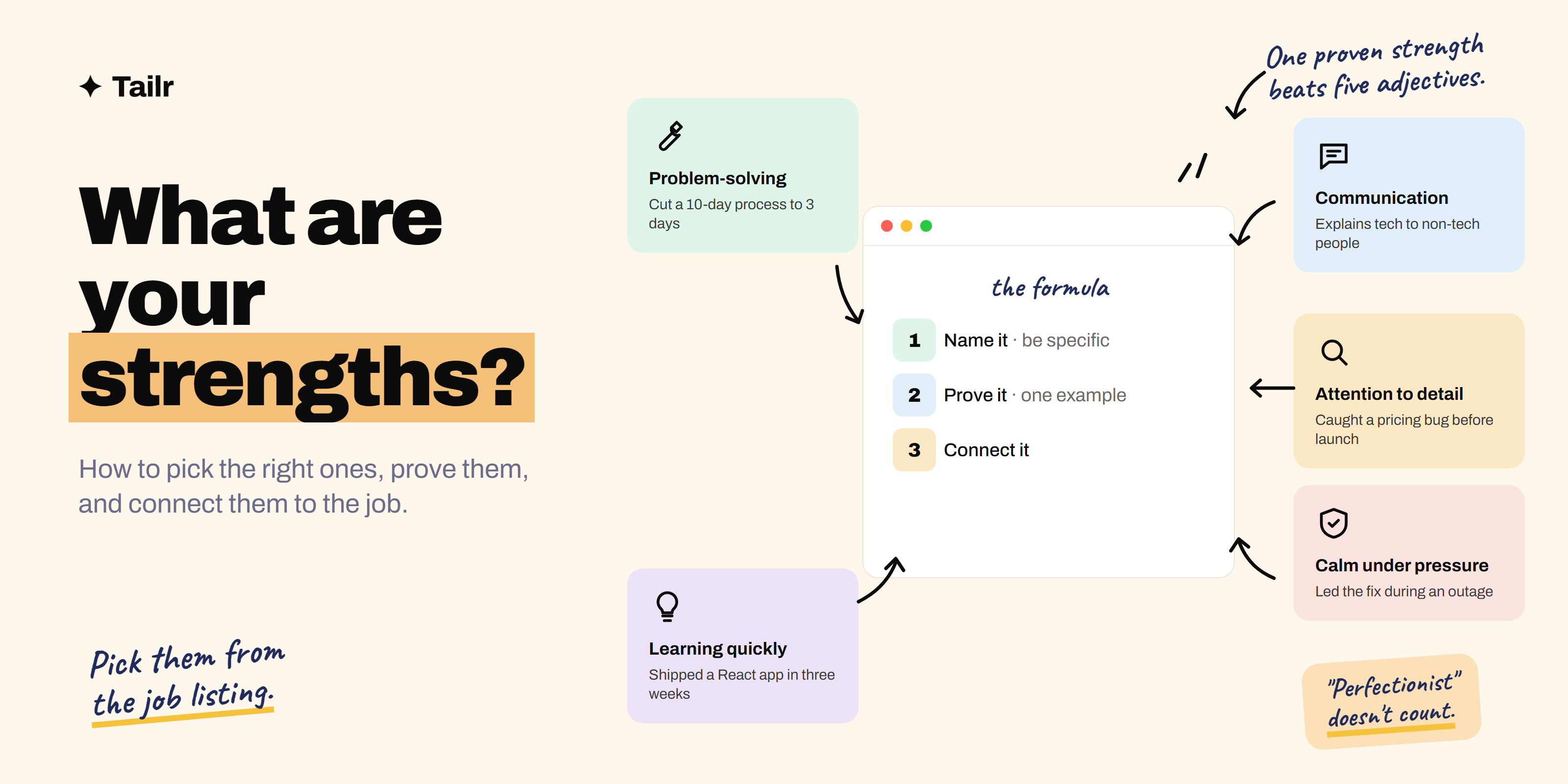
“What are your strengths?” looks like the easiest question in the interview. You get to say nice things about yourself. But most answers sound identical (“I’m hard-working, a fast learner and a team player”), and the interviewer forgets them before you’ve finished. Here’s how to answer “what are your strengths?” with strengths that fit the job, proof that makes them believable, and examples you can adapt.
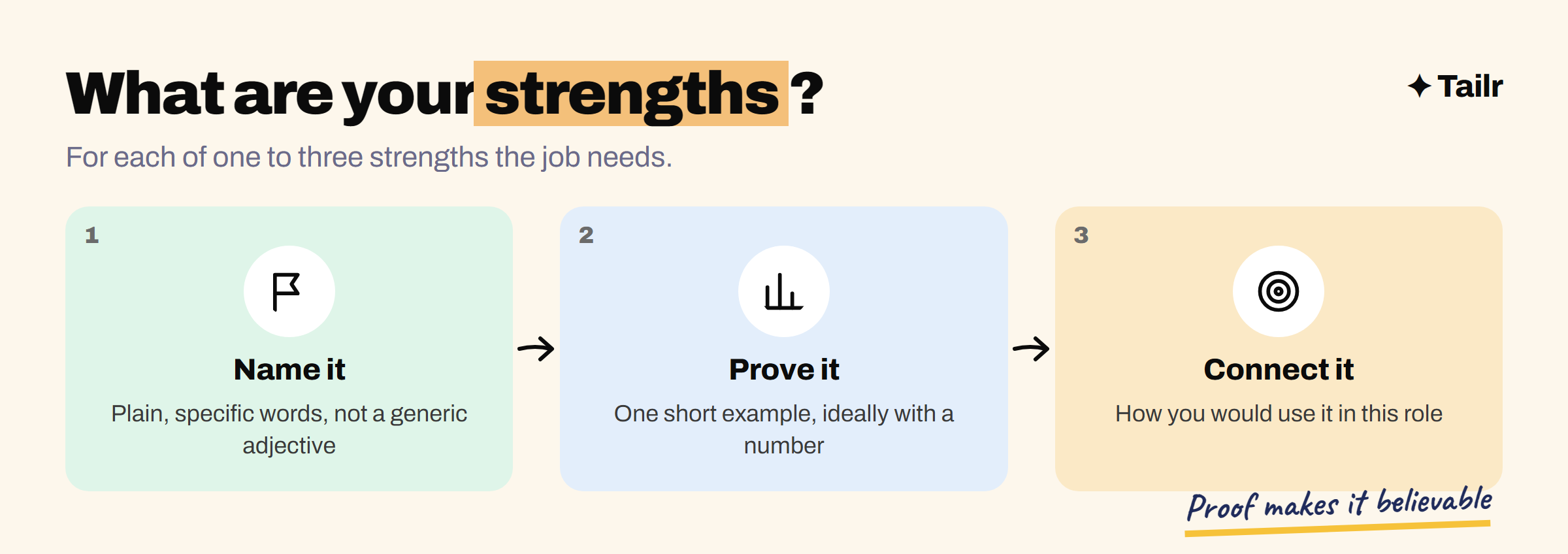
The short answer: answer “what are your strengths?” with one to three strengths the job needs, and for each one:
- Name it: say the strength in plain, specific words.
- Prove it: give a short example or result that shows it.
- Connect it: say how you’d use it in this role.
Pick strengths from the job description, not a generic list, and keep the whole answer to about a minute.
What the interviewer is really asking
The question is testing two things:
- Self-awareness. Do you know what you’re good at, and can you back it up?
- Fit. Are your strengths the ones this job needs?
That’s why “I’m a perfectionist” or “I work too hard” fall flat. They don’t prove anything and they don’t connect to the role. A strength only counts in an interview if it’s relevant and believable.
How to pick the right strengths
- Read the job description. List the qualities it mentions more than once or puts first: “detail-oriented”, “comfortable with ambiguity”, “strong communicator”.
- Match them to your evidence. For each one, can you think of a specific time you showed it? If not, cross it off.
- Make it specific. “Communication” is vague. “Explaining technical problems to non-technical people” is a strength someone can picture.
- Pick one to three. One for “what is your greatest strength?”, two or three for “what are your strengths?”.
The name, prove, connect formula
1. Name it
Use plain words, and narrow it down. Compare:
- Vague: “I’m a good problem-solver.”
- Specific: “I’m good at untangling messy processes that nobody owns.”
2. Prove it
Give one short example, ideally with a number or visible result. This is where the STAR method helps, but keep it to two or three sentences, not a full story.
- “At my last job, our refund process involved four teams and took ten days. I mapped it, removed two hand-offs and got it down to three days.”
3. Connect it
Close by tying it to the role: “You mentioned the operations team is growing fast, and that’s usually where processes start breaking, so I think that strength would be useful here.”
Examples of strengths by type
| Strength | A specific way to say it | Example proof |
|---|---|---|
| Problem-solving | “I’m good at untangling messy processes” | Cut a 10-day refund process to 3 days |
| Communication | “I explain technical things to non-technical people” | Wrote the help docs that cut support tickets by 20% |
| Attention to detail | “I catch errors before they reach customers” | Found a pricing bug in QA that would have overcharged 2,000 users |
| Learning quickly | “I get productive in new tools fast” | Learned React for a project and shipped it in three weeks |
| Organisation | “I keep complicated projects on track” | Ran a 12-person product launch with no missed deadlines |
| Calm under pressure | “I stay steady when things go wrong” | Led the response to a site outage on Black Friday |
| Customer focus | “I build trust with difficult customers” | Turned a cancelling account into a renewal |
| Ownership | “I take on problems no one has claimed” | Fixed a broken onboarding email nobody owned, lifting activation |
Use this as a starting point, then swap in your own proof.
Sample answers
Experienced professional (operations manager)
“My biggest strength is untangling messy processes. At my current company, our refund process ran across four teams and took about ten days. I mapped every step, removed two hand-offs and set up a shared tracker, and it now takes three days. I’m also good at getting people on board with changes, because I involve them early. You mentioned the team has doubled this year, so I think both of those would be useful here.”
Fresher or recent graduate (junior developer)
“Two strengths I’d point to are learning quickly and finishing what I start. For my final-year project, I needed a frontend framework I’d never used, so I taught myself React in about two weeks and we shipped a working app that 150 students used during exam season. I also built a small budgeting tool on my own over the summer and kept going until it was deployed, rather than leaving it half-done. For a junior role where I’ll be picking up your stack, I think both matter.”
Customer-facing role (account manager)
“I’m good at building trust with customers who are unhappy. Last year one of our larger accounts was about to cancel after a bad rollout. I set up weekly calls, fixed the three issues they cared most about and was honest about what we couldn’t do yet. They renewed for two years. This role covers a lot of existing accounts, so I’d expect to use that a lot.”
Career changer (nurse to project coordinator)
“My strengths are staying calm under pressure and keeping lots of moving parts organised. As a nurse, I coordinated care for eight to ten patients a shift, across doctors, pharmacy and families, where small mistakes really matter. I also led the switch to a new handover checklist on my ward. Project coordination is a different setting, but it’s the same core skill: making sure the right people know the right things at the right time.”
Fill-in-the-blank template
“One of my strengths is [specific strength in plain words]. For example, at [company or project], I [what you did], which [result, ideally with a number]. I think that would be useful here because [connection to the role or something the interviewer said].”
Mistakes to avoid
- Listing adjectives. “Hard-working, passionate, team player” with no proof is forgettable.
- Picking strengths the job doesn’t need. Creativity is great, but not if the role is about precision and compliance.
- Humblebrags. “I’m a perfectionist” and “I care too much” are weakness answers in disguise.
- Overclaiming. “I’m the best communicator you’ll meet” invites the interviewer to look for gaps.
- Contradicting yourself. If you say you’re detail-oriented, make sure your resume has no typos.
If you’re also preparing the other side, read how to answer “what is your greatest weakness?”.
Make your resume show the same strengths
Your strongest answer is one that confirms what’s already on the resume in front of the interviewer. If you’re claiming you’re great with customers, your top bullets should show it. Tailr is a Chrome extension that tailors your resume to the job listing you’re viewing, pulling forward the experience that matches what they’re asking for, without inventing anything. Then use those same examples when you talk about your strengths.
Try TailrRelated guides
- How to answer “why should we hire you?”
- How to answer “where do you see yourself in 5 years?”
- Resume action verbs
Conclusion
“What are your strengths?” is a chance to show self-awareness, not to list compliments. Pick one to three strengths the job needs, name each one in specific words, prove it with a short example, and connect it to the role. Keep it to about a minute, avoid humblebrags, and make sure your resume backs up what you say.
Frequently asked questions
01How do I answer 'what are your strengths?'
Pick one to three strengths the job actually needs, taken from the job description. For each one, name it in plain words, prove it with a short, specific example or result, and connect it to how you'd use it in this role. Keep the whole answer to about a minute.
02What are good strengths to mention in an interview?
The best strengths are ones the role needs and you can prove. Common ones include problem-solving, clear communication, attention to detail, learning new tools quickly, organisation, reliability under pressure, working well with customers, and taking ownership. A specific version, like 'explaining technical problems to non-technical people', beats a vague one.
03How many strengths should I mention?
One to three. One strength with a strong example is better than five with no proof. If the interviewer asks for your 'greatest strength', give one. If they ask for 'strengths', give two or three, each with a quick example.
04What are good strengths for freshers?
Freshers can talk about learning quickly, strong fundamentals in the tools the role uses, reliability, communication, and taking initiative. Prove them with projects, internships, coursework, part-time jobs or volunteering, such as teaching yourself a new framework for a final-year project.
05What strengths should I avoid mentioning?
Avoid strengths with no link to the job, clichés with no proof like 'hard-working' or 'perfectionist', anything that sounds arrogant, and humblebrags like 'I care too much'. Also avoid strengths the interviewer can easily contradict from your resume or the rest of the interview.
06What's the difference between strengths and skills?
Skills are things you've learned to do, like SQL or writing ad copy. Strengths are broader qualities you bring to the work, like solving messy problems or staying calm with angry customers. In an interview, the best answers combine them: a strength, shown through a specific skill or result.