STAR Method: How to Answer Interview Questions (With Examples)
· updated
“Tell me about a time when…” is the most common way interviewers find out how you actually work. It’s also where good candidates ramble, skip the outcome or describe what their team did instead of what they did. The STAR method fixes all three.
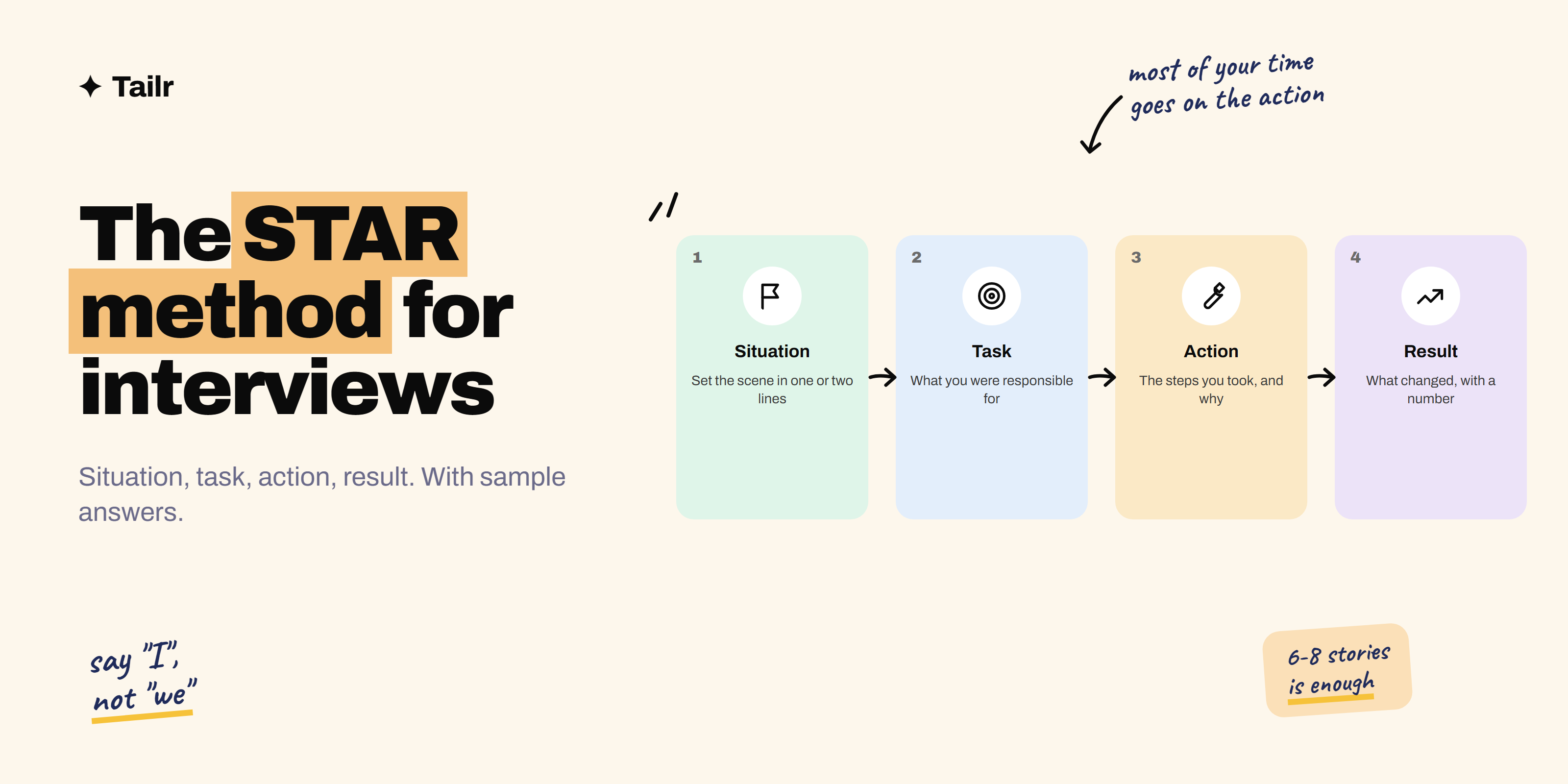
The short answer: the STAR method is a four-part structure for answering behavioral interview questions:
- Situation: set the scene in one or two sentences.
- Task: say what you were responsible for.
- Action: explain the specific steps you took. This is the longest part.
- Result: share what happened, with a number if you can, and what you learned.
Use it whenever a question asks for a real example from your past.
When to use the STAR method
STAR is built for behavioral questions. You’ll recognize them by how they start:
- “Tell me about a time when…”
- “Give me an example of…”
- “Describe a situation where…”
- “Have you ever…?”
- “What did you do when…?”
Interviewers ask these because past behavior is the best predictor of future behavior. They don’t want your opinion on how to handle conflict; they want proof you’ve done it. Our list of behavioral interview questions has 40 of them with sample answers.
STAR is less useful for hypothetical questions (“what would you do if…?”). Those are situational questions, and you answer them with a plan rather than a story. See our guide to situational interview questions for that format.
How to structure each part
The most common STAR mistake is getting the proportions wrong. People spend a minute on background and ten seconds on what they did. Flip that.
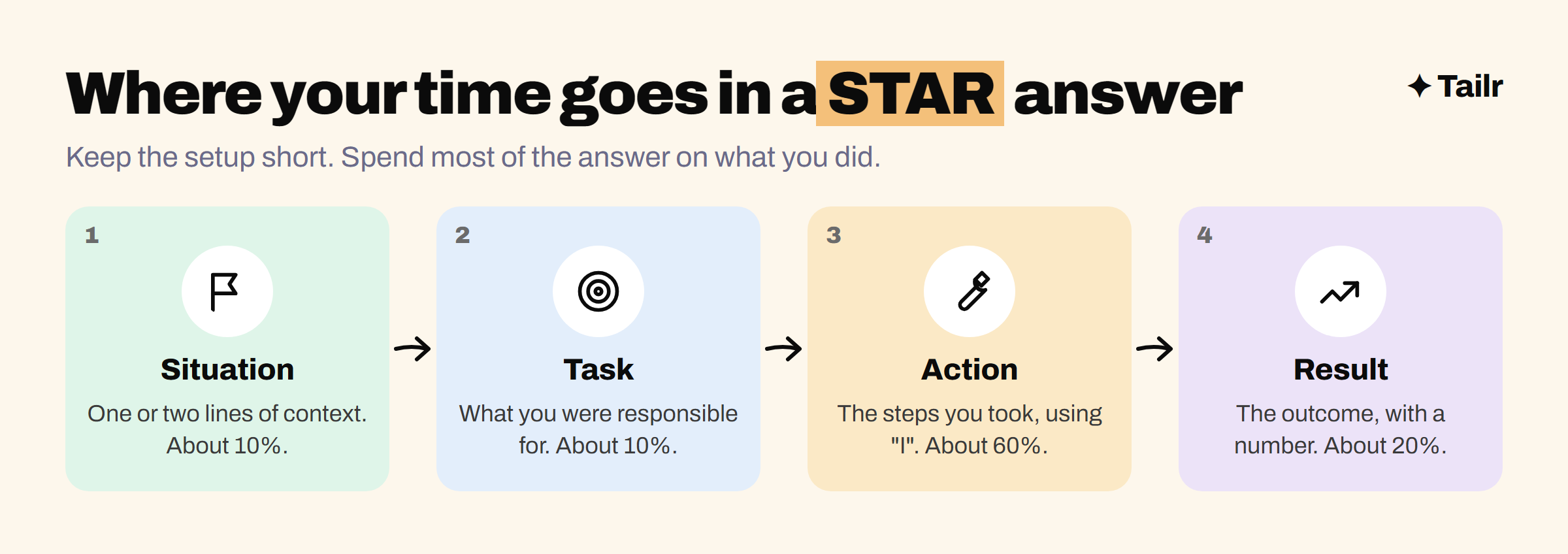
Situation (about 10%)
Give just enough context for the story to make sense: where you were, what was going on, why it mattered. One or two sentences.
“In my second year at a logistics startup, our biggest customer threatened to leave after three late deliveries in a month.”
Task (about 10%)
Say what you were responsible for. This separates your role from the team’s.
“I was the operations analyst, and my manager asked me to find out why deliveries were late and fix it within two weeks.”
Action (about 60%)
This is the heart of the answer. Walk through what you did, step by step, using “I”. Include the decisions you made and why.
“First, I pulled three months of delivery data and found that 80% of late orders came from one warehouse. I spent a day there and saw that orders were being picked in the order they arrived, not by delivery deadline. I worked with the warehouse lead to add a priority flag for same-day orders, rewrote the pick list to sort by deadline, and set up a daily report so we’d see problems before the customer did.”
Result (about 20%)
End on the outcome. Use a number if you have one, and say what changed for the business, team or customer. If it’s useful, add one line on what you learned.
“Late deliveries for that customer dropped from 12% to under 2% within a month, and they renewed their contract for another year. The priority flag became standard across all three warehouses.”
STAR method examples
Example 1: a conflict with a colleague
Q: Tell me about a time you disagreed with a coworker.
“On a website redesign, the lead designer wanted to remove the search bar from the homepage to simplify it (situation). I owned the product analytics and was worried it would hurt sales (task). Instead of arguing in the meeting, I pulled data showing that 35% of purchases started with a homepage search, and suggested we A/B test the new design rather than ship it straight away. I shared the data with her privately first so it didn’t feel like an ambush (action). The test showed a 9% drop in sales without search, so we kept it but made it smaller. She later asked me to help set up tests on her other projects (result).”
Example 2: a failure
Q: Tell me about a time you failed.
“In my first month as a team lead, I promised a client a feature launch in three weeks (situation). I was responsible for the timeline (task). I estimated it myself without asking the engineers, and we missed the date by two weeks. When it became clear we’d be late, I told the client straight away, explained why, and gave a new date with buffer built in (action). We hit the new date, and the client stayed. Since then, I never commit to a date without the people doing the work in the room (result and reflection).”
Example 3: with no work experience
Q: Give me an example of when you showed leadership.
“In my final-year project, our team of four was two weeks behind with a month left (situation). Nobody had been made lead, and I decided to take on coordinating the work (task). I broke the remaining work into small tasks, set up a shared board, and ran a 15-minute check-in every other day. When one teammate was struggling with the backend, I paired with him for two evenings (action). We submitted three days early and got the second-highest grade in the class (result).”
Before and after: fixing a weak answer
Before:
“We had a big project with a tight deadline, and the team worked really hard. There were a lot of challenges but we managed to pull together and deliver it. It was a great experience and I learned a lot about teamwork.”
This has no specific situation, no clear role, no actions and no measurable result. The interviewer learns nothing about you.
After:
“Our client moved a product launch forward by two weeks, and I was responsible for getting the reporting dashboard ready. I cut the scope to the five reports they’d use on day one, agreed that list with the client in a 20-minute call, and asked a backend engineer to build the data pipeline in parallel with my front-end work. We shipped two days early, and the other reports followed the next sprint.”
Common STAR method mistakes
- Saying “we” the whole time. The interviewer can’t hire your team. Say “I” for your own actions, even if it feels awkward.
- Too much situation. If your setup takes more than 20 seconds, cut it.
- No result. Stories that trail off (“…and then the project ended”) leave the interviewer guessing. Always land on an outcome.
- Made-up numbers. Use real figures or honest estimates (“roughly half”). Interviewers often ask follow-up questions.
- Reciting a script. Know your stories well enough to tell them naturally, not word for word.
How to build your STAR story bank
You don’t need a new story for every question. Prepare six to eight strong ones and adapt them. Cover these themes:
- A time you led something
- A conflict or disagreement
- A failure or mistake
- A tight deadline or pressure
- A difficult customer or stakeholder
- A time you took initiative
- Your proudest achievement
- A time you learned something quickly
For each, write a few bullet points (not a full script) for S, T, A and R. Then practise saying each one out loud in under two minutes. If you want to add variety, our guide to interview answer frameworks covers alternatives like CAR and STARR.
Match your stories to the job
The best STAR stories prove the exact skills the job asks for. Before each interview, read the job description and pick the stories that match its top three requirements. If the listing stresses stakeholder management, lead with your difficult-client story, not your technical one.
Your resume should do the same thing. Every bullet is a mini STAR answer: an action and a result. Tailr is a Chrome extension that tailors your resume from the job listing you’re viewing, so the experience the interviewer asks about is already on the page. It also writes a matching cover letter and tracks your applications. For the manual approach, see how to tailor your resume to a job description.
Try Tailr before your next interview.
Related guides
- 40 Behavioral Interview Questions With Sample Answers
- Interview Answer Frameworks: 7 Methods to Structure Any Answer
- How to Answer “Tell Me About Yourself” in Any Interview
Conclusion
The STAR method works because it makes you answer the question the interviewer is really asking: what did you do, and did it work? Keep the situation and task short, spend most of your time on your actions, and always end on a result. Prepare six to eight stories, practise them out loud, and match them to each job you apply for.
Frequently asked questions
01What is the STAR method in an interview?
The STAR method is a way to structure answers to behavioral questions like "tell me about a time when...". You describe the Situation, the Task you were responsible for, the Action you took, and the Result. It keeps your answer focused and makes sure you end on the outcome, which is what interviewers remember.
02How long should a STAR answer be?
Aim for about one and a half to two minutes when spoken. Spend roughly 10% on the situation, 10% on the task, 60% on your actions and 20% on the result. If you're past three minutes, you're almost certainly giving too much background.
03Which interview questions need the STAR method?
Any question that asks for a real example from your past: "tell me about a time...", "give me an example of...", "describe a situation where..." or "have you ever...". These are behavioral questions, and they come up in almost every interview, from graduate roles to senior leadership.
04Can I use the STAR method if I have no work experience?
Yes. Use examples from college projects, internships, part-time jobs, volunteering, sports teams or clubs. Interviewers care about how you behaved and what you learned, not whether the example came from a paid job.
05What if my STAR story didn't have a good result?
You can still use it, especially for questions about failure or mistakes. Describe the result honestly, then add what you learned and what you'd do differently. This version is sometimes called STARR, with the final R standing for reflection.
06How many STAR stories should I prepare?
Prepare six to eight strong stories that cover common themes: leadership, conflict, failure, a tight deadline, a difficult stakeholder, a time you took initiative, and your biggest achievement. Most stories can be adapted to answer several different questions.