SMART Framework for Interviews: How to Answer Goal Questions
· updated
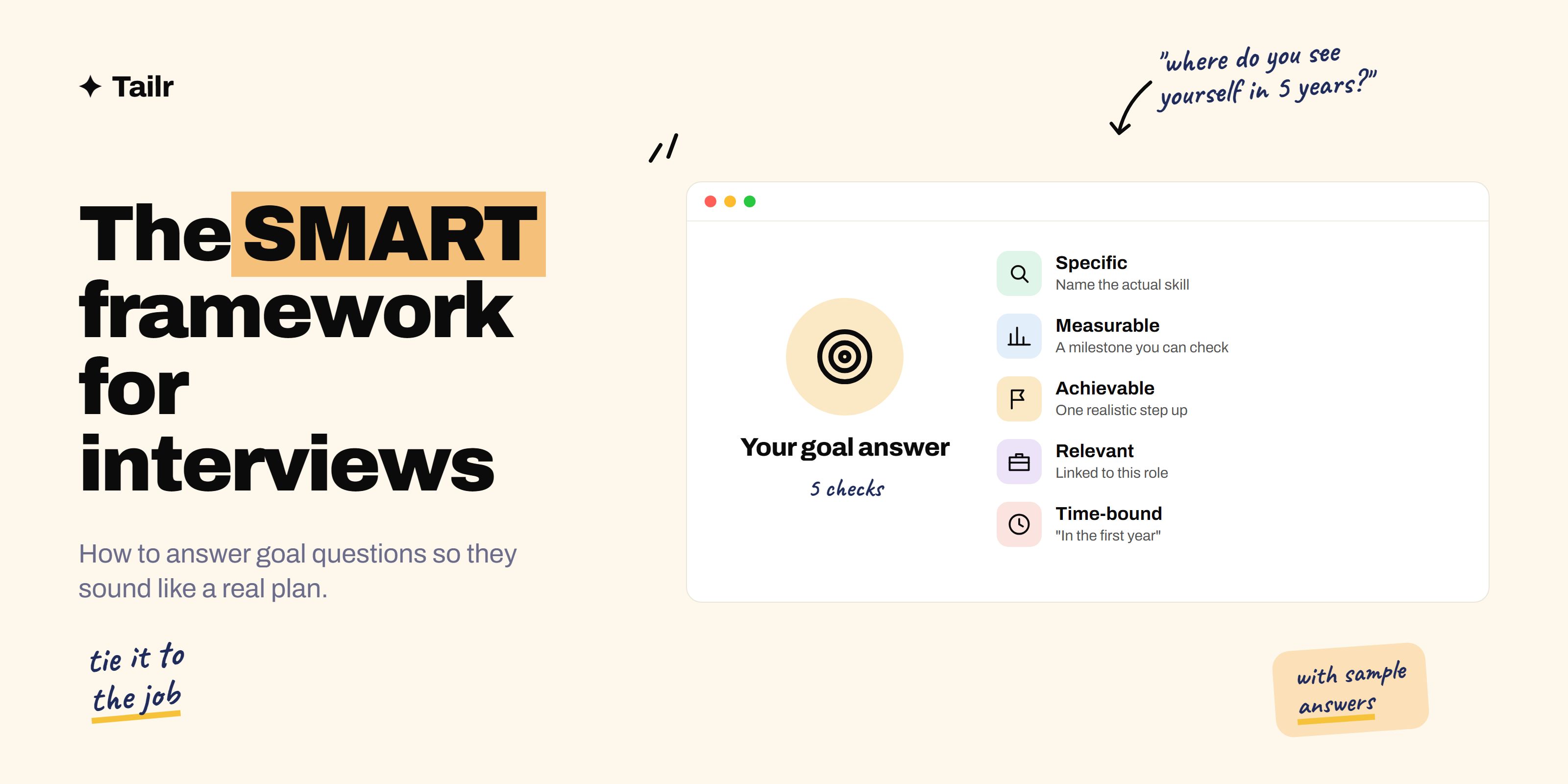
“Where do you see yourself in five years?” sounds like a friendly question, but it’s a test. The interviewer wants to know whether you’ve thought about your career, whether this job fits into it, and whether you’ll stick around. Vague answers (“growing in my career”, “taking on more responsibility”) fail all three. The SMART framework gives you a structure that passes.
The short answer: the SMART framework turns a vague goal into a concrete one. A SMART goal is:
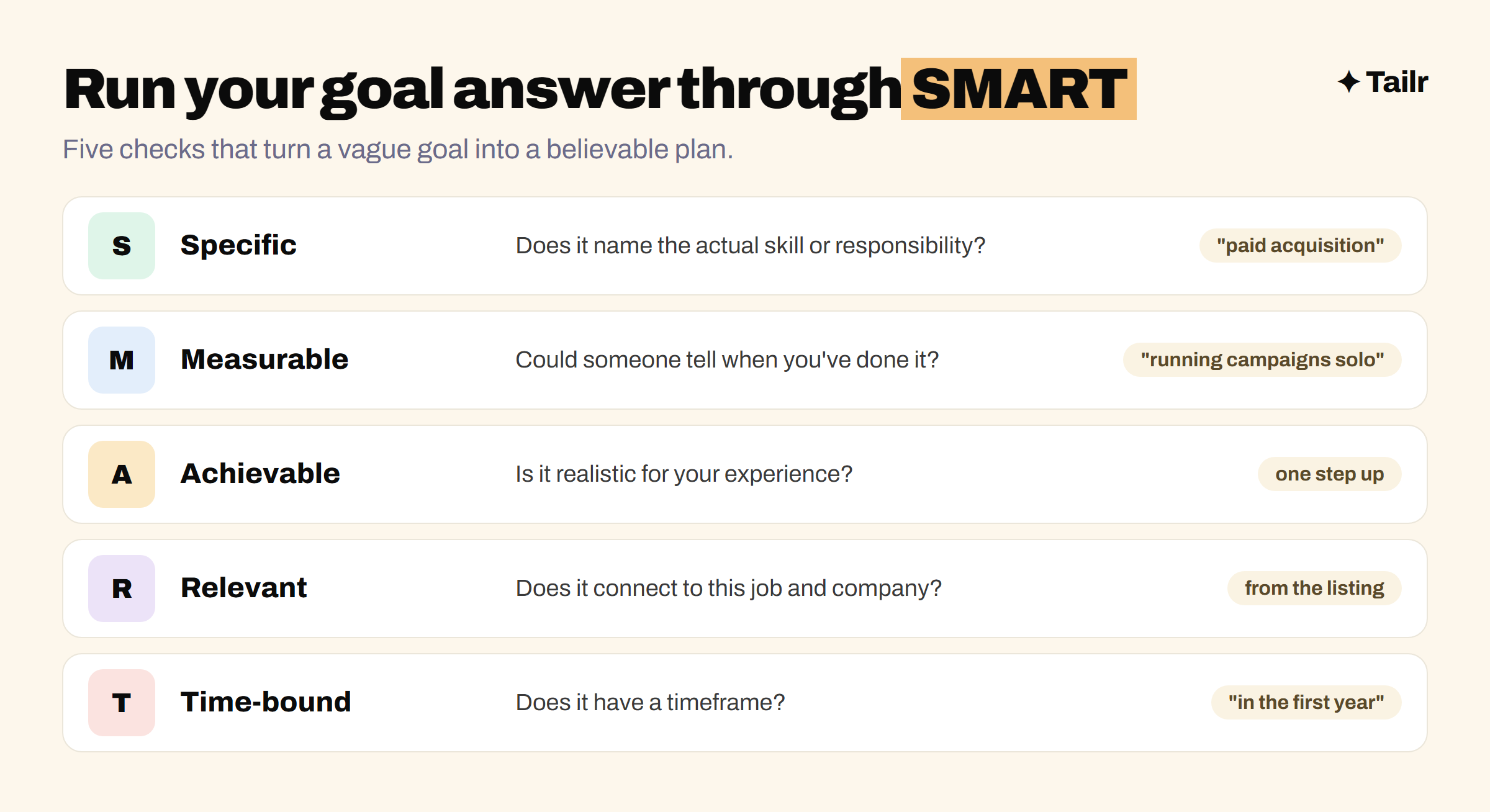
- Specific: names exactly what you want to do or learn.
- Measurable: includes a way to tell you’ve done it.
- Achievable: is realistic for your experience and the role.
- Relevant: connects to the job and company you’re interviewing for.
- Time-bound: has a timeframe, like a year or the first 90 days.
Use it for any interview question about your goals, plans or ambitions.
What SMART means in an interview
SMART is a goal-setting framework, usually traced to a 1981 article by George T. Doran in Management Review. Most companies use some version of it for performance reviews and planning, so interviewers already think in these terms.
In an interview, you don’t need to say “here’s my SMART goal”. You just use the five checks to shape your answer so it sounds like a plan. Compare:
Vague: “I want to grow as a marketer and take on more responsibility.”
SMART: “In the next year, I want to get really good at paid acquisition, to the point where I’m running campaigns on my own and hitting our cost-per-lead targets. Longer term, I’d like to be leading a small growth team, which is why this role, where I’d own campaigns from day one, is exactly the next step I’m looking for.”
The second answer is specific (paid acquisition), measurable (hitting cost-per-lead targets, leading a team), achievable (one step at a time), relevant (this role) and time-bound (next year, longer term).
Interview questions where SMART helps
“Where do you see yourself in five years?”
Split the five years in two. Be specific about the next one or two, since you know what this role involves. Be broader about years three to five, because nobody can plan that far precisely.
“For the first year or two, I want to become the person on the team who really knows our customers. I’d like to have run enough research and shipped enough features that I can make product calls confidently on my own. By year three to five, I’d like to own a whole product area and mentor newer PMs. This role is a great fit because I’d be working directly with customers from the start.”
“What are your short-term goals?”
Short-term means the next 6 to 12 months. Make it about the skills and results you’ll deliver in this job.
“In the next six months, I want to get comfortable with your tech stack and ship my first feature end to end. By the end of the first year, I’d like to have taken on code reviews for the team and reduced our page load time, which I saw was a priority in the job description.”
“What would you achieve in your first 90 days?”
This is the most SMART question of all. Break it into 30, 60 and 90 days, with a clear outcome for each.
“In the first 30 days, I’d meet every key stakeholder and learn how the current sales process works. By day 60, I’d aim to be running my own demos and have a pipeline of 15 qualified opportunities. By day 90, I’d want to close my first deals and share one improvement to the onboarding process based on what I’ve seen.”
“Tell me about a goal you set and achieved.”
Combine SMART with STAR. Describe the goal using SMART, then tell the story with the STAR method.
“Last year, I set myself a goal to cut our support team’s average response time from 8 hours to under 2 within one quarter (SMART goal). I started by tracking where tickets got stuck, found that 40% were waiting for the wrong team, and built routing rules to send them to the right place automatically. I also wrote saved replies for our 20 most common questions (action). We hit 1 hour 50 minutes by the end of the quarter, and customer satisfaction scores went up 12 points (result).”
“How do you set goals for yourself or your team?”
For managers and senior roles, describe your process. Mention SMART by name here if you like, since it shows you have a method.
“I use a simple version of SMART. Every goal needs a clear owner, a number we can track, and a date. I set them with the team rather than for them, so they’re achievable, and I make sure each one connects to a company priority. We check progress every two weeks, which means we spot problems early instead of at the end of the quarter.”
How to make each part strong
- Specific: replace “grow” and “learn” with the actual skill, tool or responsibility. “Get better at SQL” beats “develop technical skills”.
- Measurable: use a number, a milestone or a visible change. “Running campaigns on my own” is a milestone you can check.
- Achievable: don’t overreach. Saying you’ll be head of department in two years sounds unrealistic and a little alarming.
- Relevant: this is the part most people miss. Every goal should connect to the job you’re interviewing for. Use the job description to find the link.
- Time-bound: say “in the first year” or “by the end of the first quarter”, not “eventually”.
Mistakes to avoid
- Goals that point away from the job. “I’d like to start my own business” or “I’m planning to do a master’s next year” tells the interviewer you’re leaving.
- Naming their job. “I want to be in your seat” can come across as a threat. Describe responsibilities instead of titles.
- Being too rigid. “I’ll be a senior engineer in exactly 18 months” sounds inflexible. Leave room for the company’s needs.
- Only talking about yourself. Link your growth to what you’ll deliver for the team.
Use the job listing to make your goals relevant
The “relevant” part of SMART is easiest when you’ve read the job listing closely. If the listing mentions scaling a team, talk about mentoring. If it stresses data, talk about building analytics skills. Your goals should sound like they were made for this role, because they were.
The same applies to your resume. Tailr is a Chrome extension that tailors your resume from the job listing you’re viewing, so your experience lines up with what the role needs before you even get to the interview. It also writes a matching cover letter and tracks your applications. Try Tailr when you start applying, and read how to tailor your resume to a job description for the manual approach.
Related guides
- STAR Method: How to Answer Interview Questions (With Examples)
- Interview Answer Frameworks: 7 Methods to Structure Any Answer
- OKRs vs KPIs: What’s the Difference?
Conclusion
The SMART framework makes your goals sound real: specific, measurable, achievable, relevant and time-bound. Use it for any interview question about the future, split long-term answers into near-term detail and long-term direction, and always connect your goals back to the job you’re interviewing for. When they ask about a goal you’ve already hit, pair SMART with STAR.
Frequently asked questions
01What is the SMART framework in an interview?
SMART is a way to describe goals so they sound concrete and believable. A SMART goal is Specific, Measurable, Achievable, Relevant and Time-bound. In interviews, you use it to answer questions about your goals, plans and ambitions, so your answer sounds like a real plan rather than a vague wish.
02Which interview questions should I answer with SMART?
Use it for any question about goals: "where do you see yourself in five years?", "what are your short-term goals?", "what would you achieve in your first 90 days?" and "how do you set goals?". For questions like "tell me about a goal you achieved", combine SMART with the STAR method.
03How do I answer "where do you see yourself in five years" with SMART?
Split the answer into near term and long term. Be specific about the next one to two years, such as the skills you'll build and the work you'll own in this role, then describe the broader direction for years three to five. Tie both back to the company so the goal is clearly relevant.
04What does SMART stand for?
SMART stands for Specific, Measurable, Achievable, Relevant and Time-bound. The idea is usually traced to a 1981 article by George T. Doran in Management Review, and it's now one of the most widely used goal-setting frameworks at work.
05What is the difference between SMART and STAR?
SMART describes a goal looking forward, while STAR describes something you did in the past. Use SMART when the interviewer asks about your plans, and STAR when they ask for an example. When they ask about a goal you set and achieved, use SMART to describe the goal and STAR to tell the story.
06Should I mention a specific job title in my five-year goal?
Be careful with it. Naming a title can sound rigid, or like you want your interviewer's job. It's usually better to describe the responsibilities and skills you want, such as leading a small team or owning a product area, which keeps the goal specific without boxing you in.