What Does a Developer Advocate Do?
· updated
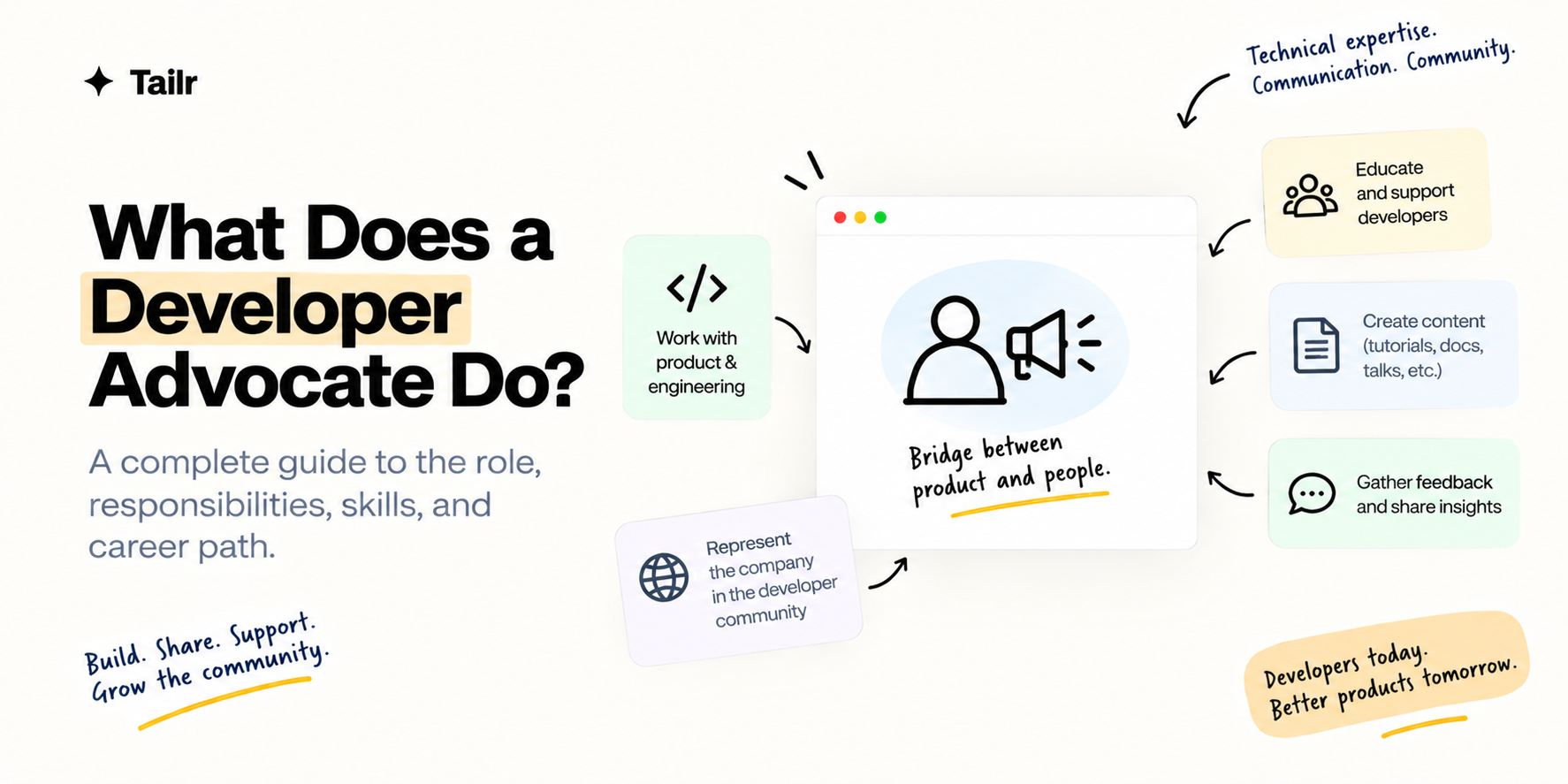
Every company that sells to developers, whether it’s a cloud platform, an API, a database, or an AI model, has people whose job is to help outside developers succeed with it. Their title is usually developer advocate, and their job is one of the most misunderstood in tech: too technical for marketing, too public for engineering, and measured differently at every company. Here’s what the role actually involves.
The short answer: a developer advocate helps developers succeed with a product and represents those developers back to the company that builds it. The work runs in three directions:
- Outward: tutorials, documentation, sample apps, talks, videos, and workshops that teach developers how to use the product.
- Sideways: answering questions and building relationships in the community, on forums, Discord, GitHub, and at events.
- Inward: turning what they hear from developers into specific, prioritised feedback for product and engineering.
Developer advocates are almost always engineers by background, and the role pays around $136,000 to $140,000 on average in the US in 2026, with senior roles at large tech companies well above $220,000.
Advocate for developers, not to them
The name causes confusion, so it’s worth being precise. A developer advocate is not primarily someone who advocates for a product to developers, though they do plenty of that. The distinctive part of the job is the reverse: advocating for developers inside the company.
That’s why the role exists separately from marketing. A marketer can write a launch post. Only someone who has actually built with the product, spent hours in the community, and watched fifty people hit the same confusing error can walk into a product meeting and say “this is what’s blocking adoption, and here’s the fix.”
The best developer advocates are trusted by developers precisely because they’ll say when the product is wrong. That trust is the whole asset.
What developer advocates actually do
Create technical content
The most visible part of the job. Developer advocates write getting-started guides, tutorials, blog posts, and sometimes reference documentation. They record videos and livestreams. They build sample applications and starter templates that developers clone. At smaller companies they may own the documentation entirely; at larger ones they work alongside technical writers.
Good content in this role is honest and specific. It’s built by actually doing the thing and writing down where it hurt, not by paraphrasing the product spec.
Speak and teach
Conference talks, meetups, workshops, webinars, hackathons, podcast appearances. Some developer advocates travel heavily; others do most of it online. The purpose isn’t just reach. A workshop with thirty developers is also thirty pieces of feedback on where the product is confusing.
Build in public
Developer advocates build demos, integrations, and proof-of-concept projects with the product, often in public on GitHub. These serve as teaching material, as marketing, and as an early warning system: if the advocate can’t build the thing smoothly, neither can customers.
Answer questions and run the community
Forums, Discord or Slack communities, Stack Overflow, GitHub issues, social media replies. Developer advocates spend a meaningful chunk of every week answering questions, reproducing reported problems, and pointing people to the right resource. At companies with a community manager, the advocate focuses on the technical answers; without one, they run the whole thing.
Carry feedback inward
This is the part that separates a developer advocate from a technical content creator. Every week, the advocate gathers what they’ve heard, spots the patterns (five people asked the same question, three integration attempts failed at the same step), and takes it to product and engineering as prioritised, evidenced feedback. Sometimes they file the bug themselves. Sometimes they open the pull request.
Support launches and partners
When a new feature ships, developer advocates prepare the sample code, the launch tutorial, and the talk track. They also work with partners and key customers who are building integrations, and sometimes with the sales team on technical questions from prospects, though that’s more properly the solutions engineer’s job.
A typical week
The balance shifts with what’s shipping, but a representative week might be:
- Monday: community triage, replying to questions from the weekend; reproduce an SDK bug someone reported; file it with engineering.
- Tuesday: write and test a tutorial for a feature launching next week; review the draft docs from the product team.
- Wednesday: record a ten-minute video walking through the tutorial; prep slides for Thursday’s meetup.
- Thursday: give the meetup talk; stay for an hour of hallway questions; write down the three things everyone asked.
- Friday: feedback summary to product: what’s confusing, what’s missing, what people are asking for; open a pull request fixing a sample app that broke in the last release.
Travel-heavy weeks look different. So do launch weeks. Most developer advocates describe the job as never quite the same two weeks running.
Developer advocate vs the roles around it
| Role | Main focus | Writes code | Talks to developers directly | Feeds product decisions |
|---|---|---|---|---|
| Developer advocate | Teach, support, and represent developers | Yes, samples and demos | Daily | Yes, that’s the job |
| Developer evangelist | Older title, leans toward outbound promotion | Yes | Yes, mostly at events | Sometimes |
| Community manager | Run the community, moderate, organise events | Rarely | Daily | Indirectly |
| Technical writer | Reference documentation | Sometimes | Rarely | Occasionally |
| Product marketing manager | Positioning, launches, messaging | No | Rarely | Yes |
| Solutions engineer | Help prospects buy | Rarely | Yes, prospects | Sometimes |
Developer relations (DevRel) is the umbrella term for the team; developer advocate is the most common individual role within it. Larger DevRel teams also include developer experience engineers who work on the SDKs and onboarding flow directly, and developer marketing managers who run campaigns.
Where the role reports, and why it matters
Developer advocates sit in marketing at some companies, in engineering or product at others, and occasionally in a standalone DevRel org. Where you sit changes what you’re measured on.
Marketing-led DevRel tends to track reach: content views, event attendance, sign-ups influenced. The risk is becoming a content machine with no time for community or feedback.
Engineering- or product-led DevRel tends to track developer success: time to first successful API call, qualified feedback delivered, documentation gaps closed. The risk is that nobody outside engineering sees the work.
In 2026 the measurement question has become sharper. Executives are less impressed by blog views and impressions now that content can be produced cheaply at scale, and more interested in whether DevRel moves adoption and retention. Metrics that hold up include time-to-first-success for new developers, developer satisfaction in owned channels, feedback items that shipped, and influenced pipeline from accounts the advocate worked with. When interviewing, ask what the team is measured on; it tells you what the job really is.
Skills that matter
Technical:
- Real software engineering ability. You’ll build things, debug them, and be judged by engineers.
- Depth in the product’s domain: if it’s a database, you understand databases; if it’s an AI API, you understand prompting, evaluation, and the failure modes.
- Comfort with several languages, because developers will use the product from all of them.
- Ability to read someone else’s failing code quickly and find the problem.
Communication:
- Writing clearly for an audience that skims.
- Explaining a concept out loud, live, with questions coming in.
- Teaching: knowing what a beginner doesn’t know yet.
- Empathy for the developer who is stuck at 11pm with a deadline.
Organisational:
- Turning scattered feedback into a prioritised list a product manager can act on.
- Managing your own calendar across content, travel, community, and internal meetings.
- Working with marketing, product, engineering, and sales without belonging fully to any of them.
What developer advocates earn
US figures for 2026:
- Glassdoor average: about $136,000. PayScale: about $140,000.
- Early career: roughly $120,000 to $160,000.
- Mid-level: roughly $160,000 to $220,000.
- Senior and staff: roughly $220,000 to $300,000 base, with total compensation at large tech companies reaching $400,000 or more once equity is included. Levels.fyi data for Google developer advocates ranges from about $197,000 to $376,000 and up in total compensation.
- By city: San Francisco averages about $182,000, roughly a third above the national figure; New York around $155,000.
Pay tracks the company more than the title. AI companies, cloud providers, and well-funded developer-tool startups pay at the top; smaller companies pay closer to a mid-level engineer.
How to get into developer advocacy
There’s no degree for it. What hiring managers want is evidence of both halves of the job: that you can build, and that you can teach.
- Start from engineering. Most developer advocates were software engineers first. A few years of shipping real software gives you the credibility the role depends on.
- Build a public track record. Write blog posts explaining things you’ve figured out. Contribute to open source. Answer questions in a community you care about. Give a lightning talk at a local meetup. This is the portfolio.
- Pick a product you already use and love. The best applications come from people who are already, informally, advocating for the product. Companies notice.
- Look for adjacent openings. Developer experience engineer, technical writer, community engineer, and support engineer roles at developer-focused companies are common stepping stones.
Developer advocate roles are most common at companies selling to developers: cloud platforms, API companies, databases, AI labs, developer tools, and open-source companies. Our guide to the best websites for startup jobs covers where the smaller ones post.
Tailoring your resume for a developer advocate role
DevRel hiring managers look for three things: technical credibility, public communication, and evidence of feedback loops. Engineers applying usually show only the first.
An engineer’s bullet might say:
Built and maintained the Python SDK for the payments API.
Rewritten for a developer advocate posting:
Built and maintained the Python SDK for the payments API; wrote the getting-started guide that became the most-viewed page in the docs, answered SDK questions in the community forum, and fed 12 developer-reported issues into the API roadmap.
Same job. The second version shows teaching, community, and inward feedback, which is exactly what the screener is scanning for.
Each DevRel listing weighs these differently. One leads with content and video, another with community, a third with a specific technical domain like AI or infrastructure. That’s where Tailr fits: open the listing, and it rewrites your resume to lead with the matching experience, drafts a cover letter, and tracks the application. It works only from what’s actually on your resume, which is the right constraint for a role where your public work will be checked. Our guides on tailoring your resume to a job description and tailoring without lying go through the method.
Conclusion
A developer advocate helps developers succeed with a product and makes sure the people building the product hear what those developers need. The work is content, teaching, community, and honest feedback, and it needs someone who is both a credible engineer and a clear communicator. It pays at or above a mid-level engineering salary and leads naturally to DevRel leadership, product management, developer experience engineering, or founding something.
If you like explaining things, enjoy being in public, and would rather help a thousand developers ship than ship one feature yourself, it’s worth pursuing. Build the public track record first, then make sure your resume shows both halves of the job.
Try Tailr to tailor your resume to the next developer advocate listing you open.
Frequently asked questions
01What does a developer advocate actually do?
A developer advocate helps developers succeed with a company's product and represents those developers back to the company. Day to day that means writing tutorials and documentation, building sample apps and demos, giving talks and workshops, answering questions in community channels, and turning what they hear from developers into concrete feedback for the product and engineering teams.
02Is a developer advocate a marketing role or an engineering role?
It can sit in either, and sometimes in product. Developer relations teams report into marketing at many companies, into engineering or product at others, and occasionally stand alone. Where it reports changes what gets measured: marketing-led teams track reach and sign-ups; engineering-led teams track feedback shipped and developer success. The work itself is technical either way.
03Do developer advocates need to code?
Yes. A developer advocate has to build real things with the product to write honest tutorials, produce working sample code, and reproduce the problems developers report. Most come from a software engineering background. You don't usually ship production code for the core product, but you write a lot of code that other developers will read and copy.
04How much does a developer advocate make?
In the US in 2026, Glassdoor puts the average around $136,000, and PayScale around $140,000. Early-career roles commonly pay $120,000 to $160,000, mid-level $160,000 to $220,000, and senior $220,000 to $300,000 or more, with total compensation at large tech companies reaching well beyond that once equity is included. San Francisco pays roughly a third above the national average.
05What is the difference between a developer advocate and a developer evangelist?
In practice the titles overlap heavily. 'Evangelist' was the earlier term and leans toward outbound promotion: talks, launches, spreading the word. 'Advocate' was adopted partly to stress the inbound half of the job: advocating for developers' needs inside the company. Most modern developer relations teams use 'advocate', and the job descriptions look the same.
06How do you become a developer advocate?
The most common route is from software engineering, with a track record of public work: blog posts, open source contributions, conference talks, or an active presence in a developer community. Companies hire for the combination of technical credibility and the ability to teach. Building that public track record before applying matters more than any qualification.