How to Ask for a Job Referral (With Message Templates)
· updated
A referral is the closest thing to a shortcut in a job search. It usually means a person reads your resume instead of a filter, and you get a contact inside the company. But asking can feel awkward, especially with people you barely know. This guide shows you who to ask, what to say, and exactly what to send so saying yes takes them two minutes.
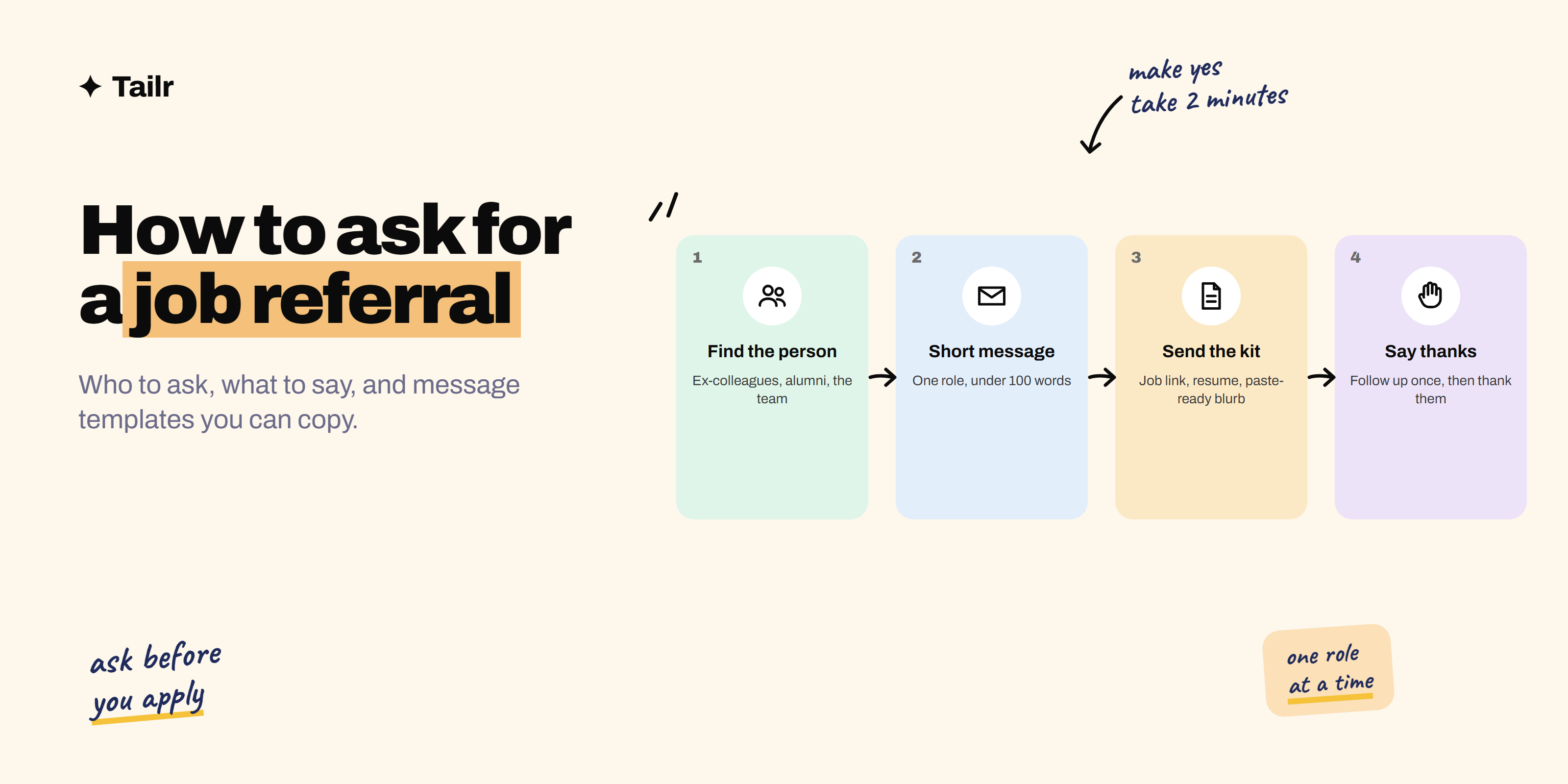
The short answer: How to ask for a job referral:
- Pick one specific role you’re a strong fit for, and grab the job link.
- Find the right person: someone who knows your work first, then people on or near the team.
- Send one short message with the role, the link, and two or three lines on why you fit.
- Make it easy: attach your tailored resume and a blurb they can paste into the referral form.
- Follow up once after about a week, and thank them whatever happens.
Ask before you apply, keep it under 100 words, and never ask for more than one role at a time.
Why referrals work
- A human reads your resume. Many referral programmes route resumes straight to a recruiter.
- You get context. Your referrer can tell you about the team, the interviews and what the manager cares about.
- Companies like them. Referred hires often stay longer, which is why many firms pay employees a referral bonus. You’re not asking for a huge favour; you might be helping them earn one.
When to ask, and when not to
Timing makes a big difference to how a request lands.
Good times to ask:
- Soon after a role is posted. Many roles get most of their applicants in the first week or two. A referral in that window gets seen before the pile builds.
- After a real conversation. If you’ve had a quick chat with someone about their team, asking a week later feels natural.
- When you clearly fit. You meet most of the must-have requirements and can say why in two lines.
Times to hold off:
- You don’t meet the basics. Asking someone to refer you for a role that needs five years of Kubernetes when you have none puts them in an awkward spot.
- You’ve never spoken and haven’t done any homework. A cold “Can you refer me?” with no context is easy to ignore.
- You’re asking for five roles at once. It looks like you’ll take anything. Pick the best one.
- The role has been open for months and the company has clearly slowed hiring. Ask the person whether it’s still active before asking for a referral.
If you’re not sure you’re a strong fit, ask a different question first: “I’m thinking about applying for this role. From the inside, does my background look like what the team needs?” You’ll get honest feedback, and often a referral offer anyway.
Who to ask, in order
- People who’ve seen your work: former managers, teammates, classmates you built projects with, clients. They can vouch for you honestly.
- Friends and acquaintances at the company, even outside the team.
- Alumni from your university or bootcamp. Shared background makes a cold message warm.
- People on the team you’d join, found via the company’s LinkedIn “People” tab.
- Complete strangers at the company. Possible, but expect fewer replies and put more effort into the message.
People a few years into their careers, on or near the hiring team, often respond more than senior leaders. They’re closer to the work and less buried in messages.
How to find people to ask
Most people know more people at a company than they think. Work through these in order:
- Your LinkedIn connections. Go to the company’s LinkedIn page and click the employees link. LinkedIn shows your first-degree connections there first. Then check second-degree connections and note who you share.
- Your alumni network. LinkedIn’s university pages have an “Alumni” tab where you can filter by company and job function. Shared schools get much better reply rates than strangers.
- Former colleagues’ new companies. People move. Scroll through your old teams and see who has joined companies you’re interested in.
- Communities. Slack and Discord groups, meetups, open source projects and bootcamp cohorts are full of people who work at the companies you’re targeting, and who are used to helping.
- A mutual introduction. If a friend knows someone at the company, ask the friend to introduce you instead of messaging cold. Warm introductions are the single best way to reach someone you don’t know.
When you find someone, look at what they’ve posted or worked on. One genuine line about their work (“I read your post on moving your team to Playwright”) makes your message stand out from the dozens of generic requests they get.
How to optimise your LinkedIn profile is worth a look before you start, because the first thing most people do when they get your message is click your profile.
What to send: the referral kit
Before you message anyone, have these ready:
- The exact job link (and the job ID if there is one).
- Your resume, tailored to that role, as a PDF named like
Priya-Sharma-Data-Analyst.pdf. - A two-to-three sentence “why I fit” blurb written so they can paste it straight into the referral form.
That last one matters most. Many people say yes to a referral and then stall at the form that asks, “Why are you referring this person?” Write it for them.
Example blurb: “Priya has three years as a data analyst in e-commerce, working in SQL, Python and Looker, which match this role’s core requirements. She built a cohort report that lifted repeat purchases by 9%. I worked with her at ShopCo and would happily work with her again.”
Referral message templates
Template: someone who knows your work
Hi [Name],

Hope you're well! I'm looking for my next [type of] role and saw
[Company] is hiring a [Job title]: [link]

It lines up closely with what I did at [Company/Project]: [one specific
result]. Would you be comfortable referring me?

I've attached my resume and a short blurb you can paste into the form
below. No worries at all if it's not a good time.

[Blurb]

Thanks!
[Your name]
Template: a friend or acquaintance at the company
Hi [Name],

Quick one: I'm applying for the [Job title] role on the [team] team at
[Company] ([link]). I've spent [X years] doing [relevant work], most
recently [specific result].

Would you be open to referring me? Happy to send anything that makes it
easier. And if you know anything about the team, I'd love to hear it.

Thanks so much,
[Your name]
Template: alumni or a stranger on LinkedIn
Hi [Name], I'm a fellow [University] grad working as a [your role].
I saw the [Job title] opening on your team ([link]) and it's a strong
match: I [one-line specific result relevant to the listing].

Would you be open to a referral, or to a quick chat about the team
first? Either way, thanks for reading.
For strangers, offering the chat first often works better than asking for the referral straight away. Our guides to cold messaging on LinkedIn and cold emailing for a job cover finding the right people and writing first messages that get replies.
Template: following up once
Hi [Name], just floating this back up in case it got buried. Totally
understand if you're busy. Happy to apply directly if that's easier.
Template: thank you
Hi [Name], thank you for referring me for the [Job title] role.
I really appreciate it, and I'll keep you posted on how it goes.
Then actually keep them posted, especially if you get the job.
Template: text or WhatsApp to someone you know well
Hey [Name]! Random one: [Company] has a [Job title] role open
that's right up my street: [link]

Would you be up for referring me? I'll send you my resume and a
couple of lines you can paste into the form. Totally fine if not!
With close friends, a casual message is fine, but still send the full kit by email afterwards so they have everything in one place.
Template: asking a former manager
Hi [Name],

I hope things are going well at [Company]. I'm applying for the
[Job title] role on [team] ([link]) and it's very close to the work
we did together on [project].

Would you be willing to refer me, or to be a reference later in the
process? I've attached my resume and a short summary of the [project]
results in case it's useful.

Thank you, I really appreciated working with you.
[Your name]
A former manager’s referral carries extra weight, because they can speak to how you actually work. Remind them of the specific project so they don’t have to dig through their memory.
Referral do’s and don’ts
| Do | Don’t |
|---|---|
| Ask for one specific role | Ask “Are there any openings?” |
| Send the link, resume and blurb in one message | Make them chase you for details |
| Tailor your resume to that role | Send the same generic resume |
| Ask before applying | Apply first, then ask |
| Follow up once after a week | Message them every few days |
| Thank them either way | Go silent if it doesn’t work out |
What happens after someone refers you
Knowing the process helps you set expectations and follow up at the right moment.
- They submit you. Usually through an internal referral form or portal, where they paste the job ID, your details and their blurb. Some companies email you a link to finish your application; check your spam folder.
- A recruiter reviews it. Referred applications are often flagged for a person to read, sometimes within days. That’s a review, not a guaranteed interview.
- You hear back, or you don’t. If you’re a fit, the next step is normally a recruiter screen. If not, you may get a rejection email, or simply silence.
- Your referrer may get updates. Some systems tell the employee when your status changes. It’s fine to ask them, once, whether they can see where things stand.
If a week or two passes with nothing, send the recruiter a short follow-up and mention who referred you. How to follow up after a job application has templates for exactly this.
And prepare as if the interview is coming. Your referrer can often tell you what the process looks like, what the team values and what interviewers tend to ask. That inside view is one of the biggest benefits of a referral, so use it.
If they say no, or don’t reply
It happens, and it’s rarely personal. People get busy, some companies limit how many referrals an employee can make, and some people only refer those they’ve worked with directly.
- No reply after a week: send the one follow-up, then apply directly.
- A polite no: thank them and ask one easy question instead, such as “Is there anything about the team I should know before applying?”
- “I don’t know you well enough”: completely fair. Offer a 15-minute chat so they can get to know you, or ask if there’s someone else they’d suggest.
Never push, and never go around them by naming them without permission in your application. Keep the relationship warm; the same person might be able to help with a different role in six months.
Ask before you apply
At many companies, the referral is credited only if the employee submits you before you apply yourself. Ask first. If you haven’t heard back after about a week, apply directly; a referral is a boost, not a gate.
Make your resume worth referring
A referral gets your resume read, but your resume still has to fit the role. The person referring you is putting their name next to yours, so make it easy for them to look good: match the job title, lead with the most relevant results, and use the language of the listing. Tailr tailors your resume from the job listing you’re viewing, writes a matching cover letter, and tracks every application, so you know which referrals you’ve asked for and when to follow up. For the full manual process, see how to tailor your resume to a job description.
Try TailrConclusion
Asking for a referral isn’t pushy when you do it well: one specific role, one short message, and everything they need attached, including a blurb they can paste. Start with people who know your work, ask before applying, follow up once, and say thank you. A handful of well-targeted referral requests will often do more than fifty cold applications.
Frequently asked questions
01Is it OK to ask for a job referral?
Yes. Referrals are a normal part of hiring, and many companies pay employees a bonus when a referred candidate is hired. Asking politely, for a specific role you fit, with everything they need in one message, is a favour most people are happy to do.
02Can I ask a stranger for a referral?
You can, but expect a lower response rate and don't lead with the ask. Show you've done your homework, explain briefly why you fit the specific role, and ask whether they'd be open to referring you or sharing a bit about the team. Keep it short and easy to say no to.
03What should I send someone who agrees to refer me?
Send the exact job link or requisition ID, your tailored resume as a PDF, and a two-to-three sentence blurb on why you fit that they can paste into the referral form. The less they have to write themselves, the more likely the referral actually gets submitted.
04Should I apply before or after asking for a referral?
Usually after. Many applicant systems credit the referral only if the employee submits it before you apply, or link it to your existing application only in some cases. Ask first, and if you haven't heard back in about a week, apply directly anyway.
05How do I ask for a referral on LinkedIn?
Send a connection request or message that's under 100 words: who you are, the specific role with its link, one line on why you fit, and a clear question asking whether they'd be comfortable referring you. Attach or offer your resume and thank them either way.
06Do referrals actually help you get hired?
Yes, they're one of the most effective ways in. A referral usually gets your resume read by a person, often moves it up the queue, and gives you a contact inside the company. It doesn't guarantee an interview, so your resume still needs to fit the role.