How to Prepare for Product Management Case Study Interviews
· updated
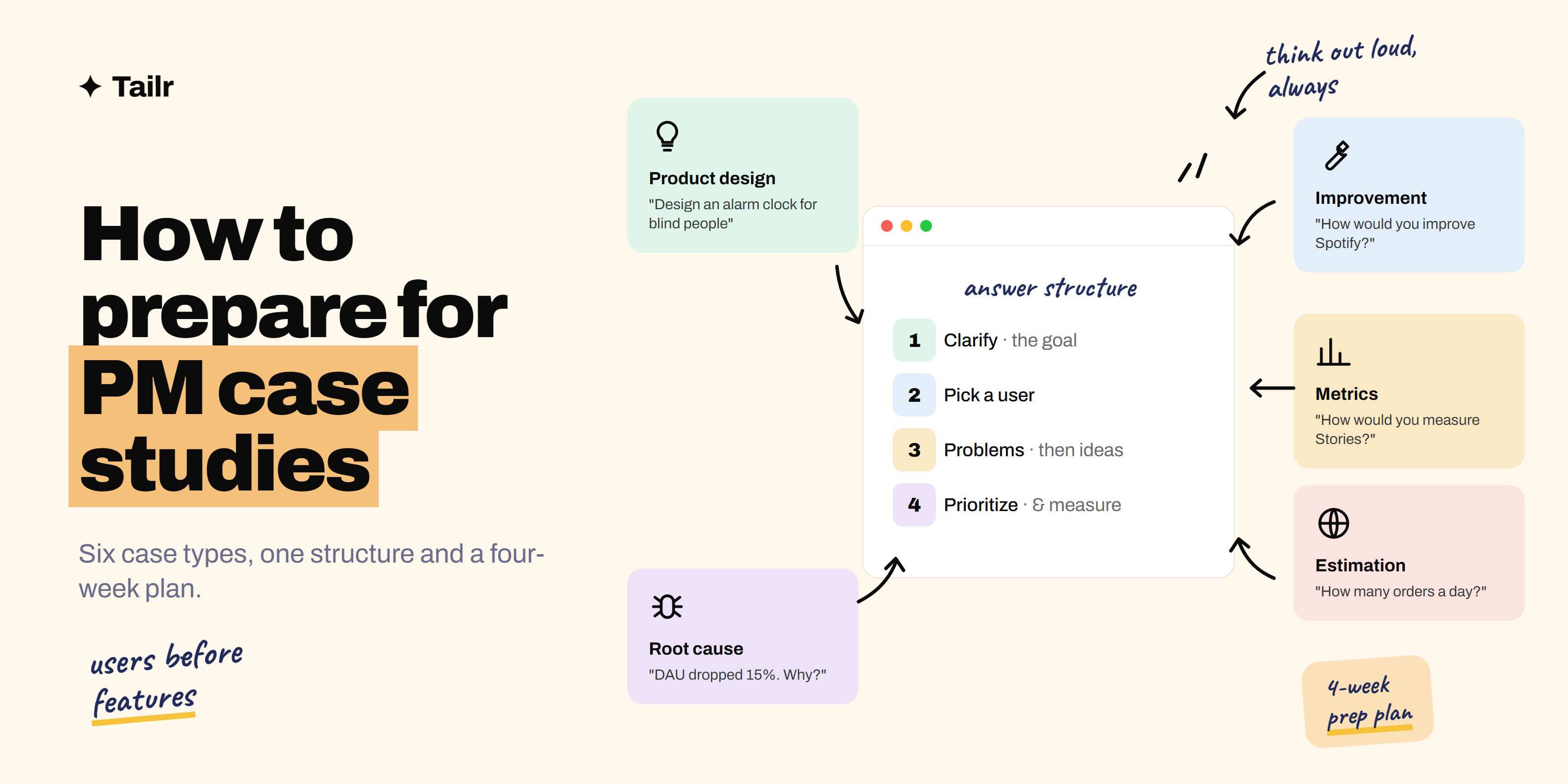
The case study is the part of a product management interview that decides most offers. You get an open-ended problem (“design a product for elderly people”, “our sign-ups dropped 20% last week, why?”) and 30 to 45 minutes to work through it out loud. There’s no single right answer. The interviewer is watching how you think.
The good news: case studies follow a small number of patterns. Once you know them and have practised enough, they stop feeling open-ended.
The short answer: to prepare for product management case study interviews:
- Learn the six common case types: product design, product improvement, metrics, root cause, estimation and strategy.
- Use one simple structure for each type, so you always know your next step.
- Practise at least two cases a week, out loud and timed.
- Do mock interviews with other people and ask for honest feedback.
- Study the company’s product before every interview.
- Prepare a template for take-home case assignments.
What interviewers look for
Before the types, know what you’re being scored on. Most PM interviewers judge four things:
- Structure: do you break a fuzzy problem into clear steps?
- User focus: do you start with who the user is and what they need?
- Prioritization: can you choose between options and explain why?
- Communication: can the interviewer follow your thinking without effort?
Notice that “having a brilliant idea” isn’t on the list. A clear, well-reasoned answer with an ordinary solution beats a clever idea delivered in a mess.
If you’re new to the role itself, read what a product manager actually does first.
The six types of PM case study
1. Product design
Example prompts: “Design an alarm clock for blind people.” “Build a product for first-time home buyers.”
Use the structure below: clarify, pick a user, find their problems, generate solutions, prioritize, define success. This is the most common case type, so practise it the most.
2. Product improvement
Example prompts: “How would you improve Spotify?” “What would you change about Google Maps?”
The trap is listing features you’d like. Instead, pick one user segment, find their biggest pain point, and improve that. Explain why that segment matters to the business.
3. Metrics and success
Example prompts: “How would you measure the success of Instagram Stories?” “What’s the north star metric for Uber Eats?”
Start with the product’s goal, then work down: a north star metric, two or three supporting metrics, and one guardrail metric that shouldn’t get worse. Frameworks like Google’s HEART (happiness, engagement, adoption, retention, task success) or AARRR (acquisition, activation, retention, referral, revenue) help you remember the categories. Our guide to DAU, MAU, retention and churn covers the metrics interviewers expect you to know.
4. Root cause analysis
Example prompts: “Daily active users dropped 15% yesterday. What happened?” “Checkout conversion is down 10% this month. Why?”
Don’t guess. Work through it systematically:
- Clarify the metric. How is it measured? Is the drop real or a tracking bug?
- Check the timing. Sudden or gradual? Any release, outage or holiday?
- Segment. By platform, country, user type, new vs returning. Where is the drop concentrated?
- Internal vs external. A change we made, or something outside (a competitor, a news event, an app store change)?
- Form a hypothesis and say how you’d test it.
5. Estimation
Example prompts: “How many food delivery orders are placed in Bengaluru each day?” “What’s the market size for dog-walking apps in the US?”
Interviewers care about your logic, not the final number. State your assumptions out loud, break the problem into small multipliable pieces (population, share who use the product, frequency), round numbers to keep the maths easy, and sanity-check the result at the end.
6. Strategy
Example prompts: “Should Netflix launch a gaming product?” “A competitor just launched a free version of our product. What do we do?”
Cover the company’s goals, the market, competitors, the company’s strengths, and the risks. End with a clear recommendation and what you’d measure to know if it worked. Sitting on the fence is the most common way to fail a strategy case.
A structure for any product case
Most design and improvement cases can be answered with the same six steps. Popular frameworks like Lewis Lin’s CIRCLES follow a similar pattern.
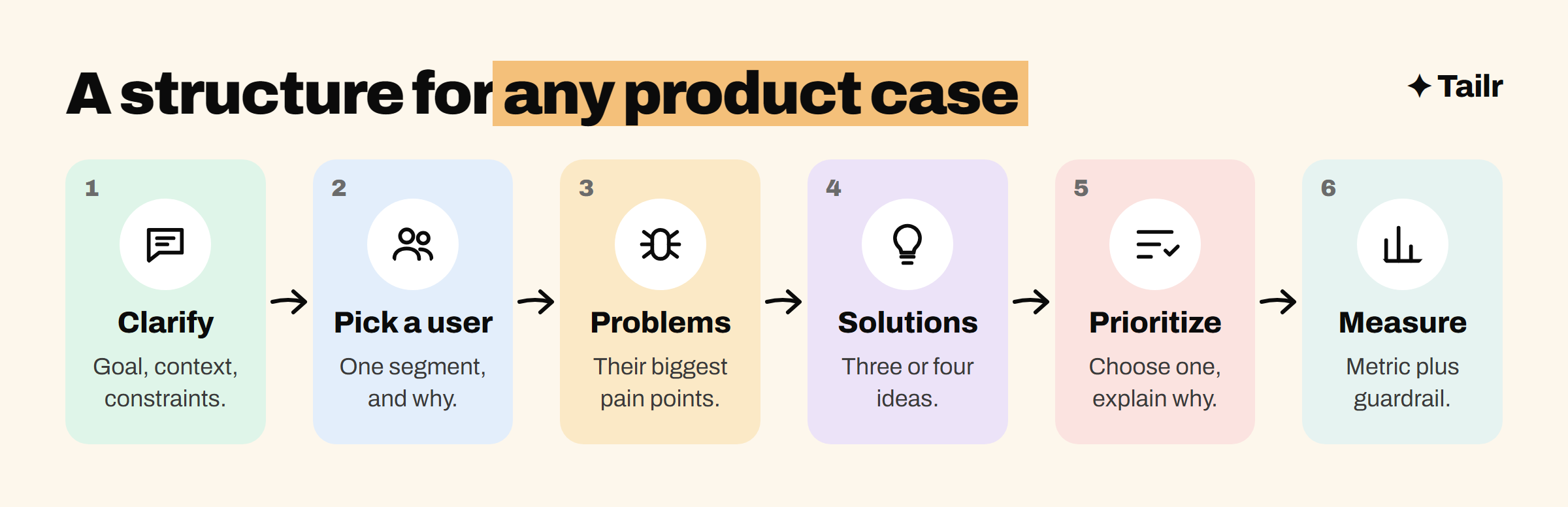
A worked example: “Design a product to help people drink more water.”
- Clarify: “Is this a physical product or an app? Any company context?” Assume it’s an app for a health company.
- Pick a user: office workers, students, athletes, older adults. “I’ll focus on office workers, because they’re a large group with a clear problem: they get busy and forget.”
- Problems: they forget to drink, don’t know how much they’ve had, and find tracking tedious.
- Solutions: reminders based on calendar gaps, a smart bottle that logs automatically, a team challenge feature, a one-tap widget.
- Prioritize: “I’d start with calendar-based reminders plus a one-tap widget. It’s cheap to build, tackles the biggest problem (forgetting), and doesn’t need hardware.” Use a simple impact vs effort comparison; our guide to prioritization frameworks covers RICE and others.
- Success: “The main metric is the share of users who hit their daily goal at least five days a week. I’d also track week-four retention, and make sure notification opt-outs don’t rise.”
How to handle take-home case studies
Some companies send a case to complete at home, usually with a time limit and a presentation afterwards. Keep these rules in mind:
- Respect the time limit. Candidates often report take-homes running long. Decide your scope early and stop when the time’s up.
- Use a simple structure: problem, users, options, recommendation, metrics, risks. Five to eight slides or two pages is usually enough.
- State your assumptions. You won’t have all the data. Say what you assumed and why.
- Prepare for pushback. The discussion afterwards is where you’re really assessed. Be ready to defend your trade-offs and change your mind gracefully when given new information.
- Write it like a PRD. A clear product requirement document structure shows you know how real product work is written.
A four-week preparation plan
Week 1: learn the patterns. Read up on each case type and the structure for it. Do one practice case per type on your own, out loud.
Week 2: practise product sense. Do four to six design and improvement cases, timed at 30 minutes. Our product sense interview questions guide has plenty to work through.
Week 3: practise analytical cases. Do four to six metrics, root cause and estimation cases. Get comfortable with the key product metrics.
Week 4: mock interviews. Do at least three mocks with other people, ideally working PMs. Practise a full take-home under real time limits. Before each real interview, spend an hour using the company’s product and noting what you’d improve.
Useful resources: the books Decode and Conquer by Lewis Lin and Cracking the PM Interview by Gayle Laakmann McDowell and Jackie Bavaro, and practice platforms like Exponent (tryexponent.com), which has mock interview videos and peer practice.
Common mistakes
- Jumping to solutions. If you mention a feature in the first two minutes, slow down.
- Skipping clarifying questions. Two or three good questions at the start shape the whole answer.
- Trying to serve everyone. Pick one user segment and go deep.
- No prioritization. Listing five ideas isn’t enough. Choose one and say why.
- Forgetting metrics. Always end with how you’d know if it worked.
- Going silent. Think out loud. If you need a moment, say so.
Getting the interview in the first place
Case study prep only pays off if you get the interview. PM job listings differ a lot (growth, platform, B2B, AI), and your resume needs to show the experience each one asks for. Tailr is a Chrome extension that tailors your resume from the job listing you’re viewing, so your most relevant product work shows first. It also writes a matching cover letter and tracks your applications. Try Tailr when you start applying.
Related guides
- Product Sense Interview Questions: How to Answer With Examples
- 10 Terms You Should Know Before a Product Management Interview
- RICE, MoSCoW and Kano: Prioritization Frameworks for PM Interviews
- Best AI Presentation Makers in 2026
Conclusion
PM case study interviews feel open-ended, but they follow six patterns: design, improvement, metrics, root cause, estimation and strategy. Learn a structure for each, practise out loud at least twice a week, do real mock interviews, and always move from users to problems to solutions to metrics. With three to four weeks of steady practice, the case round can become your strongest.
Frequently asked questions
01What is a product management case study interview?
It's an interview where you're given a product problem and asked to work through it out loud, such as designing a product, improving a feature, choosing a success metric or figuring out why a number dropped. Some companies also give a take-home case that you prepare and present.
02How do I prepare for a PM case study interview?
Learn the six common case types, pick one simple structure for each, and practise at least two cases a week out loud. Do mock interviews with other people, study the company's product before each interview, and prepare a template for take-home assignments.
03What framework should I use for product design cases?
A common structure is CIRCLES: comprehend the situation, identify the customer, report their needs, cut through prioritization, list solutions, evaluate trade-offs and summarize. You don't need to name it; interviewers care that your answer moves from users to problems to solutions in a clear order.
04How long does it take to prepare for PM case interviews?
Most people need three to six weeks of steady practice, with around 20 to 30 practice cases in total. If you already work in a product-adjacent role, you may need less. If you're new to product, start with the basics of the role first.
05How do I approach a take-home PM case study?
Clarify the prompt, set a strict time limit, and structure your answer as problem, users, options, recommendation and metrics. Keep the deck short, state your assumptions openly and prepare to defend your trade-offs, because the follow-up discussion matters as much as the document.
06What are the most common mistakes in PM case interviews?
Jumping straight to solutions, not asking clarifying questions, skipping prioritization, forgetting to define success metrics, and going silent while thinking. Interviewers are judging how you think, so talk through your reasoning and check in with them as you go.