Top Product Management Fellowships for Students and New Grads in 2026
· updated
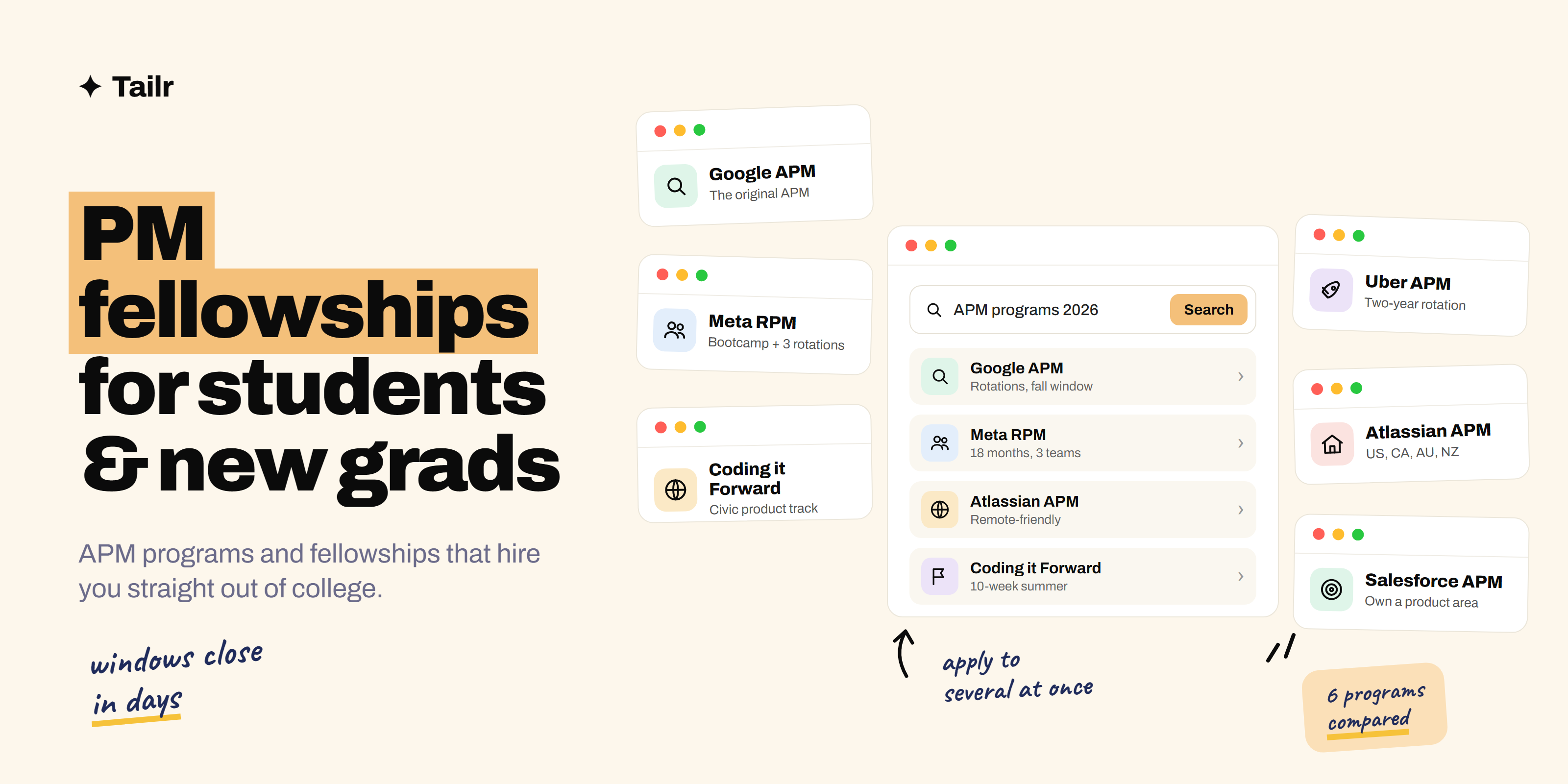
If you’re a student or a recent graduate, you don’t have to spend years in another role before you can become a product manager. A handful of companies run programs that hire new grads as PMs and train them on the job, and civic tech fellowships give you real product work before you graduate. They’re competitive and the windows are short, so it helps to know them all before the season starts.
The short answer: the top product management fellowships for students and new grads in 2026:
- Google APM: the original associate product manager program, with rotations across product teams.
- Meta RPM: an 18-month program with a bootcamp and three team rotations.
- Uber APM: a two-year rotational program for recent graduates.
- Atlassian APM: an entry-level PM track that’s remote-friendly across four countries.
- Salesforce APM: a rotational program with ownership of a product area and structured mentorship.
- Coding it Forward Fellowship: a ten-week summer fellowship with a product management track in government.
Apply to several at once. Getting into any single one is hard, so a spread of applications is your best bet.
What to look for in an APM program
All of these programs give you a real PM title and a cohort. Where they differ:
- Rotations. Some move you across two or three teams, which is great for figuring out what kind of PM you are. Others put you on one team with a mentor from day one.
- Location. Most APM programs are tied to a few offices. If you can’t relocate, focus on the remote-friendly ones.
- Eligibility. Some want graduates from a specific year. Others, like Meta RPM, are open to anyone with less than a year of PM experience.
- Timing. Windows open as early as July and can close within days. Missing one means waiting a full year.
If you’re still deciding whether product is for you, read what a product manager actually does before you start applying.
1. Google Associate Product Manager (APM)
Website: google.com/about/careers
Google’s APM program is the one that started the whole idea of training new graduates as product managers. You join as a full-time PM, rotate across product teams, and get mentorship and training alongside real ownership of a product area. Google has run APM roles in several locations, including Mountain View, London and Bengaluru, and also offers APM internships for students in some regions.
Applications usually open in the fall for the following year’s start, and they’re reviewed on a rolling basis, so applying early helps. A technical background isn’t strictly required, but you’ll need to show you can work closely with engineers and reason through data.
Why apply:
- Rotations show you very different kinds of product work
- Training and mentorship from one of the best-known product orgs
- The APM name opens doors for the rest of your career
Best for: final-year students and recent graduates with a technical or analytical background.
2. Meta Rotational Product Manager (RPM)
Website: metacareers.com
Meta’s RPM program runs about 18 months. It starts with a short bootcamp, then you rotate through three product teams. RPMs are based in Menlo Park, Seattle and New York, and the program is aimed at people with less than a year of direct PM experience, so graduates from engineering, design, consulting and other backgrounds can apply.
Meta says applications for the next cohort are expected to open in fall 2026, and you’re considered for a full-time PM role at the end.
Why apply:
- Three rotations in 18 months is a lot of range, fast
- Open to people from varied backgrounds, not just CS grads
- A clear path to a full-time PM role at Meta
Best for: new grads and early-career people who want broad exposure quickly.
3. Uber Associate Product Manager (APM)
Website: uber.com/careers
Uber’s APM program is a two-year rotational track for recent graduates. You work on real product problems across Uber’s businesses, from rides to delivery, with a cohort of other new PMs. In recent cycles, the application deadline has fallen in late September for a start the following summer.
Why apply:
- Two full years of rotations before you settle on a team
- Complex marketplace products that make for strong interview stories later
- A smaller cohort than Google or Meta
Best for: recent graduates who like marketplaces, operations and data-heavy products.
4. Atlassian Associate Product Manager (APM)
Website: atlassian.com/company/careers
Atlassian’s APM track is one of the few entry-level PM programs that’s remote-friendly, across the US, Canada, Australia and New Zealand. You’ll work on tools like Jira, Confluence and Loom, which means your users are mostly software and business teams.
The application window has been very short in recent cycles, sometimes only a few days, so set an alert and have your materials ready.
Why apply:
- You don’t have to relocate to a big tech hub
- B2B product experience, which is in high demand
- Atlassian is known for its remote-first culture
Best for: new grads who can’t relocate or who want to work on B2B software.
5. Salesforce Associate Product Manager (APM)
Website: salesforce.com/company/careers
Salesforce’s APM program gives you ownership of a defined area of a Salesforce product, exposure to senior stakeholders, structured mentorship and cross-functional rotations. It also runs an APM internship cycle about a year ahead of the full-time cohort.
Windows tend to open in summer and close fast, so this is one to watch from July.
Why apply:
- Real ownership of a product area early on
- Exposure to enterprise customers and senior leaders
- An internship route if you’re still in school
Best for: students and new grads interested in enterprise software.
6. Coding it Forward Fellowship
Website: codingitforward.com
Coding it Forward runs a ten-week summer fellowship that places early-career technologists in government agencies. Product management is one of five tracks, alongside software engineering, data, design and cybersecurity. Its sister program, the Civic Innovation Corps, focuses on state and local government.
It’s a great way to get real product experience while you’re still a student, which makes your APM applications much stronger. In recent years, applications for the summer cohort have closed around January.
Why apply:
- Product work on public services millions of people use
- A real project to talk about in APM interviews
- A smaller, mission-driven cohort with a strong alumni network
Best for: US students and early-career people who want product experience with public impact.
PM fellowships for students compared
| Program | Who it’s for | Length | Where |
|---|---|---|---|
| Google APM | Final-year students, new grads | Full-time, rotational | Mountain View, London, Bengaluru and more |
| Meta RPM | Under 1 year of PM experience | About 18 months | Menlo Park, Seattle, New York |
| Uber APM | Recent graduates | Two years | Uber offices |
| Atlassian APM | New grads | Full-time | Remote-friendly in US, Canada, Australia, NZ |
| Salesforce APM | Students and new grads | Full-time, plus internships | Salesforce offices |
| Coding it Forward | US students, early career | 10 weeks (summer) | Government agencies, remote possible |
Programs pause, restart and change details from year to year, so check each careers page before you apply.
How to prepare before the window opens
Have one strong story ready. APM interviewers want to hear about something you built, led or improved: a side project with real users, a club you grew, an internship feature you shipped. Write it up as the problem, what you decided, why, and what happened.
Practise product sense out loud. Most APM loops include a product design question and an analytical one. Work through our product sense interview questions and product metrics guide until you can answer without notes.
Learn the language. Knowing terms like north star metric, PRD and MVP makes you sound like someone who’s already done the job. Our list of product management interview terms is a quick place to start.
Set alerts in early summer. Bookmark every careers page above and check them weekly from July. When a window opens, apply in the first few days.
Have a backup plan. Apply for product analyst and associate PM roles at smaller companies too. Many great PMs never went through a formal APM program.
Tailor your resume for each program
Every APM program reads your resume slightly differently. Google looks for technical depth, Meta for range and impact, Atlassian for interest in B2B tools, Coding it Forward for mission. Sending the same resume to all of them wastes your strongest stories.
Tailr is a Chrome extension that tailors your resume from the job listing you’re viewing, so each application leads with the projects that program cares about. It also writes a matching cover letter and tracks every application, which helps when you’re juggling six windows that open and close at different times. For the manual approach, see how to tailor your resume to a job description, and if your experience is thin, read how to write a resume with no experience.
Try Tailr before the next application window opens.
Related guides
- Top Product Management Fellowships for a Career Upgrade in 2026
- How to Get Experience When Every Job Requires Experience
- What Does a Product Manager Actually Do?
Conclusion
The best product management fellowships for students and new grads are Google APM, Meta RPM, Uber APM, Atlassian APM, Salesforce APM and Coding it Forward. They’re competitive, and their windows are short, so prepare your story and your interview answers months ahead, apply to several at once, and tailor each application to what that program is looking for.
Frequently asked questions
01What is an APM program?
An associate product manager (APM) program is an entry-level track that hires recent graduates as product managers and trains them on the job. You usually rotate across two or three product teams, get a mentor and a peer cohort, and finish ready for a regular PM role at the same company.
02Can you become a product manager straight out of college?
Yes, and APM programs exist for exactly that. Google, Meta, Uber, Atlassian and Salesforce all run entry-level product tracks for new graduates. Competition is intense, so most successful applicants have shipped something, led a project or done a product-adjacent internship before they apply.
03Do I need a computer science degree for an APM program?
Not always. A technical or analytical background helps, and some programs prefer it, but Meta's RPM program is open to people from varied backgrounds with less than a year of PM experience. What matters most is showing you can work closely with engineers and reason through data.
04When do APM applications open?
Most open in late summer or fall for a start the following year, and some close within days. Google's APM roles usually open in the fall, Meta expects its next RPM cohort to open in fall 2026, and Uber's window has closed in late September in recent cycles. Set alerts on each careers page.
05How hard is it to get into Google APM or Meta RPM?
Very hard. These programs hire small cohorts from a very large applicant pool. You'll need a resume that shows you've built or led something, plus strong answers to product sense, analytical and behavioral interview questions, so start preparing well before the window opens.
06What should I do if I don't get into an APM program?
Apply for product analyst, associate PM or business analyst roles, join a startup where you can take on product work, or start in engineering, design or data and move into product internally. Many PMs got there that way, and you can always apply to APM programs again next cycle.